
Code Help: How to Ask for Reviews That Get Real Feedback

Sandor Farkas
Founder & Lead Developer
Expert in software development and legacy code optimization
LinkedIn
Getting useful code help from a review is rarely about finding the “perfect reviewer.” It is usually about how much context you provide, how reviewable the change is, and whether you ask for feedback on the right risks.
A vague request like “can you review?” almost guarantees a vague response like “LGTM.” This guide shows how to ask for reviews that produce real feedback, with templates you can copy into your next pull request.
Why code reviews often produce low-signal feedback
Most reviewers are not lazy, they are overloaded. When a PR is hard to understand, reviewers default to the safest, fastest behaviors:
- Skim for obvious bugs and style issues.
- Avoid deep architectural questions because they are expensive to validate.
- Approve “good enough” because they do not feel confident enough to block.
High-signal reviews happen when you reduce cognitive load and point attention at the real risks.
If your team wants a widely adopted baseline for how reviews should work, Google’s guide is a solid reference for principles like small changes and clear intent: Google Engineering Practices, Code Review.
Before you ask: make the change reviewable
If you want thoughtful feedback, treat “reviewability” as part of the deliverable.
A practical pre-review checklist
| Area | What the reviewer needs | What you can do before requesting review |
|---|---|---|
| Scope | A change they can hold in their head | Keep PRs small, split refactors from behavior changes |
| Intent | Why this exists and what “done” means | Write outcome-focused description and acceptance criteria |
| Safety | Confidence it will not break prod | Add tests, validate edge cases, document rollback or flags |
| Evidence | Proof the change works | Add screenshots, logs, traces, sample payloads, benchmark notes |
| Risk | The sharp edges and trade-offs | Call out the 1 to 3 biggest risks and what you want checked |
Two habits that dramatically improve review quality:
- Self-review the diff before requesting review (read it like a stranger would).
- Separate mechanical changes (formatting, rename-only, folder moves) from behavioral changes whenever possible.
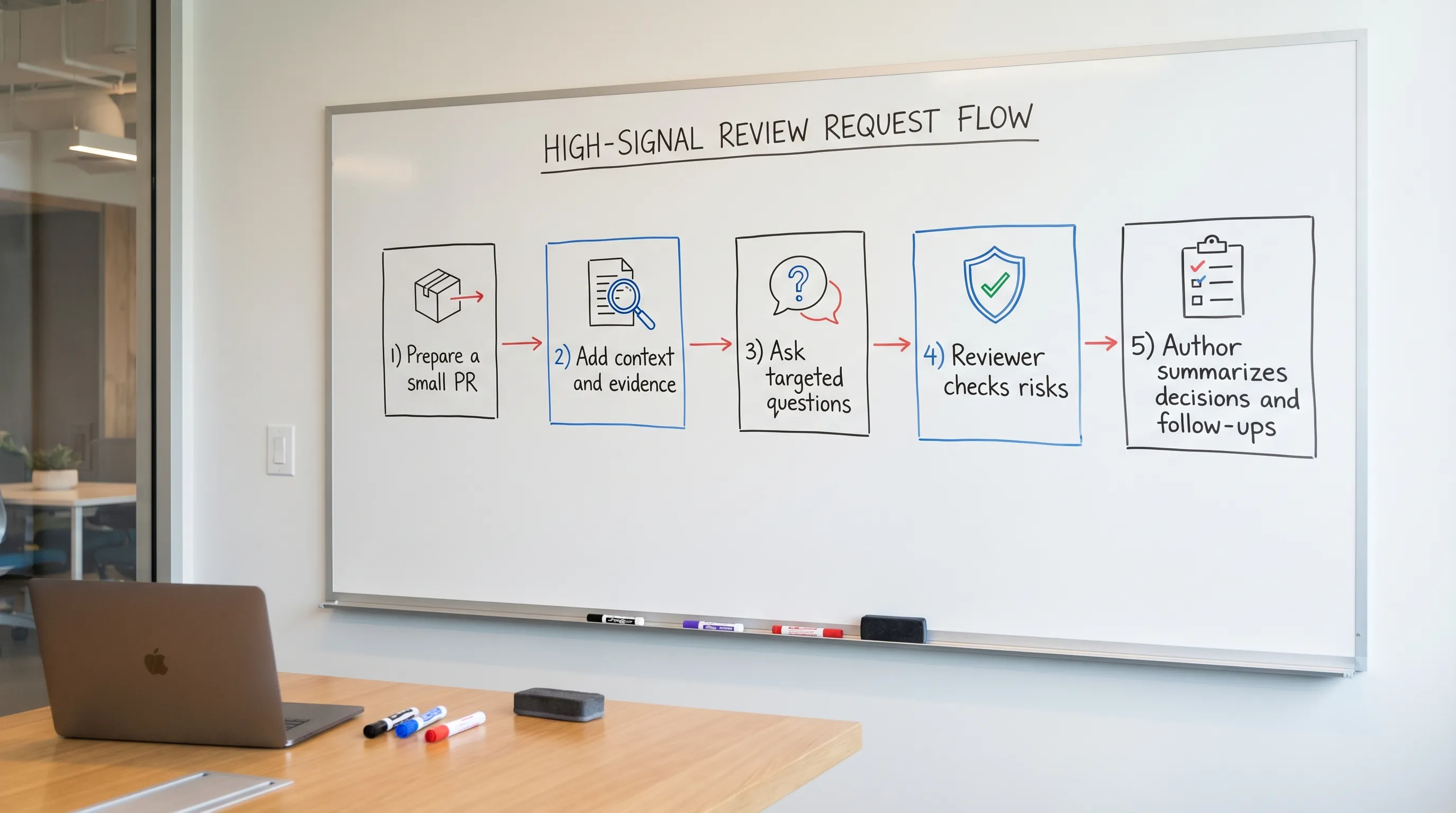
Write a PR description that creates shared context
A good PR description is not a status update, it is an onboarding document for your change.
Use this structure (copy and paste it):
1) Problem Explain what user/business problem this solves and what prompted the change (bug report, incident, feature request).
2) Approach Describe the chosen approach, plus one alternative you did not choose (and why). This is where the best architectural feedback comes from.
3) Scope and boundaries What is intentionally not included? What will be done later?
4) Risks and trade-offs Call out performance, security, compatibility, data migration, operational impact.
5) Test plan Include what you ran and what you did not run.
6) Rollout plan (if relevant) Feature flag, staged rollout, canary, or safe revert steps.
Example (short, but high-signal)
If you are improving an e-commerce product listing page, for example on a site selling designer lighting like modern lighting and lamps, reviewers will care about correctness, UX, and performance. A strong PR summary might say:
- Problem: Category pages stutter on scroll and sometimes duplicate items.
- Approach: Switch to cursor-based pagination, dedupe by product ID at the boundary.
- Risks: Off-by-one pagination, SEO implications if routes change, caching behavior.
- Test plan: Unit tests for pagination logic, manual test on slow network throttling.
Notice how that description guides the reviewer toward the real risks, not the superficial diff.
Ask for the right kind of feedback (and limit it)
If you ask for everything, you will get almost nothing. Instead, ask for one primary feedback goal, and optionally a secondary.
High-signal questions reviewers can actually answer
| What you want | Ask this | Why it works |
|---|---|---|
| Validate correctness | “Can you try to break this flow? I’m most worried about empty-state and retry behavior.” | Invites adversarial testing, not just reading |
| Improve API design | “Does this endpoint contract feel stable for other clients? Any naming or error-model issues?” | Focuses on compatibility and long-term cost |
| Reduce operational risk | “Any production risks with timeouts, retries, logging, or rollback?” | Pulls review into real-world failure modes |
| Maintainability | “Is there any part that feels too clever to debug at 2 a.m.?” | Encourages simplicity and clarity |
| Performance | “Do you see any new N+1 risk or extra round trips? Anything that could hurt p95?” | Targets systemic performance issues |
| Security | “Any authz gaps, injection risks, or sensitive data in logs?” | Makes security review explicit |
A practical rule: ask 1 to 3 questions, and point to the relevant files.
Use “review guidance” in the PR to steer attention
Add a short section like this:
- Please focus on: authorization logic in
Policy.ts, query shape inrepo.ts, error mapping inhandler.ts. - Less important: copy text and UI spacing (will be iterated).
This prevents wasted time and increases the chance of deeper feedback.
Choose reviewers intentionally (not randomly)
Real feedback requires the right perspectives.
A simple reviewer model
- Domain reviewer: knows the business rules and edge cases.
- System reviewer: understands architecture, boundaries, scaling, and operability.
- Security or data reviewer (as needed): validates high-risk areas.
You do not need all of them on every change. Use them when the change touches their risk area.
Timing matters more than you think
If a PR lands at the end of the day with “need this merged ASAP,” reviewers will optimize for speed, not quality. If you want thoughtful review:
- Share a draft PR early with “context only, no need to review yet.”
- Request review when tests are green and the description is complete.
- Agree on a team norm for review turnaround (even a soft SLA helps).
Make it easy to say “no” (and still be helpful)
Sometimes a reviewer cannot do a deep pass. Give them an off-ramp that still produces value:
- “If you only have 10 minutes, please just check the auth rules and the migration script.”
This improves throughput and still protects the riskiest parts.
During the review: how to get better feedback without conflict
Good review conversations are specific and decision-oriented.
When you receive comments
- Respond with the decision, not just “done.” Example: “Agreed, I changed it to X because Y, and added a test for Z.”
- If you disagree, state the trade-off: “I kept A because B (perf), but added a TODO and monitoring for C.”
- If a thread gets long, propose a 10-minute call, then summarize the outcome back in the PR.
Close the loop with a short summary
Before merging, add a final comment:
- What changed after review.
- What was consciously deferred.
- Any follow-up issues created.
This turns review into an auditable engineering decision, not just a gate.
Special cases: how to ask for reviews on risky changes
Legacy code or “I’m afraid to touch this” areas
When the codebase is fragile, reviewers need proof more than opinions:
- Add characterization tests (lock current behavior).
- Highlight seams you introduced (adapter, wrapper, extracted function).
- Ask explicitly: “Is this the smallest safe step, or do you see a better seam?”
AI-generated or “vibe-coded” changes
AI can produce plausible code that is subtly wrong or insecure. When requesting review, declare it:
- “Parts of this were AI-assisted, I want extra scrutiny on auth, input validation, and error handling.”
Then attach evidence: tests, threat model notes, and dependency changes.
Performance-sensitive changes
Do not ask “is this fast?” Ask for reviewable performance truth:
- Provide baseline numbers (even rough local or staging numbers).
- Call out the hypothesis: “This reduces API calls from 3 to 1 per page load.”
- Ask reviewers to check query patterns and caching assumptions.
A copy-paste review request template (for Slack or PR)
Use this when you ping someone for code help:
Context: One sentence on what this changes and why.
What I need from you: 1 primary question, 1 optional secondary.
Where to look: 2 to 4 files or a specific commit.
Risk: The main thing you are worried about.
Time box: “If you only have 10 minutes, please focus on X.”
This template signals professionalism and drastically increases the chance of real feedback.
Frequently Asked Questions
How do I get more than “LGTM” in code reviews? Add context (problem, approach, risks), keep the PR small, and ask 1 to 3 targeted questions that point to the highest-risk files.
What should I include in a PR test plan? What you ran (unit, integration, E2E), what you did not run (and why), and any manual scenarios you verified (edge cases, permissions, failure states).
How big should a pull request be? Small enough that a reviewer can understand it in one sitting. If you cannot summarize the change and its risks in a short PR description, it is usually too big.
Who should I request review from? Start with a domain-aware reviewer for correctness, add a system/architecture reviewer for boundary and operability risks, and involve security or data specialists for high-risk changes.
How do I ask for review on legacy code without slowing everything down? Show the smallest safe step, add behavior-locking tests, and ask reviewers specifically to validate seams and rollback safety rather than style.
Need higher-signal reviews across your team?
If your reviews feel performative, or your team is shipping changes that later turn into incidents, it is usually a system problem: unclear quality bars, missing automated gates, oversized PRs, and inconsistent architecture boundaries.
Wolf-Tech helps teams improve review quality and delivery safety through code quality consulting, legacy code optimization, and full-stack development support. If you want an expert eye on your review process and the technical guardrails behind it, learn more at Wolf-Tech.