
Web Apps Development: A Practical Starter Guide

Sandor Farkas
Founder & Lead Developer
Expert in software development and legacy code optimization
LinkedIn
You do not need a 200 page specification to start building a useful web application. You do need a crisp business goal, a small set of technical decisions made early, and a delivery plan that keeps risk low while momentum stays high. This practical starter guide walks you through the essentials of web app development, from shaping an MVP to picking a stack, shipping with confidence, and avoiding the most common pitfalls.
Start with outcomes, not features
Before you choose a framework, define what success looks like. Align the product objective, measurable outcomes, and guardrails that keep scope under control.
- Product objective: the customer problem you will solve and for whom.
- Success metrics: one to three measurable signals, for example activation rate, time to complete a key task, support tickets per 100 users.
- Non negotiables: privacy constraints, regulatory requirements, critical integrations.
- Time box: an MVP window that is short enough to force prioritization, usually a few development sprints.
Capture this in a one page PRD. It should be understandable by executives and developers alike. Great delivery starts here.
Make a few high leverage architecture decisions early
You do not need to design everything up front, you do need to pick a baseline that fits your problem and team. Use the table below to choose sensible defaults.
| Decision | Option A | Pick it when | Option B | Pick it when |
|---|---|---|---|---|
| Rendering model | SPA with client routing | You need highly interactive UI, offline support, or a desktop like experience | SSR or hybrid rendering | You need great initial load, SEO, or content heavy pages |
| Service structure | Modular monolith | Team is small, strong need for fast iteration and simple deployments | Microservices | Clear domain boundaries, independent scaling needs, dedicated platform engineering |
| Data model | SQL (PostgreSQL, MySQL) | You need transactions, reporting, complex queries | NoSQL (Document, KV) | You need flexible schema, high write throughput, large event or session data |
| API style | REST | Simple CRUD, broad client compatibility, caching via HTTP | GraphQL | Aggregating many resources per view, type safety at the client, selective data fetching |
| Hosting | Containers on managed service | You want control, predictable workloads | Serverless | Spiky workloads, low ops overhead, pay per use fits traffic profile |
Useful references: the Twelve Factor App for service hygiene and MDN HTTP caching for response caching fundamentals.
Choosing your frontend stack
Pick what your team can ship with today. All major frameworks can deliver an excellent result if used well.
| Framework | Strengths | Best when |
|---|---|---|
| React | Massive ecosystem, flexible architecture, strong TypeScript support | You want ecosystem breadth, or you plan to hire widely |
| Vue | Gentle learning curve, single file components, great docs | You want fast onboarding and a compact core |
| Angular | Batteries included, opinionated structure, enterprise ready | You want a full framework with conventions and tooling built in |
| Svelte | Compiles to minimal JS, very fast runtime, simple reactivity | You want small bundles and straightforward state management |
Whatever you choose, adopt a component library and a design system early. Consistent UI accelerates development and reduces rework.
Choosing your backend stack
Pick a platform that aligns with your team’s expertise, the integrations you need, and your deployment target.
| Platform | Common frameworks | Strengths | Best when |
|---|---|---|---|
| Node.js | Express, NestJS, Fastify | One language across stack, huge package ecosystem | Real time features, JSON heavy APIs, rapid iteration |
| Python | Django, FastAPI, Flask | Batteries included, great data tooling, type friendly with FastAPI | Data centric apps, admin backends, ML adjacent needs |
| Ruby | Rails | Convention over configuration, fast CRUD delivery | MVPs that benefit from Rails conventions and productivity |
| Go | Gin, Fiber | Low latency, simple concurrency, single binary deploys | High throughput APIs, infrastructure services |
| .NET | ASP.NET Core | Strong typing, performance, Windows and Linux friendly | Enterprise ecosystems, existing Microsoft stack |
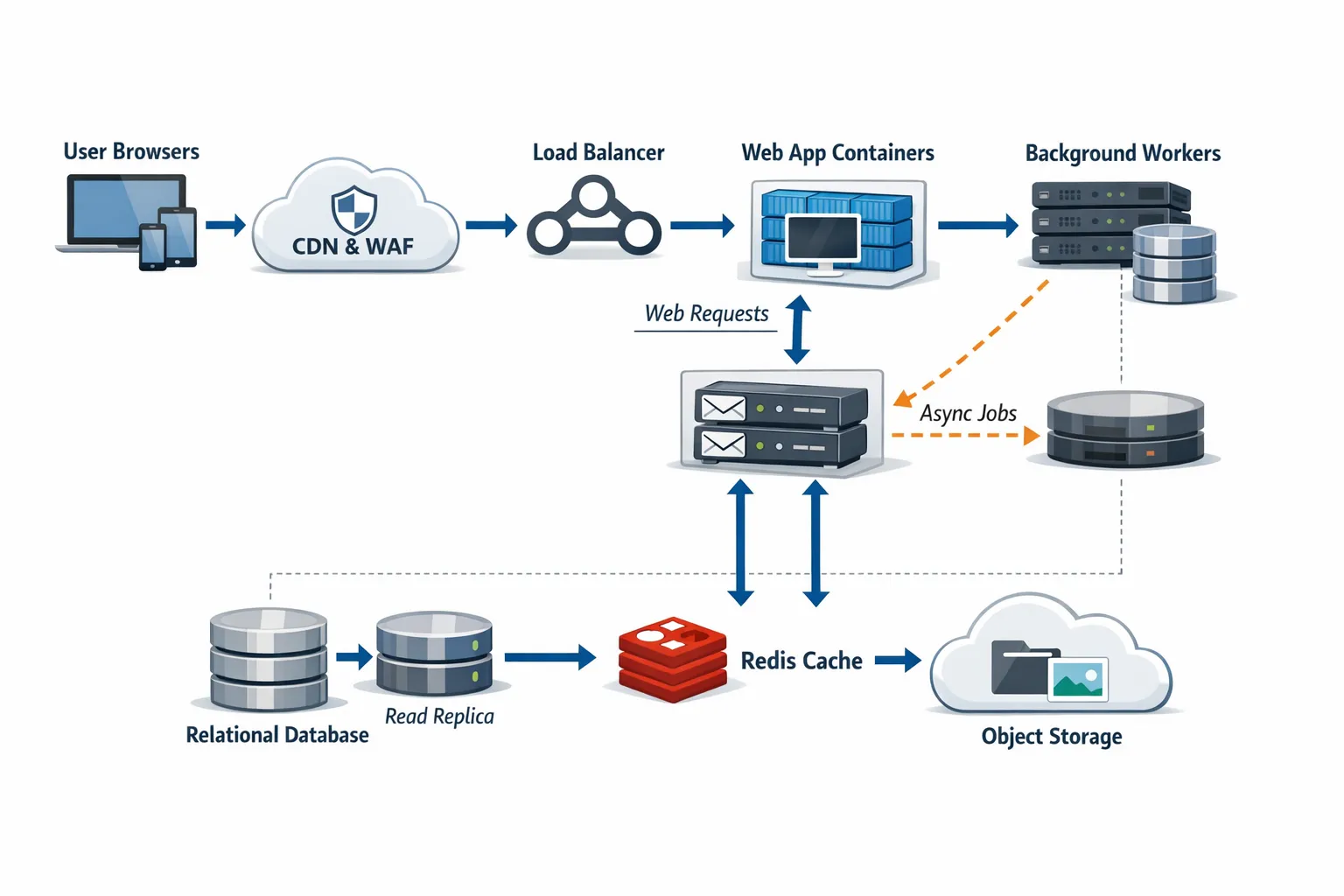
Do not forget background processing. Put long running work into a job queue with workers, for example BullMQ for Node, Celery for Python, or Hangfire for .NET.
Data and integration basics
Start simple, optimize later.
- Default to PostgreSQL for most transactional workloads. It offers mature JSON support, powerful queries, strong reliability, and broad hosting options.
- Add a cache when read load or latency demands it. Redis is a pragmatic choice for hot keys, sessions, and rate limiting.
- Use object storage for user uploaded files, for example S3 compatible storage, with presigned uploads to keep large files off your app servers.
- Prefer REST for simple APIs. Consider GraphQL where a single UI view needs data from many resources at once.
- For integrations, isolate each third party behind your own interface. This reduces blast radius when vendors change.
Security from day zero
Security is not a phase at the end. Bake it in from day one.
- Follow the OWASP Top 10 categories during design and code reviews.
- Centralize auth and session management. Use short lived tokens, secure cookies with SameSite and HttpOnly, and rotate keys regularly.
- Never trust user input. Validate on the server, encode outputs, and use parameterized queries for the database.
- Keep secrets out of source control. Use cloud secret managers and environment variables for runtime injection.
- Automate dependency scanning and patching in CI. Pin versions, review transitive risk, and remove unused packages.
- Log security relevant events. Successful and failed logins, permission changes, and admin actions are table stakes.
Performance and UX essentials
Speed is a feature. Optimize what users feel first.
- Track Core Web Vitals, for example LCP, INP, CLS. Google’s overview is at web.dev/vitals.
- Ship less JavaScript. Use code splitting, tree shaking, and image optimization. Prefer modern build tools like Vite.
- Render critical content early. If SEO matters, consider server side rendering or static generation for top landing pages.
- Cache at the right layer. Use HTTP caching headers for public assets and CDN edges, and cache expensive API responses where safe.
- Keep database queries predictable. Add indexes for common filters and pagination, and use connection pooling.
- Design for resilience. Time out slow calls, add retries with backoff, and use circuit breakers on flaky dependencies.
DevOps baseline for reliable delivery
You do not need a complex platform to start. Aim for a simple, repeatable pipeline that you can evolve.
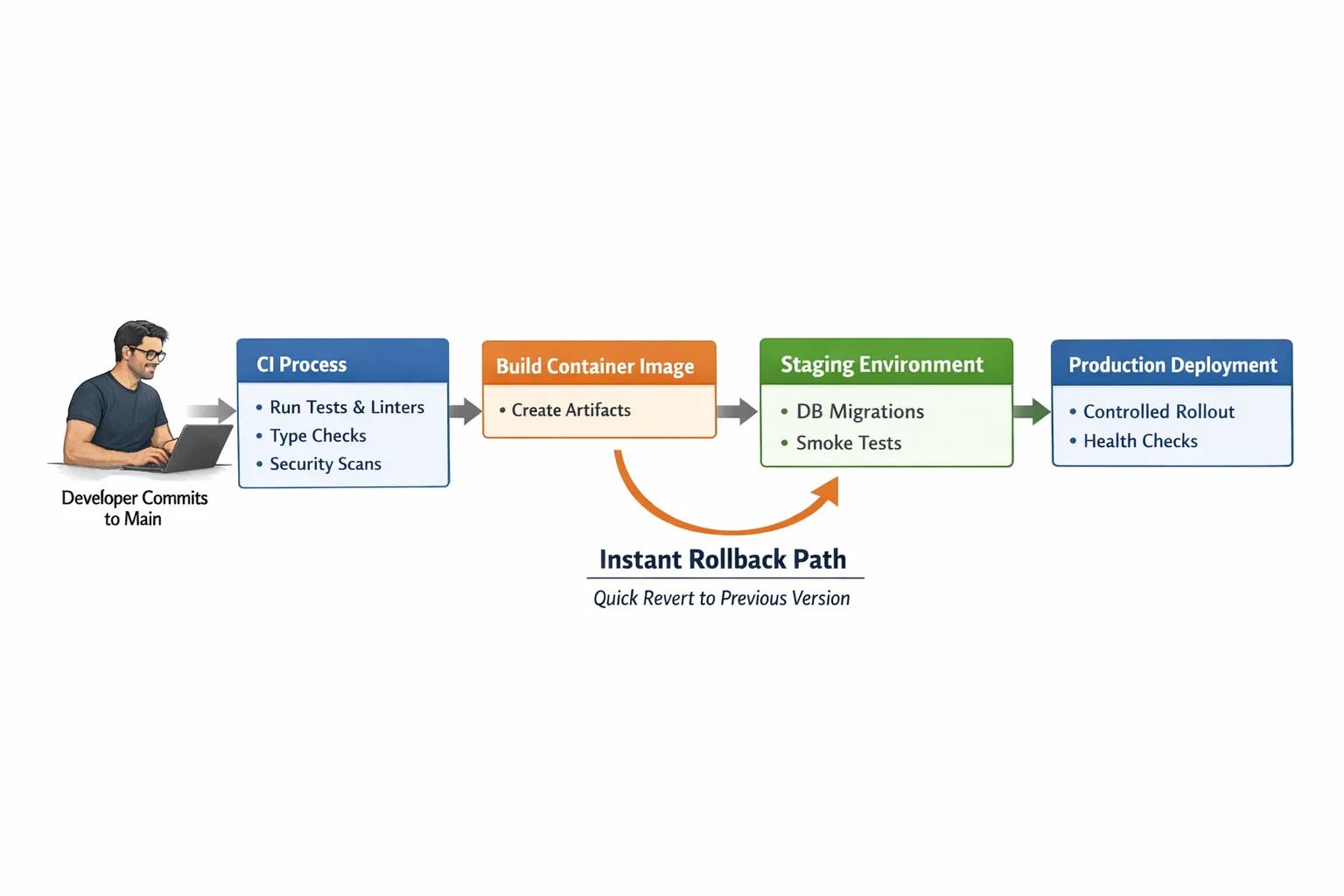
- Containerize the app so that dev, test, and production run the same way. The Docker getting started guide is here: docs.docker.com/get-started.
- Create three environments, development, staging, production. Promote builds through them. Do not hotfix directly on production.
- Automate CI, for example run unit tests, linting, type checks, security scans on every pull request. Block merges on red builds.
- Automate CD with blue green or rolling deploys. Keep a one click rollback.
- Instrument from day one. Collect logs, metrics, and traces using OpenTelemetry. Aggregate errors and alert on user facing failures.
- Keep configuration in the environment, not in code. The Twelve Factor App remains a solid checklist.
A pragmatic 60 day MVP plan
This outline assumes a small cross functional team. Adjust scope to fit your resources.
Weeks 0 to 2, align and set the foundation
- Finalize the one page PRD with objective, metrics, and constraints.
- Create a clickable prototype to validate the core user flow.
- Choose the stack and architecture using the decision table above.
- Set up repo, CI, staging environment, and error tracking.
- Implement authentication and the first protected route.
By the end of week 2 you should be able to sign in, load a basic dashboard, and deploy changes with a single command.
Weeks 3 to 6, build the core use cases
- Implement the smallest set of features that deliver the core value.
- Add data models, migrations, seed data, and a minimal admin view.
- Integrate the first external system behind an abstraction layer.
- Add analytics for the key metrics you defined.
- Begin usability tests with a handful of target users.
By the end of this phase you should have a vertical slice that a real user can complete end to end.
Weeks 7 to 8, harden and prepare for beta
- Close critical bugs, improve empty states, polish onboarding.
- Add rate limits, security headers, and basic monitoring dashboards.
- Run load tests against top endpoints and fix the top bottlenecks.
- Document runbooks for deploy, rollback, and on call escalation.
Your output is a stable beta that a limited audience can use without hand holding.
Team, roles, and ways to reduce risk
A small MVP team typically includes a product manager, a product designer, one frontend engineer, one backend engineer, and a part time DevOps or platform engineer. Add a QA specialist as soon as you can. If you do not have all roles in house, bring in experienced partners for the riskiest areas, for example architecture, security, and CI.
Where possible, buy before you build on cross cutting concerns like auth providers, email delivery, observability, and payments. Building the parts of the product that customers will pay for is the best use of your limited time.
Common pitfalls and how to avoid them
- Over scoping the MVP. Pick one primary use case and do it well. Every additional feature adds integration and testing cost.
- Premature microservices. Start modular, extract services only when clear boundaries and scaling needs appear.
- Ignoring security until late. It is far cheaper to start with safe defaults than to retrofit after incidents.
- Skipping automated tests. Even a small suite of unit and smoke tests catches regressions that manual testing will miss.
- Neglecting observability. If you cannot see it, you cannot fix it. Logs, metrics, and traces are your eyes.
Starter stack recipes you can trust
- TypeScript SPA plus Node.js API plus PostgreSQL. Balanced choice for product teams who value end to end TypeScript and a huge ecosystem.
- Python SSR with Django plus HTMX plus PostgreSQL. Excellent for CRUD heavy apps that benefit from server rendered pages and an admin backend.
- ASP.NET Core API plus Angular plus SQL Server or PostgreSQL. A great fit when teams are already productive in the Microsoft stack.
All three options deploy cleanly in containers, scale horizontally behind a load balancer, and integrate well with a CDN for assets.
Launch readiness checklist
- The app solves the defined core use case end to end for at least five external testers.
- You have clear metrics dashboards for availability and the top user journey.
- Backups, migrations, and rollbacks are tested, not just documented.
- Security headers, rate limits, and dependency scans are in place.
- There is a plan for triage and fixes during the first week after launch.
Where Wolf-Tech can help
If you want to accelerate delivery, reduce risk, or validate your early decisions, Wolf-Tech brings 18 plus years of full stack experience across modern tech stacks and industries. Typical engagements include architecture and stack strategy, legacy code modernization, code quality audits, end to end web application development, and Cloud plus DevOps enablement. When you are ready, we can meet you where you are, help shape an MVP, and build a path to scale.
Useful references
- The Twelve Factor App, https://12factor.net/
- MDN Web Docs on HTTP caching, https://developer.mozilla.org/en-US/docs/Web/HTTP/Caching
- OWASP Top 10, https://owasp.org/www-project-top-ten/
- Core Web Vitals overview, https://web.dev/vitals/
- Docker getting started, https://docs.docker.com/get-started/
- OpenTelemetry, https://opentelemetry.io/
If you keep scope tight, make a handful of smart technical choices, and ship in small increments with good hygiene, web apps development becomes a predictable path from idea to impact. When you need experienced hands, Wolf-Tech is ready to help you build, optimize, and scale.