
Taming Legacy Code: Strategies That Actually Work

Sandor Farkas
Founder & Lead Developer
Expert in software development and legacy code optimization
LinkedIn
Legacy code is not just old code, it is code you are afraid to change. Taming it requires more than good intentions. In 2026, with tighter budgets and higher reliability expectations, teams need approaches that measurably reduce risk while increasing delivery speed. This guide distills strategies that actually work in the field, with pragmatic sequencing, metrics to prove progress, and patterns that keep your system stable while you improve it.
What success looks like when you tame legacy code
Successful modernization is not a rewrite for rewrite’s sake. It is a steady improvement in specific outcomes that matter to the business:
- Change failure rate drops, incidents per deploy decline.
- Lead time for changes shortens from weeks to days or hours.
- Deploy frequency increases without paging the team at night.
- Reliability stays within SLOs while you ship new capability.
- Run costs and toil trend down as complexity is retired.
If you are not measuring at least these four metrics during legacy work, you are flying blind: deploy frequency, lead time for changes, change failure rate, and mean time to restore. Add service level objectives and basic cost telemetry to see impact on reliability and spend.
A battle‑tested sequence that de‑risks modernization
You do not have to invent a plan. This five‑step flow works across industries and tech stacks.
1) Stabilize and see what is happening
Before changing logic, make the system observable and safer to operate.
- Add health checks, structured logging, and request IDs. Centralize logs.
- Instrument top user journeys or business capabilities with timers and error tracking.
- Define temporary error budgets and a rollback plan for every deploy.
- Introduce feature flags so you can ship code paths inactive by default.
If you need a deeper rollout playbook, see our guide on Modernizing Legacy Systems Without Disrupting Business.
2) Map the system and choose fracture planes
Work from capabilities, not files. Map the system by domain and risk, then choose where to act first.
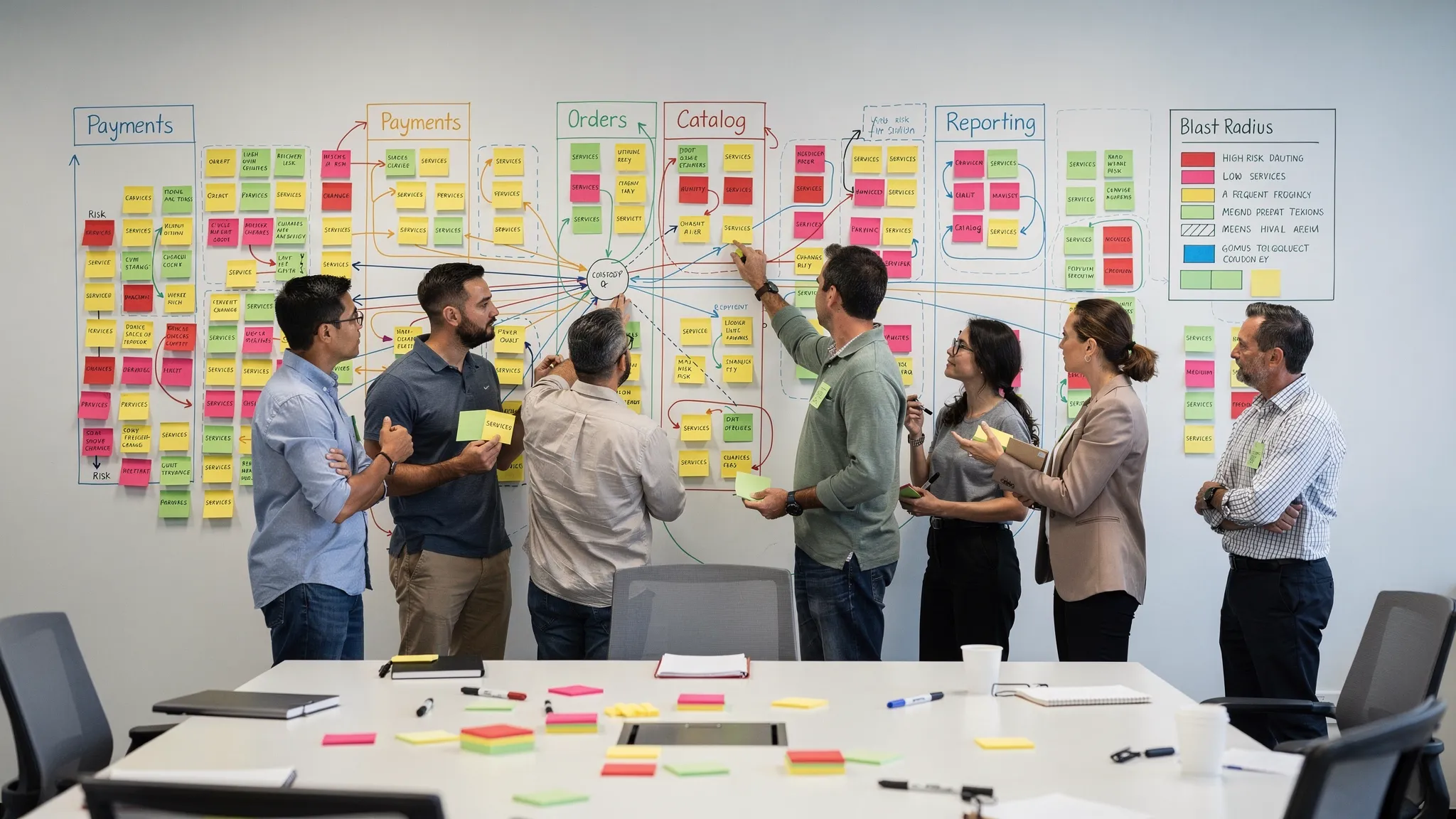
A simple risk matrix helps you pick high‑leverage targets. Here is an example structure with sample entries to illustrate how to use it.
| Area | Risk | Change frequency | Blast radius | Candidate strategy |
|---|---|---|---|---|
| Payments | High | Weekly | High | Anti‑corruption layer, strangler around checkout |
| Reporting ETL | Medium | Monthly | Low | Characterization tests, batch refactor, replace job |
| Public API v1 | High | Weekly | High | Contract tests, facade, parallel v2 behind flags |
| Admin UI | Medium | Weekly | Medium | Modularize screens, migrate per route |
| Cron invoice job | High | Daily | Medium | Idempotent commands, outbox pattern, dual run |
Focus first where risk and change frequency are both high, you will get faster impact on failure rates and delivery speed.
3) Create safe seams and run in parallel
You rarely replace a legacy module in one shot. Create seams so new code can live beside old code.
- Strangler pattern with a router or gateway that forwards specific routes to new components.
- Branch by abstraction, introduce an interface in the legacy code, redirect calls to new implementations gradually.
- Anti‑corruption layer, translate between old and new models to keep domain logic clean.
- Shadow traffic and read‑only mirrors, exercise new paths without affecting users.
4) Lock in behavior with tests before changing code
When there are no tests, you capture current behavior first, then refactor.
- Characterization tests, assert what the code does today, even if it is quirky.
- Golden master tests for pure functions or batch jobs, compare outputs on real fixtures.
- Consumer‑driven contract tests around public APIs to prevent breaking integrators.
- Narrow unit tests in high‑churn modules to protect refactors.
For a step‑by‑step refactor plan, our Refactoring Legacy Applications guide breaks down how to start small and build momentum.
5) Replace incrementally and measure as you go
Deploy behind flags, ramp exposure with canaries, and keep an easy path to rollback.
- Migrate read paths first, validate parity, then cut writes.
- Dual‑write with verification during transitions, switch to single write after parity holds.
- Remove dead code quickly, do not leave toggles and old endpoints lingering.
- Track the four key delivery metrics and SLOs each week so you can prove value.
For additional tactics and examples, see Code Modernization Techniques: Revitalizing Legacy Systems.
Tactics that work for specific legacy smells
Use the smell‑to‑strategy map below to choose a proven next move.
| Legacy smell | What actually works | First step that pays off |
|---|---|---|
| No tests, fragile modules | Characterization tests plus branch by abstraction | Wrap a risky function with an interface and add golden master tests on real fixtures |
| Big ball of mud monolith | Modular monolith boundaries, then strangler per capability | Define module boundaries and move one feature behind an internal facade |
| Shared database across services | Anti‑corruption layer and event‑driven integration | Introduce a gateway service that translates and publishes domain events |
| Outdated framework lock‑in | Facade and adapter layer, remove hard dependencies | Add an adapter around the framework, replace direct calls with the adapter |
| Cron jobs with side effects | Idempotent commands and outbox pattern | Split job into read, compute, write, add idempotency keys and an outbox |
| UI tightly coupled to backend | Route‑by‑route migration, backend‑for‑frontend | Carve one screen behind a lightweight BFF, keep the rest intact |
| Vendor SDK sprawl | Centralized client and retry policies | Wrap SDK in one library with timeouts and circuit breakers |
Data migrations that do not break the business
- Choose the smallest seam that supports parallel run, for example one tenant or one region.
- Use change data capture to mirror writes into the new store.
- Validate with counts, checksums, and domain invariants, not just raw row numbers.
- Flip reads to the new store first, then cut writes, keep a reversible toggle for one release.
- Decommission old tables or topics promptly to avoid split‑brain.
Governance and culture that prevent debt from regrowing
- Make reliability and delivery metrics visible, discuss them weekly.
- Allocate a standing improvement budget in every sprint, even 10 to 20 percent compounds.
- Adopt trunk‑based development with small pull requests and fast reviews.
- Establish code ownership by domain, not by people.
- Standardize paved paths for logging, metrics, testing, and deployment so new code is born modern.
Industry note: payments and regulated domains
In regulated or payments-heavy systems, avoid building commodity capabilities from scratch. Use strong seams, auditability, and domain boundaries to integrate specialized services. When modernizing, isolate your domain logic behind an anti-corruption layer and integrate the provider at the boundary so you keep control of business rules.
For security‑first guidance in regulated environments, our overview on Software Development for Financial Services covers controls, auditability, and resilience patterns.
A 90‑day starter plan you can run now
- Set baselines, current delivery metrics, top SLOs, incident types, and a rollback policy.
- Add observability, structured logs, request tracing, and error dashboards for top two journeys.
- Map capabilities, risk, and change frequency. Pick one high‑leverage module as the pilot.
- Create a seam, facade or interface around that module. Start capturing behavior with tests.
- Implement the first replacement behind a feature flag. Shadow traffic for one week.
- Run a canary, flip reads first, monitor error budgets, then cut writes.
- Remove dead code immediately, document the decision, and celebrate the win.
- Iterate to the next capability, apply the same pattern, and publish weekly metrics.
What not to do
- Big‑bang rewrites without a reversible path, the risk curve is unacceptable.
- Copy‑paste migrations, you carry forward bugs and design debt.
- Tool‑only modernization, linters and scanners help but they do not change architecture.
- Unbounded parallel work, limit WIP so each slice reaches production.
- Unmeasured efforts, no metrics means no proof of value and weak stakeholder support.
Tooling that accelerates legacy work
- Feature flags and targeted rollouts for safe exposure control.
- Contract testing and schema registries to prevent integration breakage.
- Static analysis, dependency health checks, and automated updates to reduce known risks.
- Observability, tracing and error analytics focused on business journeys.
- Migration utilities, data diff tools and CDC for safe data moves.
For architectural migration patterns and rollout gates, revisit Modernizing Legacy Systems Without Disrupting Business. For refactor‑first techniques, see Refactoring Legacy Applications and our broader Code Modernization Techniques.
Frequently Asked Questions
How do I decide between refactoring and a rewrite? Treat it as a risk and ROI decision. If the module still delivers value and you can create seams and tests, refactor in place. If change failure rate remains high after a few iterations and the cost to safely modify outpaces a greenfield slice, strangle and replace capability by capability.
What if there are zero tests? Start with characterization tests around the highest risk code paths, then add golden master tests for pure logic or batch jobs. Introduce an interface so you can branch by abstraction and test the new implementation behind it.
How do we measure progress credibly? Track deploy frequency, lead time for changes, change failure rate, mean time to restore, and your critical SLOs. Publish a weekly scorecard with a short narrative about what changed and why.
Do we need microservices to fix legacy code? Not necessarily. Many teams get excellent results by moving to a well‑structured modular monolith first, then extracting only the capabilities that genuinely benefit from independent scaling or release cadence.
How can we migrate data without downtime? Use change data capture to mirror writes, validate parity with invariants, flip reads first, and keep a reversible toggle for at least one release window.
What is the fastest first win? Improve observability, add a seam around one risky module, ship a small change behind a flag, and measure the effect. Momentum matters as much as design.
Ready to tame your legacy code?
Wolf‑Tech helps teams stabilize, modernize, and scale systems without disrupting the business. Our expertise spans full‑stack development, code quality consulting, legacy code optimization, custom software and web applications, tech stack strategy, cloud and DevOps, and database and API solutions across industries.
If you want a pragmatic plan and hands‑on help, let’s talk. We can assess your codebase, map fracture planes, set up observability and test scaffolding, and execute an incremental modernization that shows value in weeks, not quarters.