
Software Development Trends Shaping 2025

Sandor Farkas
Founder & Lead Developer
Expert in software development and legacy code optimization
LinkedIn
The headline buzzwords about AI, platforms, and cloud are not the story in 2025. The story is disciplined execution, responsible AI, and shipping faster with fewer moving parts. Teams that win this year will pair AI with strong engineering fundamentals, invest in internal platforms that actually remove toil, and adopt pragmatic architectures that cut complexity instead of adding it.
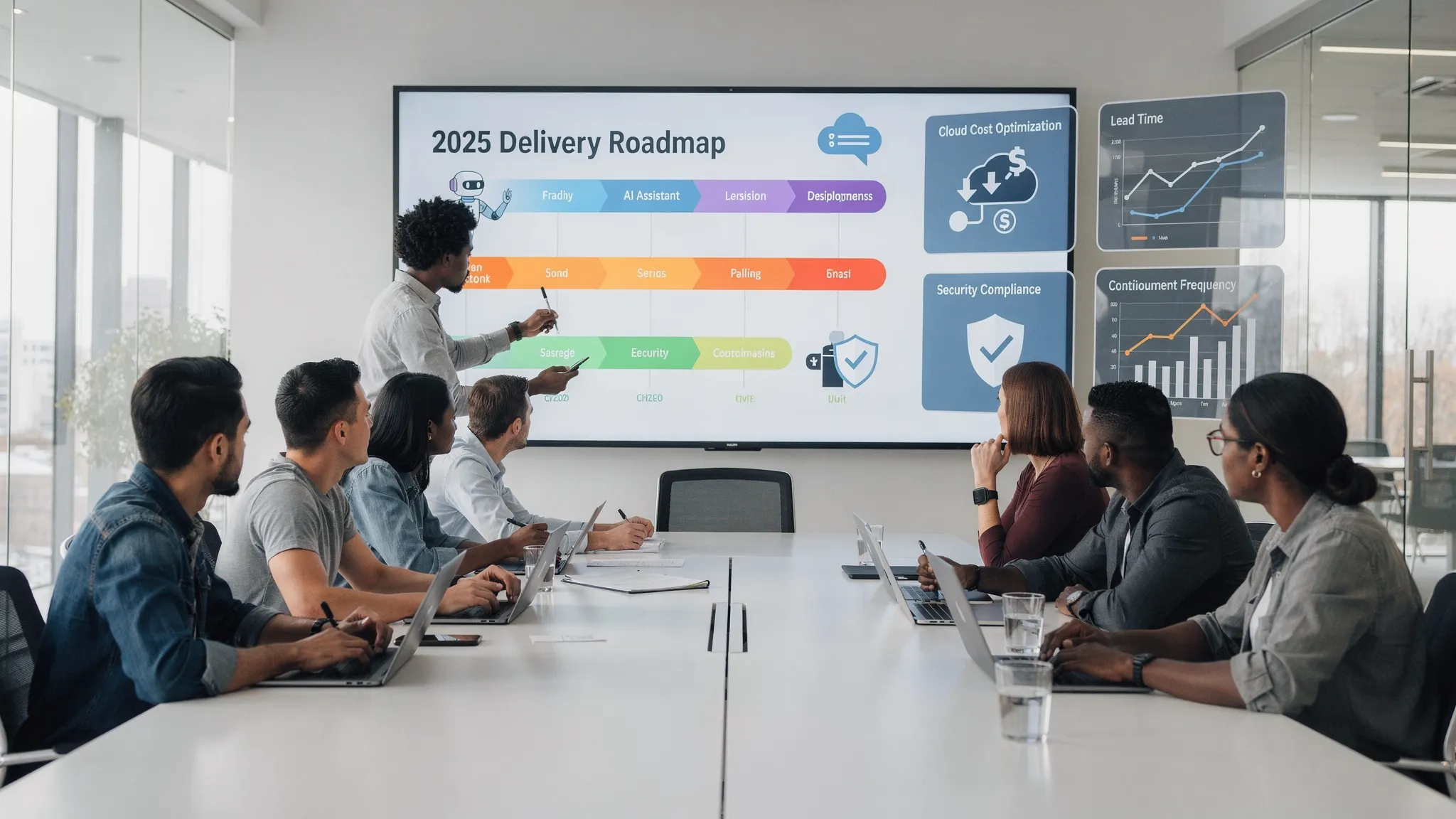
The 10 software development trends shaping 2025
1) AI-augmented delivery becomes standard
AI coding assistants and agents are moving from novelty to normal. The value is less about writing code and more about accelerating reading, refactoring, test generation, reviews, and documentation. Organizations are establishing guardrails, model access policies, and data handling rules, then measuring the impact on quality and speed. GitHub Octoverse 2024 highlights broad adoption of AI-assisted workflows, with productivity and developer sentiment gains when paired with good practices.
What to do now: define an AI usage policy, pilot on a few repos with clear tasks like unit test generation and PR review, instrument quality gates, and treat prompts as reusable assets. Keep humans in the loop for acceptance, security, and architecture decisions.
2) Platform engineering matures into a product discipline
Internal developer platforms are evolving from a DIY cluster of scripts to product-managed experiences with golden paths, self-service templates, and paved roads for delivery. The goal is consistent environments, secure-by-default defaults, and faster lead time with fewer handoffs. CNCF ecosystem data continues to show growth in cloud native tooling and platform patterns, see the CNCF reports hub.
What to do now: give your platform an owner, define the top three developer jobs to be done, remove one painful manual step each quarter, and publish measurable service level objectives for the platform.
3) Pragmatic architecture over hype
Teams are pivoting from microservice sprawl to modular monoliths and purposeful decomposition. You still use services where boundaries are strong and change rates differ, but default to simpler deployments and fewer repos when domain complexity is modest. Align your choices with business outcomes and non functional requirements, not trends. For a grounded evaluation process, see How to Choose the Right Tech Stack in 2025.
What to do now: document current pain per module or service, identify three seams where coupling hurts, and plan a small refactor that improves cohesion without expanding your service count.
4) Security and supply chain move left and get opinionated
Secure by design is not optional. Expect stronger supply chain controls, SBOMs, signed artifacts, and policy-as-code in CI. Memory safe languages like Rust and Go gain adoption for systems work, while sandboxed plugins reduce blast radius. Regulators and industry bodies continue to push baselines such as the CISA Secure by Design initiative. Breach costs remain significant, see the IBM Cost of a Data Breach 2024 report for context.
What to do now: enable dependency and container scanning on every PR, sign build artifacts, require provenance for third party components, and prioritize a top five threat model with concrete mitigations.
5) FinOps and unit economics by default
Cloud cost is an engineering constraint, so teams instrument spend like any other SLO. Expect stronger tagging hygiene, showback and chargeback, automated rightsizing, and workload-aware placement across regions and runtimes. The FinOps community’s latest benchmarks and practices are summarized in the State of FinOps 2024.
What to do now: standardize tags in CI, map cost to user facing units such as cost per report or per thousand requests, and include cost regression checks in performance tests.
6) Edge runtimes and serverless first patterns
Lightweight compute at the edge reduces latency for personalization, streaming UI, and auth. Serverless across functions, queues, and storage continues to shrink undifferentiated ops. The caveats are cold starts, runtime limits, and observability surface area. Tune rendering and caching by route, and be explicit about data consistency models. For practical guidance, see Next.js Best Practices for Scalable Apps.
What to do now: identify two user journeys that are latency sensitive, move them to edge backed endpoints with cache keys aligned to personalization scopes, and measure impact on conversion and error rate.
7) Real time and event driven experiences
Users expect live updates, collaborative editing, and streaming workflows. Teams blend WebSockets or Server Sent Events for interactivity with asynchronous event pipelines for durable processing. Event schemas become contracts, and idempotency is non negotiable. Start small, model events explicitly, and avoid binding core UX to brittle connections.
What to do now: define your top three domain events, add contract tests for producers and consumers, and launch one real time feature that degrades gracefully when offline.
8) Data architecture for AI features
Retrieval augmented generation moves from prototypes to production. The practical path is disciplined data governance, feature stores for reusable signals, vector search where it belongs, and privacy by design. Many teams will get more mileage by adding a vector index to systems they already operate instead of introducing new databases prematurely.
What to do now: audit your data sources and access controls, start with low risk AI features that summarize internal content, and measure usefulness with task completion and user feedback rather than only accuracy.
9) Observability everyone can use
OpenTelemetry becomes the default instrumentation layer and SLOs the shared language across app and platform teams. The trend is toward prebuilt dashboards keyed to user journeys, trace based profiling, and alerting that emphasizes error budgets over CPU graphs. Observability is successful when new engineers can answer why a request was slow without paging an SRE.
What to do now: instrument one end to end flow with traces, define service level indicators for latency and availability, and attach runbooks to every alert.
10) Governance and compliance shift left, especially for AI
The EU AI Act begins phased application in 2025, which means inventorying AI systems, classifying risk, and documenting data and model lineage. Privacy regulations and data residency requirements continue to shape architecture, especially for multi region deployments. Read the European Commission overview of the EU AI Act to understand timelines and obligations.
What to do now: create a system of record for models and datasets, add policy checks in CI for sensitive data usage, and publish a lightweight model card for any new AI feature.
From trends to traction, a 90 day adoption plan
A good plan trims scope and maximizes learning. Pick small, high signal bets that are easy to measure and roll back.
- Select two delivery bottlenecks and remove them with your internal platform, for example self service app templates and one click test environments.
- Pilot AI assistants on a single repo focused on tests, documentation, and PR review. Establish quality gates and rotate a working group to capture prompts and patterns.
- Rationalize architecture around clear domain boundaries. Reduce service count where coupling is high and operational overhead is real.
- Implement a minimal supply chain baseline, signed artifacts, SBOM generation, and policy checks in CI.
- Stand up cost visibility with tags and unit metrics. Add a cost gate to performance testing for one critical workload.
- Instrument one critical user journey with OpenTelemetry traces and SLOs, publish a dashboard and a simple on call policy.
Quick reference, trends mapped to first moves and success metrics
| Trend | Why it matters | First move in 90 days | Metric to watch |
|---|---|---|---|
| AI augmented delivery | Speed and quality across the SDLC | Pilot on tests and reviews in one repo with guardrails | Lead time, review time, escaped defect rate |
| Platform engineering | Consistency and faster onboarding | Ship one golden path template with built in security | Time to first deploy, developer NPS |
| Pragmatic architecture | Less operational drag, clearer domains | Merge or retire one unnecessary service | Change failure rate, mean time to recovery |
| Supply chain security | Lower breach risk and audit friction | SBOM plus signed artifacts in CI | Percentage of builds signed, dependency vulns fixed |
| FinOps | Sustainable margins and predictability | Tagging policy and unit cost for one product | Cost per transaction, right sizing coverage |
| Edge and serverless | Better latency and simpler ops | Move one route to edge with caching | P95 latency, cache hit ratio |
| Real time UX | Higher engagement and task completion | Add SSE or WebSockets to one feature | Active session duration, reconnect rate |
| Data for AI | Useful AI features without data risk | RAG prototype on internal content | Task completion, user satisfaction |
| Observability for all | Faster diagnosis and fewer pages | End to end tracing on one journey | Error budget burn, time to diagnose |
| AI governance | Compliance and trust | Model inventory and simple model cards | Percentage of AI systems documented |
Modernization remains the unlock
Many teams cannot adopt these trends because legacy systems and fragile pipelines absorb all the oxygen. Start by paying down the right debt in small, test backed steps. If your codebase shows the usual signs of high risk changes and repeated regressions, use a modernization roadmap that you can execute incrementally. Our guide to Code Modernization Techniques and the playbooks on refactoring will help you plan improvements that stick.
How to de risk delivery in 2025
- Align every technology choice to a measurable business outcome and a time bound hypothesis to test.
- Make golden paths real, same repo template, CI preset, deploy script, and observability baked in.
- Use architectural decision records to capture trade offs and create shared memory for the team.
- Bake in security and cost checks directly in developer workflows so they do not rely on heroics later.
- Choose vendors and partners that can prove fundamentals. If you are evaluating external help, use this checklist, Top Traits of Web Application Development Companies, to structure your due diligence.

FAQs
What software development trend should I prioritize first in 2025? Start where your constraints are most painful. If delivery time is slow, invest in platform workflows and AI for tests and reviews. If costs are opaque, start with FinOps basics and unit economics. If incidents dominate, focus on observability and SLOs.
Is AI coding safe to adopt in regulated industries? Yes, if you set clear boundaries. Use organization specific policies, control data sent to models, restrict training on proprietary code when required, and keep human approval for merges and releases. Document model usage and decisions for audit.
Do I need microservices to scale in 2025? No. Many teams scale further and faster with a modular monolith plus a few well chosen services. Optimize for team cognition and operational simplicity before splitting more.
How do we measure the impact of platform engineering? Track time to first deploy for new services, change lead time, deployment frequency, and developer satisfaction. Compare before and after for teams that use the golden path template.
What is a pragmatic FinOps target for a midsize product? Start with 100 percent tagging coverage on production resources, cost per core user or per thousand requests, and rightsizing automation on your top five services. Improve from there.
How do we reduce security risk without slowing delivery? Automate it. Run dependency and image scans on PRs, sign builds, and enforce minimal policies in CI. Pair this with short lived credentials and zero trust defaults in runtime.
Which databases should we use for vector search and AI features? Begin with capabilities in systems you already operate if they meet latency and recall needs. Only introduce a dedicated vector database after you have concrete performance data and a plan for monitoring and backups.
Ready to turn trends into outcomes?
Wolf Tech helps engineering leaders ship faster with less risk, from platform engineering and DevOps foundations to modern web apps and legacy modernization. If you want a pragmatic partner who aligns technology to business outcomes, reach out to Wolf-Tech.
You can also explore these deep dives to accelerate your planning: