
Best Application Development Software for 2025

Sandor Farkas
Founder & Lead Developer
Expert in software development and legacy code optimization
LinkedIn
Picking the best application development software in 2025 is not about chasing hype. It is about selecting a stack that maximizes delivery speed, reliability, security, and long‑term maintainability for your specific goals. Based on 18+ years of building and modernizing systems across industries, this guide highlights the tools and platforms we see winning in the field, plus practical advice to help you choose with confidence.
How to evaluate application development software in 2025
Before picking tools, ground your decisions in outcomes and operating realities. We recommend a quick scorecard that weights the criteria below, then validating with a thin vertical slice.
- Business goals and success metrics, revenue, cost, user experience, compliance
- Nonfunctional requirements, scalability, latency, availability, recovery targets
- Team skills and hiring market, how easily can you staff and grow the stack
- Delivery speed versus longevity, time to first value, upgrade path, community
- Cloud and deployment constraints, data residency, vendor contracts, FinOps
- Security and governance, SDLC controls, SBOMs, access policies, audit trail
- Total cost of ownership, licensing, hosting, support, training, migration effort
For a deeper decision process, see our practical guide on how to choose the right tech stack in 2025.
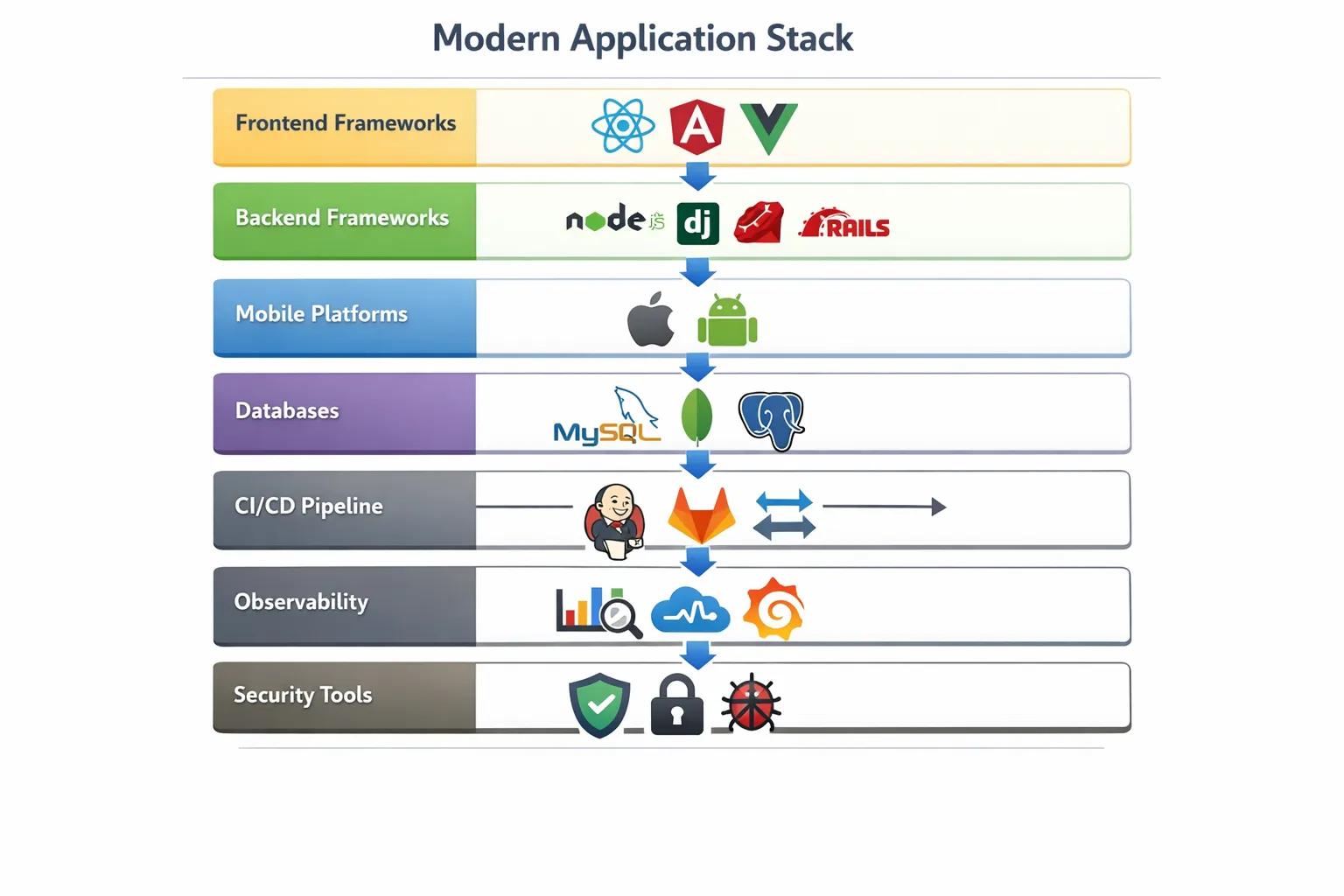
The short list, best software by category
| Category | Top pick(s) | Why it stands out | Best fit |
|---|---|---|---|
| Web frontend framework | Next.js | Mature routing, SSR and ISR, performance defaults, edge options, strong ecosystem | B2B SaaS, content plus app hybrids, global audiences |
| Backend framework | Spring Boot, ASP.NET Core, NestJS, FastAPI | Stable, productive, great docs and tooling, large talent pools | Enterprise Java, Microsoft stacks, TypeScript APIs, Python services |
| Mobile cross‑platform | React Native, Flutter | High quality UI, strong communities, near‑native performance | Consumer apps, internal tools with shared code |
| Native mobile | SwiftUI, Kotlin with Jetpack Compose | First‑class platform APIs and UX, long‑term maintainability | Apps requiring platform‑specific depth |
| Primary OLTP database | PostgreSQL | Reliable, ACID, JSONB, extensions like PostGIS and pgvector | Most transactional workloads |
| Cache and queues | Redis | Low latency, flexible data structures, streams, pub or sub | Caching, background jobs, rate limiting |
| Event streaming | Apache Kafka | High throughput, ordered logs, broad ecosystem | Event‑driven systems, integration hubs |
| CI or CD | GitHub Actions | Tight GitHub integration, huge marketplace, reasonable defaults | Teams on GitHub, cloud‑native delivery |
| Containers and orchestration | Kubernetes | Portability, ecosystem, autoscaling, policy control | Multi‑service platforms, regulated workloads |
| Serverless runtime | AWS Lambda, Cloud Run | Scale to zero, pay per use, rapid iteration | Spiky traffic, APIs, scheduled jobs |
| Edge and frontend hosting | Vercel | Excellent DX for Next.js, edge network, preview deployments | Frontend or full‑stack JS, global distribution |
| API design and testing | OpenAPI, Postman | Shared contracts, mock servers, test collections | RESTful API lifecycle management |
| GraphQL platform | Apollo | Schema‑first, robust client and server tooling, federation options | Multi‑client APIs, evolving domains |
| Web testing | Playwright, Vitest | Fast, reliable, cross‑browser E2E and unit tests | Modern web apps and SPAs |
| Observability | OpenTelemetry, Prometheus, Grafana, Sentry | Vendor‑neutral tracing and metrics, strong alerting, error tracking | SRE and app teams, cost control |
| Security scanning | Snyk, Trivy, OWASP ZAP | SCA, container and IaC scanning, DAST for apps | Shift‑left security and CI gates |
| Monorepo and build | Nx, Turborepo | Caching, project graphs, reproducible builds | TypeScript or polyglot monorepos |
No list is universal. Treat these as strong defaults to compare against your context, then test drive with a thin slice in your domain.
Web and backend frameworks: what to use when
If you are building modern web apps, Next.js leads because it pairs server rendering, static generation, and edge capabilities with a great developer experience. See our field guide on Next.js best practices for scalable apps for routing, caching, and runtime tips that hold up at scale.
For backend services, pick the ecosystem that aligns with your team and workload:
- Java with Spring Boot, enterprise‑ready, robust ecosystem, long‑term stability
- .NET with ASP.NET Core, excellent performance on Linux, great libraries
- TypeScript with NestJS, type safety, decorator patterns, fits JS‑heavy orgs
- Python with FastAPI, concise, async friendly, productive for APIs and ML adjacencies
A modular monolith is a pragmatic starting point for many teams, delivering simplicity and speed with clear module boundaries that can be split later. Use microservices when independent scaling, failure isolation, or very different lifecycles justify the added complexity.
APIs: REST, GraphQL, and contracts
REST with OpenAPI remains the most interoperable choice for integrating partners and internal teams. GraphQL shines when clients need flexibility and multiple backends must be unified behind a single schema. Avoid pitfalls like N plus 1 queries and expensive resolvers by adopting proper caching, pagination, and query complexity guards. Our guide to GraphQL APIs, benefits and pitfalls covers production patterns and trade‑offs.
Complement either approach with contract tests and mocks to decouple teams. Postman collections, MSW for browser mocks, and Pact for contract testing reduce integration surprises.
Data, search, and AI‑readiness
PostgreSQL remains the most versatile primary store. JSONB gives document flexibility, and extensions like pgvector support semantic search without an entirely separate database. Pair Postgres with Redis for caching, background work, and rate limiting. Use Kafka for durable event logs, ingestion, and pub or sub patterns across teams.
For analytics at scale, separate OLTP from analytical workloads. Consider columnar systems like ClickHouse for real‑time analytics or a cloud data warehouse for BI, but keep hot paths small and fast in your transactional plane.
If you plan to add AI features, define clear privacy and data handling boundaries. Use a gateway service to abstract model providers, store only necessary prompts and outputs, and log via OpenTelemetry attributes so you can trace AI calls alongside requests.
Delivery and operations
Strong delivery is what turns tools into outcomes. Teams that adopt trunk‑based development, CI automation, and service SLOs consistently ship faster and more reliably, see the DORA research at dora.dev. Practical moves in 2025:
- GitHub Actions for CI or CD with reusable workflows and environment protections
- Container builds with slim images, SBOM generation, and provenance metadata
- Kubernetes for multi‑service platforms, or Cloud Run and Lambda for focused services
- Preview environments on every pull request to shorten feedback cycles
Our 12‑month application development roadmap for growing teams lays out a phased path from a small team to multi‑team scale with concrete exit criteria.
Testing that catches the right failures
Automate the pyramid without bloating cycles:
- Fast unit tests with Vitest or Jest, JUnit, PyTest, or Go’s stdlib
- Component tests for UI states to curb flaky end‑to‑end coverage
- Playwright for cross‑browser E2E with realistic flows and network mocks
- Contract tests between services, plus smoke tests in production after deploy
Track coverage trends, but optimize for failure discovery rather than chasing a single percentage.
Observability and cost‑aware reliability
Adopt OpenTelemetry from day one. Emit traces, metrics, and logs with consistent attributes, then export to your platform of choice. Prometheus and Grafana deliver cost‑effective metrics and alerting, while Sentry excels at capturing client and server exceptions. Define SLOs for critical user journeys, track error budgets, and use them to guide release decisions. Learn more at opentelemetry.io.
Security and compliance in the SDLC
Shift security left without slowing teams:
- Static and dependency scanning in CI with Snyk or CodeQL plus Dependabot
- Container and IaC scanning with Trivy before deploy
- DAST with OWASP ZAP against staging, and rate‑limited production smoke tests
- Least privilege IAM, secrets rotation, SBOMs, audit trails
Use the OWASP Top 10 as a shared baseline. Instrument your pipeline so every change is traceable to a commit, a PR, and a deployment.
Low‑code and internal tools
Low‑code is a force multiplier for operations dashboards and admin portals. Tools like Retool or Power Apps are excellent for CRUD, reporting, and workflow orchestration. Guardrails still matter. Put them behind SSO, log with OpenTelemetry, and isolate access to read‑only replicas when possible. Reach for custom code when performance, UX, or unique IP are core to your advantage.
Developer productivity and adoption
AI coding assistants can reduce boilerplate and help explore unfamiliar APIs. Pair them with strong coding standards, peer reviews, and tests. Also invest in enablement for the people who will use what you build. For customer‑facing products, an AI sales and service training platform with roleplay simulations can accelerate feature adoption, improve objection handling, and feed structured feedback back to your backlog.
Starter stacks for common app types
| Use case | Frontend | Backend | Data | Notes |
|---|---|---|---|---|
| B2B SaaS dashboard | Next.js | NestJS or Spring Boot | PostgreSQL, Redis | GraphQL for client flexibility, SSO, audit logging |
| Consumer mobile app | React Native or Flutter | FastAPI or NestJS | PostgreSQL, Redis | Push notifications, feature flags, privacy by design |
| Internal tools portal | Next.js or low‑code | Lightweight API layer | PostgreSQL | SSO, role‑based access, audit logs, quick CRUD |
| Real‑time collaboration | Next.js with WebSockets | Node or Go service | Redis streams, Kafka | Presence, optimistic updates, conflict resolution |
These patterns reflect a modular, testable baseline. Modify for your compliance, data residency, and performance targets, then validate with a thin vertical slice and production‑like traffic.

Selection checklist you can run this week
- Define two or three measurable outcomes for the next quarter
- List must‑have NFRs, SLO targets, and compliance constraints
- Shortlist one option per category using the table above
- Run a 2‑week thin slice that hits auth, data, and delivery to production
- Measure build times, test flakiness, deploy flow, baseline latency, and page performance
- Capture risks, costs, and skills gaps, then make a decision with your scorecard
For a structured approach and hands‑on help validating choices, our team can partner on scorecards, proofs of concept, and operational hardening.
Frequently Asked Questions
What is the best application development software overall in 2025? There is no single best tool. The most effective stack matches your outcomes, team skills, and constraints. Our short list gives reliable defaults, but always validate with a thin slice.
Which frontend framework should most teams pick in 2025? Next.js is a strong default for web apps because it balances performance, DX, and deployment flexibility. See our guide on Next.js best practices for scalable apps for production tips.
How do I choose between REST and GraphQL? Use REST with OpenAPI when interoperability and caching simplicity matter. Use GraphQL when clients need flexible queries across multiple backends. Read our GraphQL guide for performance and security guardrails.
Kubernetes or serverless in 2025? Choose Kubernetes when you need multi‑service control, portability, and policy. Choose serverless for event‑driven or spiky workloads where scale to zero and speed to value win. Many teams use both.
What database should I start with? PostgreSQL covers most transactional needs, with Redis for caching and queues. Add Kafka when you need durable event logs or large‑scale asynchronous processing.
How can I improve delivery without a full platform rebuild? Adopt trunk‑based development, CI gates, a paved path, and SLOs first. See the DORA practices at dora.dev and our application development roadmap for phased improvements.
Build, optimize, and scale with Wolf‑Tech
If you want a pragmatic partner to help you choose the right stack, stand up a production‑ready baseline, and ship value quickly, Wolf‑Tech can help. We provide full‑stack development, code quality consulting, legacy modernization, cloud and DevOps expertise, and database and API solutions tailored to your industry and operating model.
Ship with confidence. Talk to Wolf‑Tech about your roadmap and get a thin‑slice plan you can execute in weeks, not months.