
React Frameworks Explained: Picking the Right Fit in 2026

Sandor Farkas
Founder & Lead Developer
Expert in software development and legacy code optimization
LinkedIn
React has won because it scales from simple UI widgets to complex, long-lived products. The confusing part in 2026 is not React itself, it is the growing number of “React frameworks” that bring routing, data loading, server rendering, caching, and deployment conventions along for the ride.
If you are choosing (or revisiting) a react framework this year, you will get better outcomes by starting with constraints: what must be fast, what must be secure, what must be operable, and what your team can reliably maintain.
React vs “React framework”: what you are actually picking
React is a UI library. It gives you component composition and rendering, but it does not prescribe how your application should:
- Route between pages
- Fetch and mutate data
- Handle auth and session boundaries
- Render on the server, at the edge, or only in the browser
- Bundle, deploy, and cache assets
- Instrument production behavior
A React framework (often called a “meta-framework”) is the opinionated layer that does decide many of those things, or at least gives you a standardized way to implement them.
In practice, picking a React framework is less about “developer preference” and more about choosing an operating model for your web product.
What changed in 2026 (and why it matters to your choice)
A few shifts have made the framework decision higher impact than it was a few years ago:
Server rendering is no longer one thing
Most serious apps now mix multiple rendering modes:
- Server-side rendering (SSR) for fast first paint and SEO-sensitive routes
- Static generation (SSG) for content that rarely changes
- Incremental or on-demand revalidation patterns for content that changes, but not per-request
- Client-side rendering (CSR) for highly interactive, authenticated “app-like” areas
The right framework is the one that makes these trade-offs explicit and repeatable, not magical.
Performance is measured by user-perceived outcomes
Google’s Core Web Vitals (and similar user-centric metrics) pushed teams to treat performance as a product requirement, not a last-minute optimization. If you need a refresher on what is actually measured and why it matters, Google’s overview is a solid baseline: Core Web Vitals.
Frameworks that help you avoid shipping unnecessary client JavaScript, reduce network waterfalls, and make caching predictable tend to win in real products.
Security and supply chain concerns are now table stakes
Modern frontend delivery pulls in a large dependency graph. Your “framework choice” implicitly selects a tooling and plugin ecosystem. That is why teams increasingly standardize around a small number of well-governed stacks and bake security into the delivery system (for general guidance, OWASP remains a reliable reference point: OWASP Top 10).
A practical decision lens: 7 questions that pick the right fit
Before comparing logos, answer these questions. They map directly to the failure modes we see in real delivery.
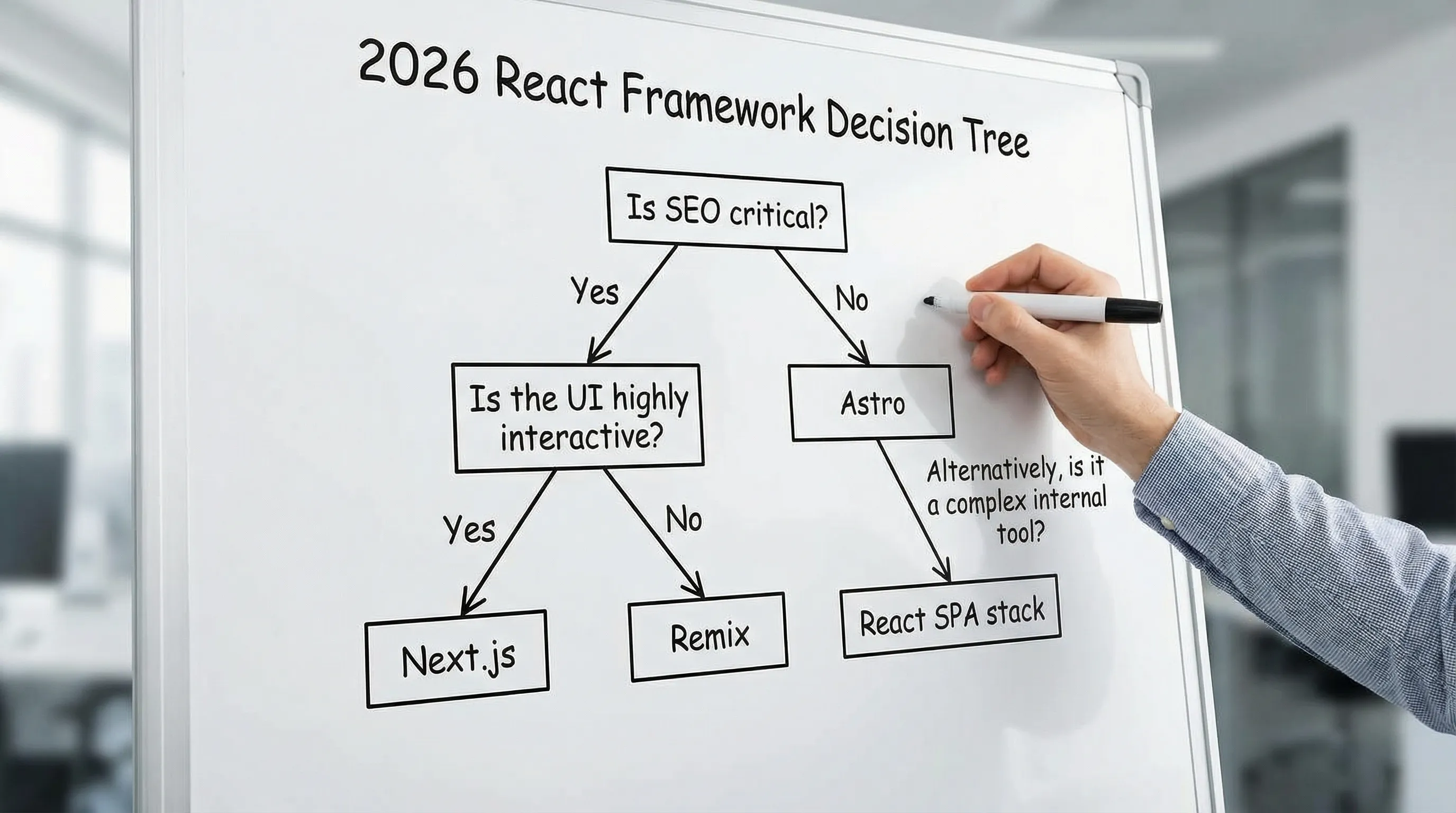
1) Do you need SEO and linkability for core routes?
If your critical acquisition or discovery flows rely on search engines (marketing pages, documentation, product-led growth landing pages), you want strong SSR/SSG support.
If your app is primarily behind authentication (internal tools, B2B dashboards), SEO matters less, and you can bias toward CSR simplicity where it makes sense.
2) Where should data loading and caching live?
Your options form a spectrum:
- Client-first data fetching: flexible, but can produce waterfalls and requires careful caching discipline.
- Route-level server data loading: often reduces waterfalls and centralizes caching, auth, and error handling.
- Hybrid: server for initial view, client for interaction.
Frameworks differ mainly in how much structure they impose here.
3) What is your deployment reality?
Be honest about where this will run:
- A managed platform with opinionated primitives
- Your own containers on Kubernetes
- Traditional VMs
- A constrained enterprise environment
If you cannot adopt a provider-specific hosting model, prioritize portability and operational clarity.
4) What is your auth and security boundary?
For many products, the most important architectural question is: where do secrets live, and where are permissions enforced?
A framework that encourages server-side authorization checks (and makes it difficult to leak secrets into the browser bundle) reduces risk.
5) How interactive is the UI?
Highly interactive experiences (rich forms, complex tables, drag and drop, real-time collaboration) often benefit from a client-heavy approach with disciplined state management.
Content-heavy experiences benefit from server rendering, streaming, and minimizing client JS.
6) How many teams will touch this codebase?
As the number of contributors grows, you need:
- Convention over configuration
- Clear routing and module boundaries
- Predictable testing and preview environments
- Strong upgrade paths
Framework conventions are a coordination tool.
7) What is your expected lifespan and upgrade appetite?
If you are building a product intended to live 5 to 10 years, optimize for:
- A stable ecosystem
- A clear path for incremental migration
- Avoiding deep coupling to experimental patterns
The main React framework options in 2026 (explained)
There is no single “best” choice. There are best fits.
React SPA stack (Vite + router + data library)
This is the “build your own framework” option. You typically combine React with:
- A bundler/dev server (commonly Vite)
- A router
- A server-state library (for example, TanStack Query)
- A form and validation setup
When it wins: authenticated applications, internal tools, and products where you control entry points and do not need broad SEO.
Main risk: you must intentionally design server boundaries, caching, and security flows. Without strong standards, teams end up with inconsistent patterns across the app.
Wolf-Tech’s take in practice: if you go this route, treat the “framework layer” as a product. Standardize the toolkit and quality gates (their companion guide on production UI tooling is useful context: React tools for production UIs).
Next.js (React framework)
Next.js is the most widely adopted React meta-framework in production. It is a strong default when you want an integrated answer to routing, rendering, and full-stack concerns.
When it wins:
- Mixed rendering needs (marketing + app)
- Performance-sensitive public routes
- Teams that benefit from a well-trodden ecosystem
Trade-offs:
- You must learn and enforce server vs client boundaries
- You need discipline around caching and data fetching patterns
If your decision is specifically “React vs Next.js”, Wolf-Tech already has a dedicated decision guide you can use as a deeper companion: Next.js and React: a decision guide for CTOs.
Remix (React framework)
Remix is built around web platform fundamentals (forms, requests, responses) and route-based data loading. Many teams like it because it pushes complexity toward the server in a way that can be easier to reason about.
When it wins:
- Data-driven apps where route-level loading reduces client complexity
- Teams that want strong progressive enhancement ergonomics
- Scenarios where you want portability across runtimes
Trade-offs:
- Smaller ecosystem footprint than Next.js (still solid, but less “default choice”)
- Some teams need time to adapt to its conventions if coming from SPA-first patterns
Gatsby (React framework for static-first sites)
Gatsby remains a static-first choice for content-heavy sites where build-time generation and plugin-driven data sourcing are central.
When it wins:
- Content sites that can be generated ahead of time
- Teams that benefit from a static deployment model
Trade-offs:
- Dynamic, per-user experiences often push you into hybrid patterns, which can erode Gatsby’s main advantage
Astro (content-first web framework that supports React)
Astro is not “a React framework” in the strict sense, but it is commonly evaluated alongside React frameworks because it can render React components as islands inside a content-first application.
When it wins:
- Documentation, marketing, content portals
- Teams optimizing for minimal client JavaScript by default
Trade-offs:
- If your app is primarily an interactive SPA, Astro’s strengths matter less
Quick comparison table (what to optimize for)
Use this as a starting point, then validate with a thin vertical slice.
| Option | Best for | Rendering posture | Operational posture | Typical risks |
|---|---|---|---|---|
| React SPA stack | Authenticated apps, internal tools, complex interaction | CSR first, SSR only if you add it intentionally | Very portable, you own conventions | Inconsistent patterns, performance regressions, DIY SSR complexity |
| Next.js | Mixed marketing + app, performance-sensitive web products | Hybrid SSR/SSG/CSR (framework-led) | Strong ecosystem, integrated defaults | Mismanaged caching, blurred server/client boundaries |
| Remix | Data-driven apps, web fundamentals, server-centric workflows | SSR-first with route loaders/actions | Often portable across runtimes | Smaller talent pool, convention shift for SPA teams |
| Gatsby | Content sites, static-first delivery | SSG-first | Simple static hosting | Hybrid complexity for dynamic user experiences |
| Astro + React | Content portals with interactive islands | Static-first, island hydration | Simple deployments, minimal JS | Not ideal as the core for highly interactive apps |
Scenario-based recommendations (pragmatic defaults)
Public marketing site plus a product app
A common 2026 pattern is “public site + authenticated app.” Your decision is really about whether you want one unified framework or two specialized surfaces.
- If you want one integrated codebase and consistent conventions, Next.js is often the simplest default.
- If the authenticated app is extremely interaction-heavy and the public site is relatively small, a split can work well (content-first framework for marketing, React SPA for the app), but you must manage shared design system and auth boundaries carefully.
B2B SaaS dashboards (behind login)
If SEO is not a requirement and your UI is complex, you can bias toward a React SPA stack with strong standards.
What matters most here is not SSR, it is:
- Change safety (TypeScript, tests, CI quality gates)
- Predictable server-state management
- Robust error handling and observability
E-commerce and transactional flows
These apps are usually performance-sensitive, SEO-sensitive, and operationally unforgiving.
- Favor a framework that makes SSR/SSG, caching, and server-side auth straightforward (commonly Next.js or Remix, depending on team preference and runtime needs).
- Validate the end-to-end critical path early: product page, cart, checkout, account.
Documentation sites and developer portals
Documentation values fast navigation, good SEO, and minimal JS.
- Astro + React islands is a strong fit when most pages are content.
- If docs must be deeply integrated with an app in the same repo and share runtime behavior, Next.js can still be the most straightforward.
Incremental modernization of a legacy React app
If you have a mature CSR app with lots of interaction, do not treat “moving to a framework” as a rewrite. The safe approach is incremental:
- Identify a thin vertical slice you can render server-side without destabilizing the rest.
- Establish performance budgets, telemetry, and rollback plans.
If you are already leaning Next.js, Wolf-Tech’s deeper implementation guides may help you avoid common migration traps: Next.js best practices for scalable apps.
A 2-week evaluation plan that prevents expensive mistakes
Most teams fail here by “trying the framework” with a toy demo. Instead, run a thin slice that resembles production.
Step 1: pick one real workflow
Choose a workflow that forces the hard decisions:
- Authenticated route with role-based access
- Data loading that can produce waterfalls
- At least one mutation (create/update)
- Error and empty states
Step 2: define measurable acceptance criteria
Keep it small and testable:
- A page-level performance target (TTFB range, LCP goal, bundle budget)
- A caching story you can explain in one paragraph
- A deployment approach with a rollback mechanism
- Minimum security baseline (secrets, headers, dependency scanning)
Step 3: validate operability, not just developer experience
A framework “works” only if you can run it like a product:
- Logging, metrics, and error monitoring are wired
- CI builds are reproducible
- Preview environments exist (or you have an alternative)
- You can answer, “what changed?” after a release
If you want a broader capability-based lens for 2026 web choices, this pairs well with Wolf-Tech’s general guide: Web development technologies: what matters in 2026.
Common mistakes when choosing a React framework
Mistake 1: treating “framework choice” as a one-time decision
Your product will evolve. Make sure the framework supports incremental change (new routes, new data needs, new teams) without forcing a platform migration every year.
Mistake 2: optimizing for local DX while ignoring production costs
A pleasant dev server is not a production strategy. The expensive surprises usually come from:
- Caching that is hard to reason about
- Server/client boundary mistakes that leak data or bloat bundles
- Inconsistent data fetching patterns
- Lack of observability when something breaks
Mistake 3: letting the framework become your architecture
Frameworks solve app delivery mechanics, not domain complexity. You still need:
- Clear bounded contexts (even inside a frontend)
- A stable API and data contract strategy
- A delivery system that enforces quality
If you are scaling teams and want to standardize wisely, this Wolf-Tech guide is relevant: Software development technology: what to standardize first.
A simple “right fit” checklist you can use in stakeholder conversations
When you need alignment across product, engineering, and leadership, keep it concrete. A react framework is a good fit if it:
- Matches your top two user journeys (SEO vs app-like interaction)
- Has a caching and data loading model your team can explain and test
- Fits your deployment reality and compliance constraints
- Supports your team topology (single team vs multi-team)
- Has an upgrade story you can sustain for the product’s lifespan
Where Wolf-Tech can help
If you are deciding between React SPA, Next.js, Remix, or a content-first approach, the most valuable support is usually not “picking the tool.” It is designing a thin-slice evaluation, surfacing operational risks early, and setting standards that keep velocity high without production surprises.
Wolf-Tech provides full-stack development and consulting across architecture, code quality, legacy optimization, and cloud/DevOps. If you want a second opinion on your React framework choice (or a safe migration plan), you can explore their approach at Wolf-Tech and dig deeper into their framework-specific guidance in the linked articles above.