
Web Development Technologies: What Matters in 2026

Sandor Farkas
Founder & Lead Developer
Expert in software development and legacy code optimization
LinkedIn
Choosing web development technologies in 2026 is less about chasing “the latest” and more about building a stack that stays fast, secure, and maintainable under real production pressure. Most teams do not fail because they picked the “wrong framework”, they fail because their technology choices do not match their constraints: delivery speed, compliance, integrations, data growth, reliability targets, and team shape.
This guide focuses on what actually matters in 2026, the technology capabilities you should prioritize, and a pragmatic way to evaluate options without turning stack selection into a months-long debate.
The 2026 reality: technology is a delivery system, not a shopping list
Web stacks have matured. Frontend frameworks are broadly capable, cloud platforms are feature-rich, and there are multiple “good” backend choices. The differentiator is how well your stack supports:
- Safe, frequent change (shipping without fear)
- Predictable performance for users
- Security and compliance by default
- Operability (debuggability, incident response)
- Longevity (upgrades, hiring, vendor risk)
If you pick technologies based only on popularity, you usually end up paying later in rewrites, incident load, or stalled delivery.
What matters most in 2026 (the 7 capability tests)
A useful way to evaluate web development technologies is to score them against seven capability tests. These are technology-agnostic, which helps you avoid “framework wars”.
1) Change velocity with quality gates
In 2026, the best teams treat delivery as a product. That means:
- CI that runs fast and is trusted
- Automated tests that catch regressions early
- Consistent code quality checks (linting, type checks, static analysis)
- Preview environments for every change (where practical)
Technology choices that slow CI, make local development fragile, or encourage large, risky releases will bottleneck your organization.
If you want a concrete baseline, Wolf-Tech’s guide on CI/CD technology is a strong starting point.
2) Performance that maps to user experience (not just benchmarks)
Performance in 2026 is measured in user outcomes, not synthetic scores. Core Web Vitals remain the practical standard for most products, especially content-heavy or conversion-sensitive apps. Google’s reference is a good baseline: Core Web Vitals on web.dev.
What to look for in technologies:
- Rendering strategies that fit your routes (SSR, SSG, streaming, partial hydration)
- Predictable caching and invalidation
- Control over client-side JavaScript weight
- Tooling for measurement (RUM, profiling, trace correlation)
If you are running Next.js, Wolf-Tech has deep, tactical guides on Next.js best practices for scalable apps and performance tuning.
3) Security and supply-chain integrity by default
Security expectations have moved “left” into the build pipeline. In 2026, you should assume you need:
- Dependency and container scanning
- Secrets management (no secrets in repo or CI logs)
- SBOM generation and artifact provenance (in regulated or enterprise contexts)
- Strong authentication and authorization primitives
Two widely referenced baselines worth aligning to are:
- OWASP Top 10 for common web risks
- NIST Secure Software Development Framework (SSDF) for organizational practices
Technologies that make authorization invisible or ad hoc (for example, scattered logic with no policy model) tend to become a long-term liability.
4) Reliability and operability (how fast you can diagnose and recover)
Most “scaling problems” are actually reliability and operability problems. In 2026, a production-ready stack should make it easy to:
- Set SLIs/SLOs and track error budgets
- Trace requests across services, queues, and databases
- Implement timeouts, retries, and idempotency safely
- Run progressive delivery (canary, blue/green) with fast rollback
If this is a priority, Wolf-Tech’s backend reliability best practices pairs well with their architecture review checklist.
5) Data and integration fit (where projects quietly fail)
In 2026, the hard part is rarely CRUD, it is integrations and data correctness:
- Identity (SSO/OIDC), permissions, tenancy
- Payments, messaging, e-signature, CRM/ERP
- Event-driven flows and audit requirements
- Data migrations and backward compatibility
When evaluating technologies, ask: “How do we safely evolve schemas, APIs, and contracts without breaking clients?” If the answer is hand-wavy, you have a risk.
If GraphQL is on the table, it is powerful but not free. Wolf-Tech’s guide on GraphQL APIs: benefits, pitfalls, and use cases is a practical decision aid.
6) Cost control and platform leverage (FinOps as engineering hygiene)
Cloud cost in 2026 is tightly coupled to architecture decisions:
- Data access patterns and caching strategy
- Workload shape (spiky vs steady)
- Observability volume and retention
- Inefficient CI and preview environments
The goal is not “cheap infrastructure”, it is predictable cost per unit of value (per customer, per transaction, per workflow). Technologies that encourage “always on, always maxed” infrastructure without clear SLO-driven sizing will inflate your total cost of ownership.
7) Longevity: upgrades, hiring, and exit options
A stack is long-lived whether you intend it or not. Evaluate:
- Upgrade paths and ecosystem stability
- Availability of experienced engineers
- Vendor lock-in risks (especially with proprietary PaaS features)
- Fit with your organization’s governance model
This is where “boring technology” often wins: not because it is exciting, but because it is survivable.
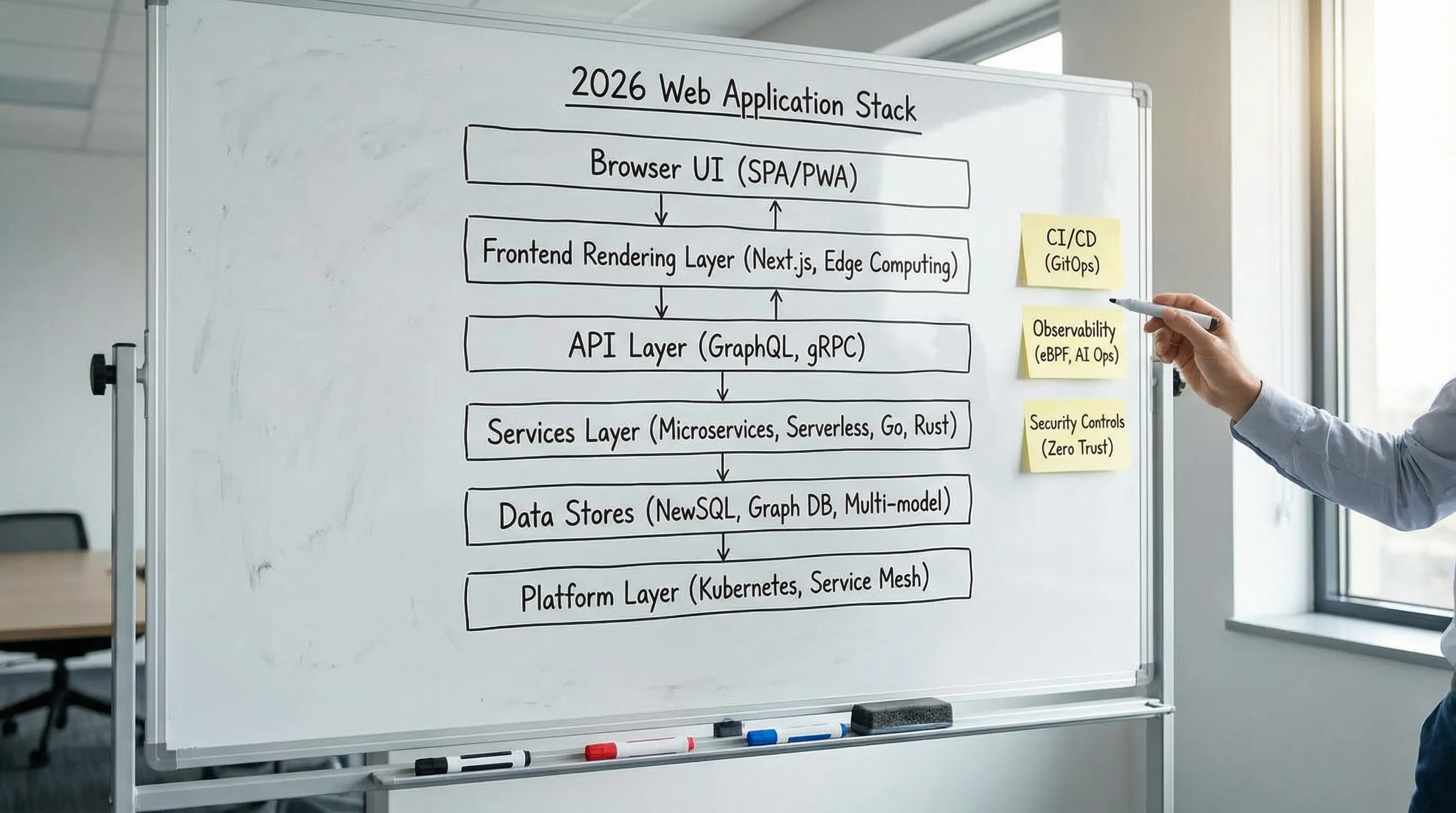
The 2026 web stack map (what to prioritize by layer)
Rather than naming a single “best” stack, it is more useful to know what strong teams standardize on across layers.
Frontend: user experience architecture is the real decision
In 2026, the frontend question is usually not “React vs X”, it is:
- What rendering modes do we need per route?
- How do we keep client JavaScript small and intentional?
- How do we handle data fetching, caching, and mutations predictably?
Common 2026 defaults that tend to work well:
- Type safety end-to-end (often TypeScript on the client, typed contracts on the API)
- A framework that supports SSR/SSG/streaming where needed (especially for public-facing apps)
- A design system approach for consistency and speed
If you are building with Next.js App Router, Wolf-Tech’s real product patterns can help avoid common production traps.
Backend: optimize for change safety and domain clarity
Backend technologies have a wide “acceptable set” in 2026. What matters more:
- Strong boundaries (modular design, clear domain ownership)
- Excellent tooling for testing and observability
- A security model you can reason about
- Migration paths for data and integrations
If you are in PHP and deciding between major frameworks, Wolf-Tech’s Symfony vs Laravel guide is a helpful example of choosing based on governance and long-term architecture rather than speed alone.
APIs and contracts: consistency beats novelty
In 2026, API problems are mostly governance problems:
- Versioning and deprecation policy
- Backward compatibility discipline
- Contract tests for critical consumers
- Rate limiting, authZ checks, and abuse protection
REST remains a solid default. GraphQL can be a strong fit for complex client needs, but only if you invest in query cost controls, caching strategy, and authorization design.
Data layer: correctness and evolution are the core features
When selecting data technologies, prioritize:
- Constraints and migrations you can run safely
- Observability into slow queries and contention
- A clear approach to read models and reporting
- A plan for data growth and retention
If you have legacy constraints, “database modernization” is often a sequence of low-risk steps rather than a big-bang move. Wolf-Tech’s legacy modernization techniques and legacy refactoring strategies cover pragmatic paths.
Platform: IaC, GitOps, and production readiness as defaults
In 2026, infrastructure is increasingly “defined”, reviewed, and promoted like application code:
- Infrastructure as Code (IaC)
- Policy-as-code where compliance demands it
- Repeatable environments (including ephemeral ones when feasible)
Wolf-Tech’s guide to infrastructure automation from scripts to IaC is a practical overview of how teams evolve here.
A pragmatic decision table: match technologies to product shape
Use this table as a starting point for aligning web development technologies to what you are building. It is intentionally “capability-first” rather than tool-first.
| Product shape (2026) | What usually matters most | Technology capabilities to prioritize | Common pitfalls to avoid |
|---|---|---|---|
| Public marketing site with lead capture | SEO, fast LCP/INP, content updates | SSR/SSG, image optimization, minimal JS, CMS integration | SPA-by-default, heavy third-party scripts, poor caching |
| B2B dashboard (internal or customer-facing) | Permissions, data correctness, UX consistency | Strong authZ model, typed APIs, robust forms, observability | Hidden authorization, inconsistent UI patterns, slow builds |
| Workflow app with many integrations | Reliability, contract stability, auditability | Idempotency, background jobs, API governance, event/outbox patterns | Tight coupling to vendors, no replay strategy, brittle migrations |
| High-scale consumer app | Cost-performance, resilience, traffic spikes | Caching, horizontal scaling strategy, progressive delivery, RUM | Over-microservices early, premature edge complexity, weak SLOs |
How to evaluate web development technologies quickly (without guessing)
A fast, low-regret evaluation method in 2026 is a thin vertical slice: one meaningful user journey, end-to-end, in production-like conditions. The point is to validate the hard parts early.
Your slice should prove:
- Value: the user journey delivers a measurable outcome
- Feasibility: the hardest integration, data flow, or permission model works
- Operability: logs, metrics, tracing, and runbooks exist from day one
- Change safety: CI gates and rollback paths are in place
Wolf-Tech covers this approach in multiple places, including their MVP checklist and build a web application step-by-step checklist.

The biggest mistakes teams make in 2026
Treating stack choice as a one-time decision
In reality, you are choosing an upgrade and governance path. The best teams plan for:
- Dependency updates as routine work
- Compatibility testing and deprecation windows
- A policy for introducing new tools (with ownership)
Optimizing for developer speed while ignoring operability
Fast local development does not matter if production is hard to debug. Make observability a non-negotiable requirement, regardless of language or framework.
Microservices or “distributed everything” too early
Unless your org already has mature platform capabilities, a modular monolith is often the most reliable way to ship quickly with clear boundaries. You can split later when there is a proven scaling or ownership need.
Under-investing in code quality signals
In 2026, maintaining velocity requires a small set of metrics that predict drift (complexity hotspots, flaky tests, review latency, defect escape rate). Wolf-Tech’s guide on code quality metrics that matter is a practical way to operationalize this.
Frequently Asked Questions
What are the most important web development technologies in 2026? The “most important” are the ones that improve outcomes for your specific product: a delivery system (CI/CD), observability, secure identity and authorization, predictable rendering and caching, and a data layer you can evolve safely.
Is Next.js still a good choice in 2026? It can be, especially when you need strong SEO, flexible rendering (SSR/SSG), and performance controls. The key is to use it with clear server vs client boundaries, caching discipline, and measurement-driven performance work.
Should we use microservices for a new product in 2026? Not by default. Many teams ship faster and safer with a modular monolith first, then split capabilities when there is a clear scaling, autonomy, or failure-isolation reason, and when platform maturity supports it.
How do we choose technologies without getting stuck in analysis paralysis? Run a thin vertical slice that proves the hardest constraints (auth, integrations, data migrations, performance budgets, observability) and use a weighted scorecard tied to your non-functional requirements.
How do we modernize legacy web systems while adopting newer technologies? Prefer incremental modernization: create seams, lock behavior with tests, introduce safer delivery, then replace components progressively. Big-bang rewrites usually increase risk unless constraints are exceptionally clear.
Need a 2026-ready stack you can actually operate?
Wolf-Tech helps teams design, build, and modernize production-grade web platforms with a pragmatic focus on performance, security, reliability, and long-term maintainability. If you want an evidence-based recommendation (not a trendy stack), start with a technology and architecture assessment, or a thin-slice proof of concept.
Explore Wolf-Tech’s approach to choosing a tech stack or contact the team at wolf-tech.io to discuss your goals and constraints.