
Symfony PHP: When It Beats Laravel

Sandor Farkas
Founder & Lead Developer
Expert in software development and legacy code optimization
LinkedIn
If you are choosing a PHP framework in 2026, the Symfony vs Laravel debate is less about “which is better” and more about which one reduces risk for your specific system, team, and time horizon. Laravel is often the fastest path to a productive app with strong conventions. Symfony is often the safest path to a long-lived platform with strict architecture, heavy integration needs, and multiple teams.
This guide focuses on the decision behind the headline: Symfony PHP: when it beats Laravel.
Symfony vs Laravel in one sentence
Symfony beats Laravel when you need maximum architectural control, long-term maintenance guarantees, and composable components for complex domains.
Laravel tends to win when you want a batteries-included product framework with strong conventions and fast delivery for common web app patterns.
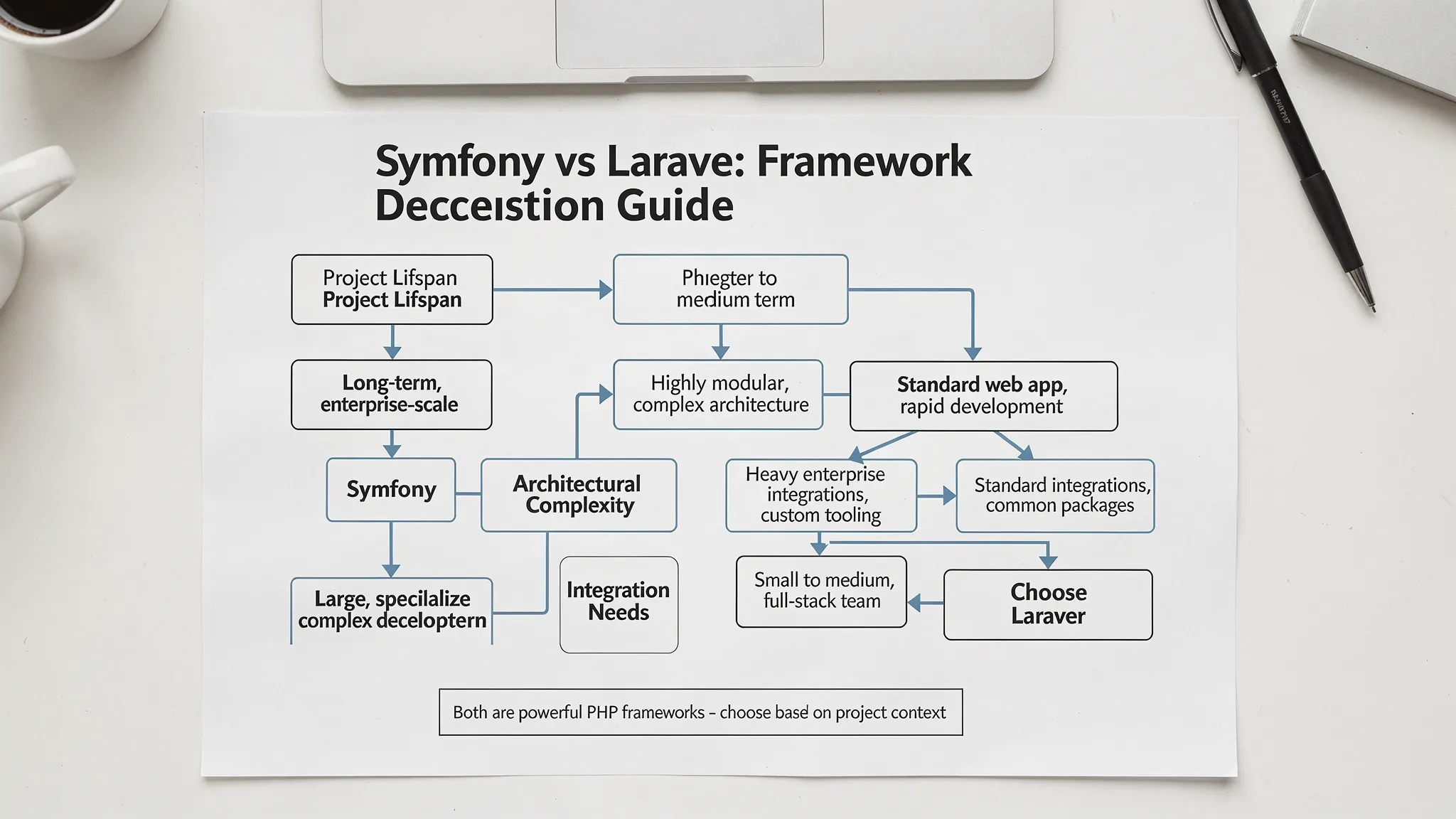
A practical decision snapshot (use this before you go deep)
Use this quick matrix to sanity-check your direction.
| Decision factor | Symfony usually wins when… | Laravel usually wins when… |
|---|---|---|
| Time horizon | The codebase should stay healthy for 5 to 10+ years, with predictable upgrades | You optimize for speed to first release and rapid iteration |
| Architecture needs | You need strict boundaries (DDD, modular monolith, multiple bounded contexts) | You are happy to follow framework conventions and ship |
| Team topology | Many teams, different skill levels, and strong governance requirements | A small to mid team can align on one “Laravel way” |
| Integration complexity | Many external systems, multiple databases, complex workflows, async messaging | Standard CRUD + common integrations are the bulk of the work |
| Framework flexibility | You want to choose patterns (not inherit them), and swap pieces deliberately | You want a cohesive out-of-the-box stack |
| Enterprise constraints | Compliance, security review, strict dependency policies | Fewer governance constraints, faster product cycles |
If most of your answers land on the Symfony side, Symfony PHP is often the more resilient choice.
Why Symfony is different (and why that matters)
Symfony is best understood as two things:
- A full-stack framework for building web applications.
- A large set of reusable components (HTTP, DI container, console tooling, security, messenger, serializer, etc.) that you can compose into your own architecture.
Laravel is also built on many Symfony components (for example HTTP foundation and routing concepts), but Laravel’s value is primarily the opinionated, integrated developer experience.
So the core tradeoff is:
- Symfony: composability, explicit architecture, long-term maintenance patterns.
- Laravel: speed, conventions, “batteries included” productivity.
When Symfony PHP beats Laravel (the real-world scenarios)
1) You are building a long-lived platform, not just an app
If you expect the system to become a business-critical platform, the biggest cost will not be version 1. It will be the next 200 releases.
Symfony tends to shine when:
- The application will be maintained by multiple generations of developers.
- You need a framework that encourages explicit boundaries and predictable extension points.
- You want to keep business logic insulated from framework-specific magic.
A key practical detail here is support policy. Symfony has a defined release process including LTS releases (see the official Symfony Release Process). Laravel has its own support policy with defined bug fix and security windows (see the official Laravel Support Policy).
Even if you do not choose based on support windows alone, having an explicit maintenance story is crucial for risk management.
2) You need strong modularity and clear boundaries (DDD-friendly by design)
In complex domains (billing, underwriting, logistics, healthcare workflows, marketplaces), success depends on keeping the domain model clean as requirements change.
Symfony typically beats Laravel when you want:
- A modular monolith with strict module boundaries.
- A layered architecture where the domain is not coupled to controllers, ORM, or framework conventions.
- Clear dependency injection and explicit wiring, rather than “it resolves automatically” behavior.
Symfony’s DependencyInjection component and configuration approach can feel verbose at first, but that verbosity is often the point: it makes architecture visible and reviewable.
If you are already thinking in terms of “fracture planes,” seams, and incremental change, Symfony pairs well with disciplined modernization approaches (Wolf-Tech has a related guide on incremental change in code modernization techniques).
3) You have multiple apps and shared building blocks
Symfony is an excellent choice when you want to standardize components across:
- Multiple products for the same company.
- A portfolio of internal tools.
- Several APIs and back-office systems with shared authentication and domain services.
Because Symfony’s components are designed to be used independently, you can standardize on shared libraries (security, HTTP, validation, messaging) without forcing every team into one monolithic framework shape.
This becomes a major advantage when organizations grow and teams naturally diverge.
4) You need serious async and messaging patterns
Modern systems increasingly rely on asynchronous work: background processing, event-driven workflows, integration with external services, and reliable retries.
Symfony’s Messenger component provides a strong foundation for:
- Command and event buses
- Background jobs
- Retries and failure transports
- Multiple message backends
You can design the system so that “doing work” is naturally separated from request/response HTTP, which makes scaling and reliability easier.
If reliability is a top priority, the framework choice is only one part, but it should support the patterns you need (timeouts, retries, idempotency, backpressure, observability). Wolf-Tech covers the operational side in backend development best practices for reliability.
5) You want security that maps cleanly to enterprise requirements
Laravel can be secure when implemented properly. Symfony often wins in security-sensitive environments because its security system is explicit and highly configurable, and because it fits well with “security as architecture” thinking.
Symfony’s Security component and configuration model make it straightforward to:
- Model multiple firewalls and auth mechanisms
- Use fine-grained authorization rules
- Integrate enterprise identity providers
For teams that must pass security reviews, explicitness is a feature.
You can review the official Symfony Security documentation for how the system is structured.
6) You are modernizing a legacy PHP system incrementally
A very common “enterprise reality” is:
- A legacy PHP app
- Mixed patterns
- Multiple integration points
- A need to evolve without stopping the business
Symfony often beats Laravel when you want to modernize by replacing parts gradually (not rewriting everything) because:
- You can adopt Symfony components incrementally.
- You can introduce modern architectural seams without a full rewrite.
This fits well with conservative modernization approaches like the strangler pattern and thin-slice migrations (see Wolf-Tech’s guide: modernizing legacy systems without disrupting business).
7) Your engineering org values explicit quality gates and tooling
Symfony projects often pair naturally with:
- Strong static analysis
- Architecture constraints
- Explicit dependency injection
- High test coverage and contract testing
This is not exclusive to Symfony, but Symfony’s style often makes it easier to enforce consistent standards across teams.
If you care about predictable delivery and maintaining velocity as the codebase grows, align the framework decision with measurable engineering outcomes. Wolf-Tech’s code quality metrics is a useful companion read.
A deeper comparison: what Symfony gives you that matters at scale
Below are the practical “scale levers” where Symfony is frequently the safer bet.
Architectural control (less magic, more design)
Symfony tends to keep your hand closer to the steering wheel:
- You can define how dependencies are composed.
- You can isolate domain logic from the framework.
- You can keep boundaries strong even as teams expand.
Laravel’s productivity often comes from conventions and syntactic convenience. That is great until your system needs to diverge from the default path.
Predictable extension points
Large systems depend on predictable extension mechanisms:
- Middleware, event subscribers, compiler passes
- Clear configuration
- Swappable implementations
Symfony’s ecosystem has matured around extension and composition.
“Components-first” reuse
This is one of Symfony’s strongest strategic advantages.
Even if you do not standardize on the full Symfony framework, standardizing on Symfony components can reduce fragmentation in a multi-team organization.
You can explore the component ecosystem directly in the official Symfony Components documentation.
When Laravel is the better choice (so you do not over-engineer)
Symfony beats Laravel in specific circumstances, but it is not automatically the best default.
Laravel is often the better choice when:
- You need to move fast with a small team.
- The product is early, and requirements are still fluid.
- The application is primarily CRUD with common patterns.
- You want strong conventions to minimize decision overhead.
If your goal is an MVP that proves value quickly, Laravel’s productivity advantage can be decisive.
A pragmatic rule: choose based on risk, not preference
Instead of picking based on “what the team likes,” frame it like a CTO:
- Delivery risk: How quickly can we ship without painting ourselves into a corner?
- Operations risk: How hard will this be to run, secure, and observe?
- Change risk: How expensive will changes be in year 3?
- Talent risk: Can we hire and onboard consistently?
If your biggest risk is time-to-market, Laravel is frequently the correct call.
If your biggest risk is long-term complexity, multi-team development, and platform longevity, Symfony PHP is frequently the correct call.
Implementation considerations if you pick Symfony
Choosing Symfony is only step one. The “Symfony wins” story typically depends on how you structure the codebase.
Start with an architecture baseline
Decide early whether you are aiming for:
- A modular monolith
- Multiple Symfony apps (bounded contexts) sharing libraries
- An API-first backend with separate frontends
If you want a structured way to make this decision, Wolf-Tech’s How to Choose the Right Tech Stack in 2025 approach (outcomes, non-functional requirements, scorecards, thin slices) transfers well to the Symfony vs Laravel decision.
Plan upgrades as a first-class requirement
The more “enterprise” your app becomes, the more upgrades become part of normal operations.
Whichever framework you choose, document:
- Your target versions
- Your dependency policy
- Your upgrade cadence nThis is less exciting than building features, but it prevents painful “stuck on an old version” outcomes.
Frequently Asked Questions
Is Symfony faster than Laravel? It depends on what you mean by “faster.” Laravel is often faster for initial development because it is convention-heavy and batteries-included. Symfony can be faster over the life of a complex system because it supports explicit architecture and modularity that reduce long-term change cost.
Is Symfony better for enterprise applications? Symfony is frequently a better fit for enterprise environments because of its component-based design, explicit configuration, and the way it supports multi-team governance. That said, an enterprise can succeed with Laravel too if the team establishes strong architectural and operational discipline.
Can I migrate from Laravel to Symfony later? You can, but a full framework migration is usually expensive. A more pragmatic approach is to introduce better boundaries, shared libraries, and incremental refactors first. In some cases you can adopt Symfony components inside existing PHP systems without migrating everything at once.
Does Symfony work well for APIs and microservices? Yes. Symfony is commonly used for APIs and service architectures, especially when you need explicit dependency wiring, strong security configuration, and reliable messaging patterns.
How do I choose between Symfony and Laravel for a new product in 2026? Start from business outcomes and constraints (time-to-market, compliance, integrations, team size, expected lifespan). If speed to first release is the primary constraint, Laravel is often the right default. If platform longevity and architectural control are primary constraints, Symfony is often the safer bet.
Need a second opinion on Symfony vs Laravel?
If you are selecting a framework for a business-critical build (or re-platforming an existing PHP system), a short architecture assessment can save months of rework.
Wolf-Tech helps teams design, build, optimize, and scale custom software across modern stacks, including full-stack development, code quality consulting, legacy optimization, and tech stack strategy.
If you want help pressure-testing the decision and mapping it to an actionable plan, explore Wolf-Tech at wolf-tech.io or start with a structured selection approach in How to Choose the Right Tech Stack in 2025.