
When to Choose Custom Solutions Over Off-the-Shelf

Sandor Farkas
Founder & Lead Developer
Expert in software development and legacy code optimization
LinkedIn
Choosing between custom software and an off‑the‑shelf product is not just a technical decision, it is a strategy call that shapes your cost structure, speed, and competitive advantage for years. In 2025, with mature SaaS ecosystems, low‑code platforms, and cloud primitives at your fingertips, the default is often to start with something prebuilt. Yet there are clear moments when a custom solution is the smarter, lower‑risk path long term.
This guide gives you a practical way to decide. You will learn when off‑the‑shelf is the fastest, safest move, when to lean into custom solutions, how to model total cost of ownership, and how to use hybrid approaches to reduce risk while you scale.
When off‑the‑shelf is the right call
Off‑the‑shelf software shines when you need proven, standard workflows and a fast time‑to‑value. If your requirement looks like a commodity capability that thousands of companies already use, you are likely to gain more by buying than building.
- Your process is conventional, for example support ticketing, basic CRM, standard payroll, or email marketing.
- Time is critical and you can accept the product’s default workflow to hit a deadline.
- Integrations are simple and supported by vendor connectors.
- Compliance needs are covered by the vendor’s certifications and data handling.
- Total user count is small to medium and per‑seat pricing will not crush your budget.
Starting with a product can unlock immediate value and reduce operational risk. Pair it with a small layer of configuration, lightweight scripts, or a thin service that adapts data and you can keep your stack simple. If you are at the exploration stage, this primer on fundamentals may also help you frame the solution shape, see What Is a Web Application? Simple Guide at https://wolf-tech.io/blog/what-is-a-web-application-simple-guide.
Clear signals you should choose a custom solution
There are recurring patterns where custom software becomes the responsible choice. They often map to differentiation, integration depth, economics at scale, or control of your roadmap.
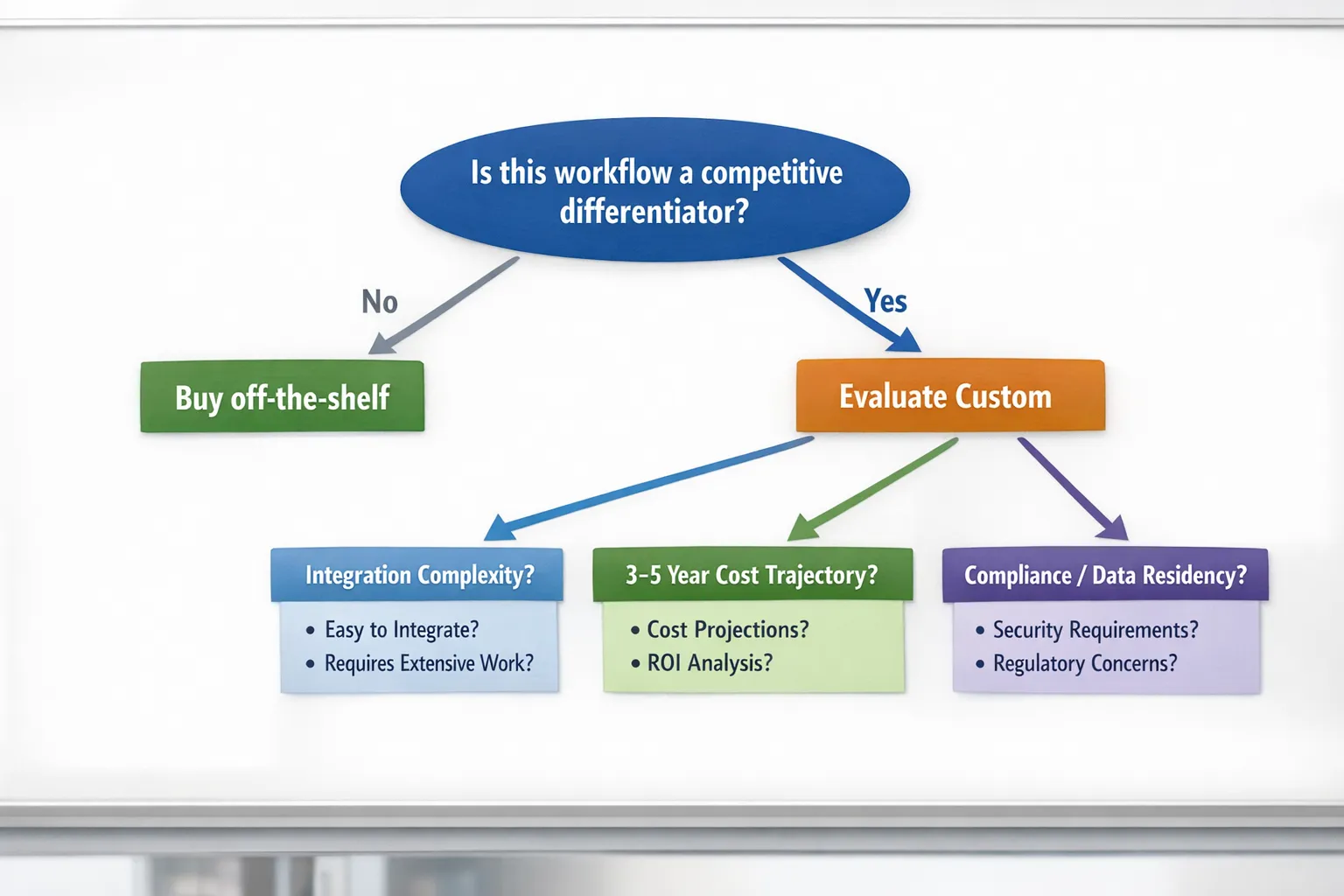
- Your workflow is a strategic differentiator, not a commodity. For example, a proprietary quoting engine, an underwriting model, or a logistics optimizer that gives you margin or speed advantages.
- Your data model is non‑standard, such as deeply nested product configurations, complex permissioning, or multi‑tenant hierarchies that off‑the‑shelf schemas cannot represent cleanly.
- You have heavy or unusual integrations, including legacy systems, event‑driven orchestrations, or real‑time constraints that exceed typical SaaS connectors.
- Performance or deployment constraints matter, for example strict latency SLOs, offline or edge operation, or data locality requirements.
- Vendor economics deteriorate as you scale. Per‑seat, per‑transaction, or overage fees outpace the cost of owning the core over a 3 to 5 year horizon.
- You need to control the roadmap, release cadence, and security posture rather than waiting on a vendor backlog.
If you are modernizing while you build new capabilities, you can also reduce risk by incrementally carving out value from legacy systems. See Refactoring Legacy Software: From Creaky to Contemporary at https://wolf-tech.io/blog/refactoring-legacy-software and Code Modernization Techniques: Revitalizing Legacy Systems at https://wolf-tech.io/blog/code-modernization-techniques for patterns that pair well with a custom strategy.
A simple decision matrix you can reuse
Use this table to take a quick position, then validate with a deeper TCO and risk review.
| Criterion | Off‑the‑shelf favors | Custom favors | Quick diagnostic question |
|---|---|---|---|
| Business process type | Commodity workflow | Differentiating workflow | Would you pitch this workflow to investors as part of your edge? |
| Time to value | Weeks to go live | Months for a precise fit | Is a near‑term deadline worth compromising fit? |
| Integration complexity | Few, standard connectors | Many systems, legacy APIs, event orchestration | Do you need orchestrations vendors cannot support? |
| Data model complexity | Standard entities | Complex domain and permissions | Does your domain break conventional schemas? |
| Scale and performance | Moderate usage | High throughput, low latency, offline/edge | Are your SLOs beyond typical SaaS targets? |
| Compliance and data residency | Vendor certifications are sufficient | Unique controls or data sovereignty | Do you need to control the data plane directly? |
| 3 to 5 year cost | License beats build | License growth or customization sprawl | Will recurring fees outpace build and maintenance? |
| Roadmap control | Vendor roadmap aligns | You must own priorities | Do you need release control and guaranteed features? |
| UX and brand | Accept default UI | Branded, device‑specific, or offline UX | Will UX materially impact conversion or retention? |
| Lock‑in tolerance | Comfortable with ecosystem | Prefer portability | Would switching cost be unacceptable later? |
Modeling total cost and payback without guesswork
A grounded decision needs a cost and value model that looks past first‑year license stickers. Use a three to five year view and include hidden costs on both sides.
For off‑the‑shelf, your TCO typically includes: licenses and overages, implementation and change management, integration and data pipelines, customization or plugins, vendor support tiers, security reviews, and the cost of vendor constraints such as features that never ship.
For custom solutions, TCO typically includes: discovery and product work, engineering time for build and integration, cloud and platform costs, observability and security hardening, ongoing maintenance and enhancements, and opportunity cost during the initial build.
A quick approach that leaders find useful:
- Define value drivers as measurable outcomes, for example cycle time reduction, error rate reduction, increased conversion, lower COGS, or fewer manual hours.
- Quantify each driver with a baseline and a target, then translate to annualized dollar impact.
- Estimate off‑the‑shelf TCO with realistic seat growth and integration complexity. Include your most likely plugin or customization needs and vendor roadmap gaps.
- Estimate custom TCO with a thin vertical slice plan, not a big‑bang rewrite. Break the build into deployable milestones so value starts appearing early.
- Compare payback periods and NPV across both paths. The break point often appears when usage scales or when vendor constraints suppress value creation.
For teams choosing tech foundations to support a custom path, this guide can help you weigh trade‑offs, see How to Choose the Right Tech Stack in 2025 at https://wolf-tech.io/blog/how-to-choose-the-right-tech-stack-in-2025.
Hybrid patterns that de‑risk the decision
You do not need to choose only one approach. Many successful teams combine both.
- Compose systems, use off‑the‑shelf for commodity functions and custom services for your differentiators. Keep your data contracts clean at the boundaries.
- Wrap and extend, place a thin service layer between SaaS and your core so you can swap vendors later without a full rewrite.
- Strangle and replace, migrate capability by capability from a packaged app to custom services as value proves out. This reduces change risk and preserves business continuity. See Refactoring Legacy Applications: A Strategic Guide at https://wolf-tech.io/blog/refactoring-legacy-applications for stepwise execution ideas.
This hybrid mindset keeps optionality high and reduces lock‑in while still giving you fast wins.
An analogy from another domain
Founders often find it helpful to think about vendor selection the way they think about manufacturing. Early on, a one-stop partner with integrated services can compress learning curves, reduce coordination risk, and deliver predictable quality. In software, the equivalent is engaging a full-stack partner for your custom work so you get architecture, development, DevOps, QA, and delivery management aligned to business outcomes.
Industry snapshots: when custom wins
Healthcare and life sciences. If your workflow touches PHI, requires fine‑grained access controls, or needs to operate in specific regions for data residency, you often need a custom application with strong auditability and a clear separation of data layers. Vendor features can augment non‑core functions like scheduling or messaging, but the core logic, traceability, and governance usually merit custom ownership.
E‑commerce and marketplaces. For storefront and catalog basics, platforms are great. The moment you cross into complex pricing, bundling, subscriptions with proration, multi‑vendor settlement, or real‑time inventory spanning online and offline, custom services around the platform protect margins and enable growth. If you are considering a modern web architecture for performance at scale, review Next.js Best Practices for Scalable Apps at https://wolf-tech.io/blog/next-js-best-practices-for-scalable-apps.
Fintech and insurance. Proprietary underwriting, fraud detection, or reconciliation flows are core IP. Custom systems help you tune data models, control latency budgets, and certify compliance boundaries. Off‑the‑shelf can still power CRM or marketing, but the financial core benefits from owning the roadmap.
Manufacturing and field operations. Offline‑first mobile apps, IoT telemetry, and routing optimizations make packaged software feel rigid. A custom approach lets you push compute to the edge, design resilient sync, and optimize for safety and throughput.
Common anti‑patterns to avoid
- Customizing a packaged tool until it becomes an unmaintainable pseudo‑platform. If you are writing bespoke code inside a vendor product just to mirror your process, you are likely past the tipping point.
- Building a custom solution for a commodity problem because you could not find the configuration settings in a mature product. Validate the requirement and the configuration before coding.
- Ignoring vendor roadmaps and upgrade policies. If an off‑the‑shelf tool does not have a plausible path to your target state, do not bank on promises.
- Rebuilding a legacy system feature for feature. If you choose custom, embrace the opportunity to simplify, modularize, and retire low‑value functionality.
A note on no‑code and low‑code in 2025
Modern low‑code platforms can cover many internal workflows and as a front end to APIs. They are excellent for prototyping, admin portals, and internal tooling. The limits typically appear around complex domain logic, multi‑tenant security, and performance under load. A pragmatic approach is to start here for non‑core tasks and reserve custom builds for the heart of your product.
Implementation checklist to reduce regret later
Before you commit, align stakeholders on these points:
- Define what must be uniquely yours and what can be standardized.
- Decide the boundary between off‑the‑shelf and custom and document data contracts.
- Set measurable outcomes, SLOs, and a 90‑day plan for first value.
- Establish an observability baseline and security guardrails from day one.
For vendor selection, this rubric can help you probe depth and execution quality, see Top Traits of Web Application Development Companies at https://wolf-tech.io/blog/top-traits-of-web-application-development-companies.
Frequently Asked Questions
Is custom software always more expensive than off‑the‑shelf? Not necessarily. Off‑the‑shelf is often cheaper in year one. Over a three to five year horizon, license growth, plugin sprawl, and process workarounds can exceed the cost of owning a focused custom solution. A TCO model with realistic growth assumptions will reveal the inflection point.
How long does a custom build take? It depends on scope and integration complexity. Many teams ship a thin vertical slice in 6 to 10 weeks, then iterate to add capabilities. A staged plan reduces risk and starts value earlier than a big‑bang rewrite.
Where do low‑code platforms fit? They are great for internal tools and simple workflows. As domain complexity, performance targets, or security needs grow, custom code typically takes over selective capabilities while low‑code remains for admin and orchestration.
How can we reduce vendor lock‑in if we buy? Introduce a small abstraction layer between vendor APIs and your core. Keep your data model portable, export data regularly, and avoid deep proprietary customizations that cannot be replicated elsewhere.
Can we start with off‑the‑shelf and migrate to custom later? Yes. Many teams start with a product for speed, then incrementally replace pieces with custom services using a strangler approach. With well‑defined interfaces, the transition can be smooth.
Work with Wolf‑Tech
If you are weighing custom solutions against off‑the‑shelf tools, Wolf‑Tech can help you make a clear, data‑driven decision and execute with confidence. Our team brings 18 years of full‑stack delivery across custom software and web applications, code quality consulting, legacy optimization, tech stack strategy, cloud and DevOps, and database and API solutions. We also build industry‑specific digital solutions that map to your regulatory and operational needs.
Start with a short discovery to frame the decision, model TCO, and outline a low‑risk delivery plan. Contact Wolf‑Tech at https://wolf-tech.io.