
Custom Software Development Cost in 2026: What Drives Price and How to Budget Realistically

Sandor Farkas
Founder & Lead Developer
Expert in software development and legacy code optimization
LinkedInCustom software development in the EU in 2026 typically costs 500 to 1,100 EUR per engineer-day, and a real B2B SaaS MVP tends to land in the low-to-mid six figures once discovery, infrastructure, migration, training and post-launch support are counted alongside the build. The biggest price drivers are scope clarity, the number of integrations and the non-functional bar (security, compliance, uptime), not the feature list. AI-assisted development speeds up parts of the build but has not removed the review, testing and integration work that makes up most of the cost.
The most common reason a project blows its budget is not scope creep. It is starting with a number that was never grounded in reality. Understanding custom software development cost in 2026 means understanding the levers that actually move the total, so you can budget realistically: set a figure you can defend to your CFO and still recognise a proposal that is quietly setting you up to overspend.
This guide is written for the commercial buyer doing research before their first RFP: what drives price, what different team shapes cost, the line items first-time buyers forget, when fixed-price protects you and when it traps you, and a worked budget for a typical B2B SaaS MVP in the EU market.
What drives custom software development cost in 2026
Price is not a function of features. It is a function of uncertainty, integration surface, and the quality bar you need to hit. Three projects with the same feature list can differ by a factor of three in cost, and the difference is almost always in these drivers.
Scope clarity comes first. A project where the workflows, data model, and acceptance criteria are written down before a line of code is committed is cheaper to build than one discovered as you go, because rework is the single most expensive activity in software. Vague scope does not save money by staying flexible; it defers the cost and usually enlarges it.
Integration surface is the second driver. Software that lives on an island is cheap. Software that has to authenticate against your identity provider, sync with a CRM, reconcile with an ERP, and respect an existing permissions model carries cost in every one of those seams. Each integration is a contract with a system you do not control, and each one needs its own error handling and testing.
The non-functional bar is the third and most underestimated. "It works on my machine" and "it holds up for ten thousand concurrent users under audit" are different products. Compliance requirements (GDPR, SOC 2, sector rules), uptime targets, and data residency all translate directly into engineering hours. If you need them, budget for them explicitly rather than discovering them in month four.
Regulation adds a 2026-specific item to that bar. Transparency obligations under the EU AI Act (telling users they are dealing with an AI system, labelling generated content) apply from 2 August 2026, while the Digital Omnibus adopted in July 2026 moved the high-risk obligations to December 2027 for stand-alone systems. The Cyber Resilience Act's vulnerability and incident reporting duties started on 11 September 2026 for products with digital elements; pure SaaS may fall outside its scope, but installable software, mobile apps and connected devices do not. Neither law makes a typical business application expensive, but both need to be in the specification if they apply. We cover the details in the EU AI Act in practice and what the Cyber Resilience Act changes for software vendors.
Team composition: what shape fits your project
Who builds the software is the largest line on the invoice, and the right team shape depends on the project, not on what an agency wants to sell you.
A single senior developer works for a well-defined build with a narrow surface, an internal tool, a focused integration, a prototype that proves one idea. It is the cheapest option per unit of output when the work genuinely fits one strong person, and it fails when the project needs parallel workstreams or specialist skills the individual does not have.
A cross-functional team (a couple of engineers, part-time design, and delivery or product ownership) is the default for a real product with a user interface, several integrations, and a roadmap. It costs more per week but delivers faster in elapsed time and carries less key-person risk. For most B2B SaaS builds this is the honest answer.
A discovery-first engagement adds a short paid phase up front to turn a fuzzy idea into a specified, estimated backlog. It looks like an added cost. In practice it is the cheapest insurance you can buy, because it converts the most expensive kind of uncertainty into a plan before the expensive team starts spending. If a vendor resists any discovery, treat that as a signal, not a saving. Our approach to custom software development starts here for exactly this reason.
EU day rates and project rates in 2026
Rates vary widely by seniority and location, and any single number is a simplification. As a working range for the EU market in 2026, a mid-level engineer at an agency typically bills somewhere in the region of 500 to 800 EUR per day, a senior engineer roughly 700 to 1,100 EUR per day, and a specialist or architect higher still. Independent contractors often sit below agency rates because there is no team overhead priced in; you trade that saving against redundancy and continuity.
Location matters but less than it used to. A Berlin or Vienna team commands a premium over a fully remote distributed team, and both command a premium over a nearshore arrangement, but the gap has narrowed as remote delivery has become standard. The more useful distinction is not geography but whether the day rate buys you a lone contributor or a supported team with review, testing, and delivery built in.
Be careful comparing rates across proposals. A lower day rate that produces more defects, needs more revisions, and ships slower is more expensive per delivered feature than a higher rate that ships clean. Rate is an input; cost per shipped, working feature is the number that matters.
Does AI-assisted development make software cheaper?
It is the question most buyers ask in 2026, and the honest answer is: partly, and not where most people expect. AI coding assistants reduce the time spent on boilerplate, first drafts of tests, straightforward CRUD screens and routine migrations. They do not reduce the time spent working out what the software should do, integrating with systems that behave differently from their documentation, reviewing code for security and correctness, or supporting users after launch. Those activities make up most of the budget on a business application.
What changes is where the effort goes. A team that uses AI assistants well spends less time typing and more time reviewing, and the review has to be stricter, because generated code fails in consistent ways (missing access checks, optimistic error handling, outdated dependencies). A proposal that is dramatically cheaper "because we use AI" should explain how the output is reviewed and tested. If it does not, the saving usually reappears later as rework, which is the pattern we describe in why vibe-coded SaaS breaks in production.
For budgeting, treat AI assistance as something that can shorten the build phase somewhat for a disciplined team, and leave discovery, integration, testing and hypercare estimates as they are.
The hidden costs first-time buyers miss
The build is the visible cost. The following line items are real, recurring, and routinely left out of first budgets.
Infrastructure and environment setup is not free. Someone has to stand up staging and production, configure CI and CD, set up monitoring and backups, and manage secrets. Data migration from a spreadsheet or a legacy system is its own small project, and dirty source data can cost more to clean than the target system costs to build. User training and change management determine whether anyone actually uses what you paid for. Documentation is what lets a second team pick the system up without paying to rediscover it. And hypercare, the intensive support window right after launch when real users find the things no test did, needs staffing before it happens, not after.
None of these are optional. Leaving them out of the budget does not remove them; it just moves them into the overrun.
Running costs after launch
The build is a one-time cost. Owning the software is a recurring one, and first budgets often stop at go-live. The recurring lines to plan for:
- Hosting and third-party services. Servers or cloud resources, databases, backups, email delivery, error tracking, and any SaaS the product depends on. These scale with usage, so estimate them at the traffic you expect in year two, not at launch.
- Dependency and framework updates. Languages and frameworks have fixed support windows. PHP 8.2, for example, stops receiving security fixes on 31 December 2026, so an application built on it needs an upgrade within its first year or two. Small, regular updates cost far less than a large upgrade every few years.
- Security fixes and monitoring. Someone has to read advisories, patch, and respond when something breaks at night.
- Model API usage, if the product has AI features. Token costs scale with users and with prompt size, and they belong in the monthly budget from the first estimate.
- Continued development. Real users will ask for changes in the first weeks. A product with no budget for a second iteration is usually abandoned or rebuilt.
Ask any vendor to estimate these lines alongside the build. A proposal that stops at launch is only a partial answer to what the software will cost.
Fixed-price versus time-and-materials
Fixed-price protects the buyer when the scope is genuinely fixed and well specified. If you can write down exactly what "done" means, a fixed price transfers the estimation risk to the agency, which is where it belongs. The catch is that a responsible agency prices that risk in, so fixed-price on a clear scope carries a premium, and fixed-price on an unclear scope becomes an incentive to cut corners or fight every change request.
Time-and-materials protects the buyer when the work is exploratory or expected to evolve, which describes most new products. You pay for what is actually built and can change direction without renegotiating a contract, but you carry the estimation risk and need real visibility (working software every sprint, a burn rate you watch) to keep it honest.
The pragmatic pattern for most SaaS work is a fixed-price discovery phase that produces a specification, followed by time-and-materials or a fixed-price-per-milestone build against that specification. It puts a firm price on the cheap phase and keeps flexibility where the uncertainty actually lives.
De-Risk the Build: Contract for a Thin Vertical Slice First
If you want both speed and safety, use a two-step engagement:
- Discovery (timeboxed) to align scope, constraints, and risks.
- Thin vertical slice (timeboxed) to prove feasibility and expose hidden work.
A thin vertical slice is not an MVP. It is a small end-to-end path that exercises the real system shape.
What a thin vertical slice should prove
A high-signal slice typically includes:
- One real user journey (happy path) wired end-to-end
- Authentication and authorization shape (even if simplified)
- One real integration (or a contract-tested stub if the dependency is unavailable)
- A production-like deployment, via CI/CD
- Baseline observability (logs, metrics, traces) so you can operate what you ship
This is also where you discover your true complexity: data modeling constraints, third-party limits, performance hotspots, and workflow ambiguity.
The full lifecycle is covered in Custom Software Application Development: End-to-End Guide.
Turn Unknowns Into Priced Risks
Vendors add contingency when buyers cannot make decisions, cannot provide access, or cannot clarify constraints. You can reduce padding by turning uncertainty into an explicit risk list.
Here is a practical risk-to-action mapping you can put directly into a statement of work.
| Common risk | What it does to pricing | De-risk action you can require |
|---|---|---|
| Integration instability (API changes, rate limits) | Adds buffer for rework and delays | Contract tests, sandbox access, named integration owners |
| Data migration ambiguity | Inflates estimate and increases production risk | Data profiling, migration rehearsal, rollback strategy |
| Unclear NFRs | Forces “enterprise-grade” assumptions | Define initial SLO targets and performance budgets |
| Slow decision-making | Increases elapsed time and cost | Decision rights, weekly review cadence, named approvers |
| Security/compliance surprises | Late re-architecture | Security baseline up front (OWASP), threat model for critical flows |
For security baselines, it is reasonable to reference established guidance like the OWASP Application Security Verification Standard (ASVS) and the NIST Secure Software Development Framework (SSDF).
Red flags in a low-bid proposal
The lowest bid is sometimes the best value and sometimes the most expensive thing you will ever sign. Read for these signals. A proposal with no discovery phase and a confident fixed price for a vague scope is guessing, and you will pay for the guess through change requests. Line items that are suspiciously round with no breakdown mean nobody has actually estimated the work. Silence on testing, security, and non-functional requirements usually means they are not included. No stated risk allocation means every surprise becomes a negotiation. If the price only makes sense assuming everything goes right, it is not a budget, it is a hope. A short code quality or technical due diligence review of a vendor's past work tells you more than any sales deck.
A worked budget: B2B SaaS MVP in the EU
Consider a typical first release of a B2B SaaS product: authentication and roles, a core workflow with a handful of screens, one third-party integration, an admin view, and the compliance basics for handling business customer data. Numbers are illustrative, not a quote.
Discovery and specification might run two to three weeks and land somewhere around 8,000 to 15,000 EUR. The build, with a small cross-functional team over roughly three to four months, is the bulk of the cost, commonly in the 90,000 to 180,000 EUR range depending on integration depth and the non-functional bar. Infrastructure setup, CI and CD, and environment configuration add a few thousand to low five figures. Data migration, if any, is highly variable and worth estimating separately rather than folding into a round number. Training, documentation, and a hypercare window after launch add another meaningful slice, often overlooked, in the low tens of thousands.
The honest total for a real MVP in the EU market in 2026 tends to land in the low-to-mid six figures once every line above is counted, not the build number alone. A budget that only includes the build is not wrong about the build; it is just incomplete, and the missing pieces are the ones that surface as overruns.
How Long Should You Plan For?
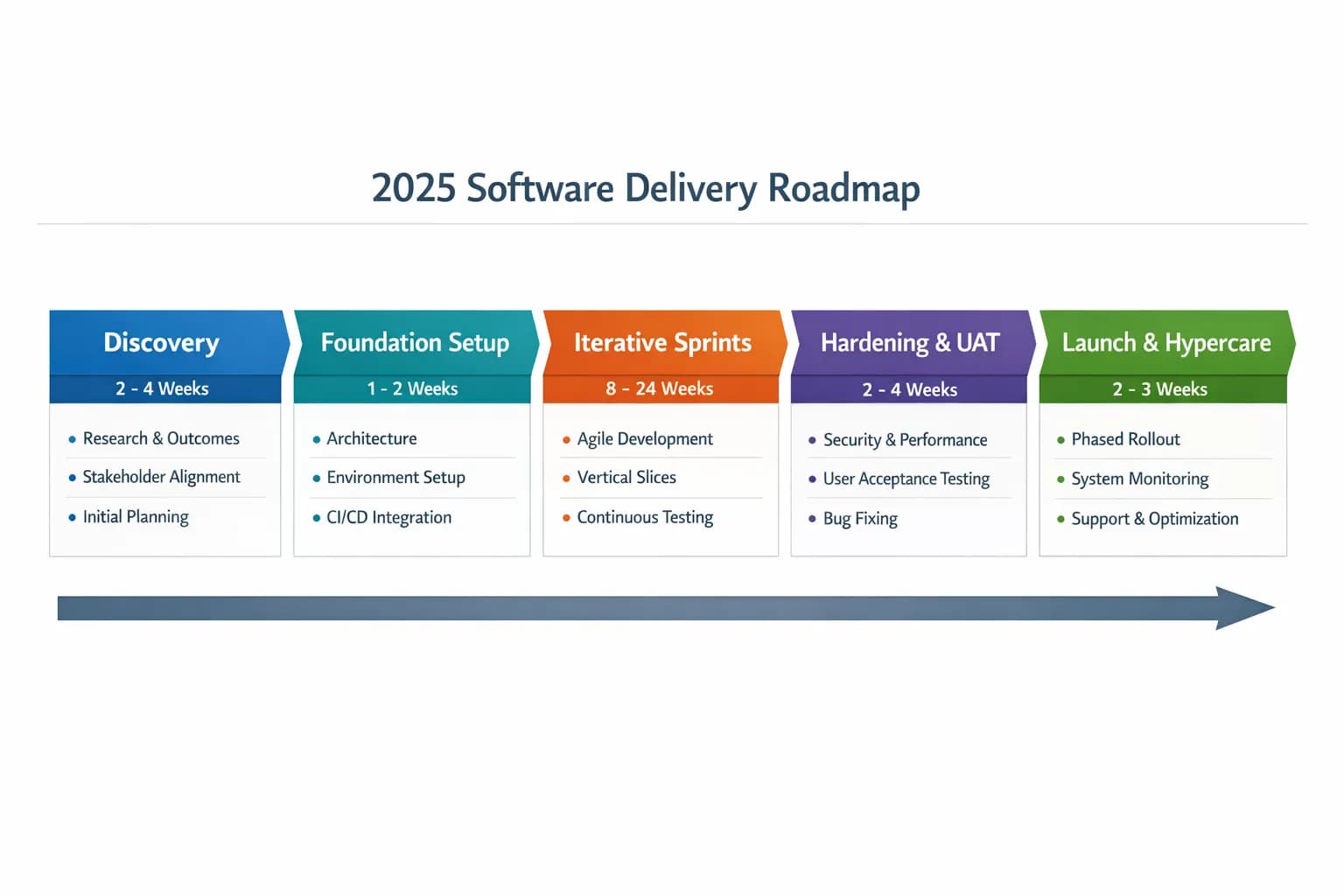
Most successful deliveries follow a predictable shape. Treat these as time boxes with clear exit criteria, not calendar fillers.
- Discovery and scoping, 2 to 4 weeks. Outcomes, measurable objectives, prioritized backlog, architecture baseline, risk register, initial budget and ROI model.
- Foundation setup, 1 to 2 weeks overlapping. Repo and branches, environments, CI/CD, observability, access control, paved paths for services and front end.
- Iterative delivery, 8 to 24 weeks in two week sprints. Thin vertical slices that trace to outcomes, demo every sprint, production hardening every third sprint.
- Hardening and UAT, 2 to 4 weeks. Nonfunctional testing, performance runs, security review, training and enablement, migration plan and rollback tested.
- Launch and hypercare, 2 to 3 weeks. Phased rollout, canaries and feature flags, runbooks, dashboards, on call and error budget in place.
Want a deeper dive on architecture choices that keep timelines under control, including why modular monoliths are often fastest for v1? See our guide on how to choose the right tech stack in 2025.
ROI Modeling That Finance and Product Both Trust
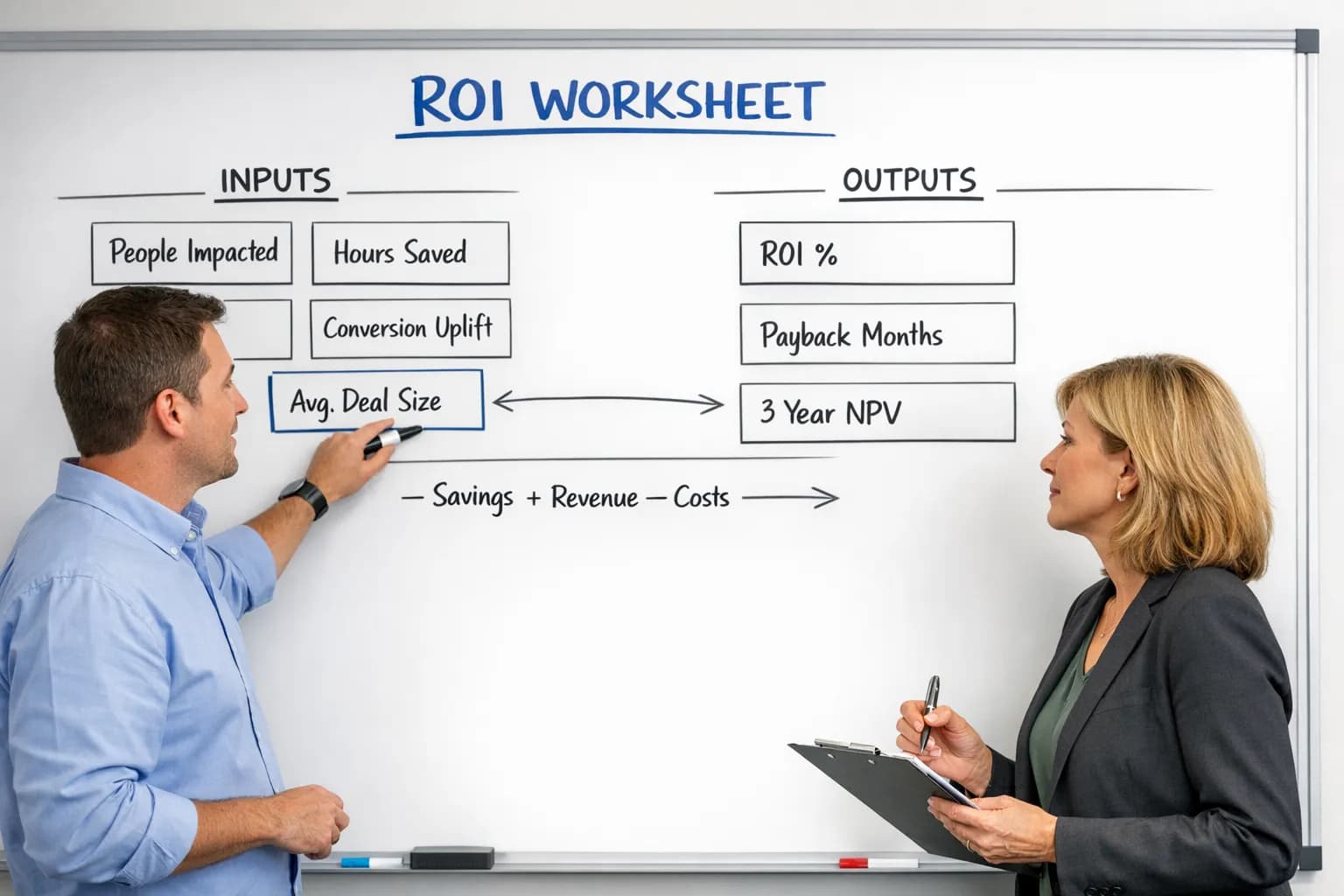
The fastest way to align executives is a simple, transparent model you can update as reality changes. Use a one page sheet with three sections: benefits, costs, and time value of money.
Benefits categories to quantify
- Revenue uplift, new bookings, higher conversion, higher average order value, expansion revenue.
- Cost savings, hours saved, fewer tools, reduced rework and defect rates, lower support tickets.
- Risk reduction and compliance, avoided fines or audit costs, reduced outage costs, reduced vendor lock in risk.
- Strategic option value, speed to experiment, faster partnership integrations, faster geographic entry.
Track these with baseline measurements before kickoff. Adoption metrics are crucial, because benefits only accrue if people use the product in their daily work.
Cost categories to include
- Build costs, discovery, design, development, testing, and project management.
- Run costs, cloud and third party licenses, monitoring, incident response, security reviews.
- Change costs, training, documentation, comms, internal admin time.
The three equations you need
- ROI, over your chosen period. ROI equals total benefits minus total costs, divided by total costs.
- Payback period in months. Payback months equals twelve times initial build cost divided by annualized net benefit, net benefit equals annual benefits minus annual run costs.
- Net present value. NPV equals the sum of discounted future net cash flows minus initial build, use your finance team’s discount rate, commonly 8 to 12 percent.
A worked example, year one
Assume a new internal platform that reduces manual admin and improves conversion:
- Initial build cost, 280,000 dollars.
- Annual run costs, 70,000 dollars.
- Annual benefits, 600,000 dollars (labor savings plus modest revenue uplift).
Results:
- Year one ROI equals, 600,000 minus 350,000, divided by 350,000, which is about 71 percent. We used total year one costs of 350,000 dollars, build plus run.
- Payback equals, twelve times 280,000 divided by 600,000 minus 70,000, which is about 6.3 months.
These are illustrative only. Swap in your own numbers and pressure test with sensitivity analysis at plus or minus 20 percent on both benefits and costs.
A simple worksheet you can copy
| Line | Input | Example | Formula |
|---|---|---|---|
| People impacted | count | 50 | |
| Hours saved per person per week | hours | 0.5 | |
| Weeks per year | weeks | 48 | |
| Loaded hourly cost | dollars | 55 | |
| Annual labor savings | dollars | 66,000 | People x Hours x Weeks x Rate |
| Additional annual revenue | dollars | 400,000 | Conversion uplift x average deal value |
| Risk avoidance value | dollars | 30,000 | Finance or compliance estimate |
| Total annual benefits | dollars | 496,000 | Sum of benefits |
| Initial build cost | dollars | 280,000 | |
| Annual run costs | dollars | 70,000 | Cloud, licenses, support |
| Year one ROI | percent | 41 percent | (Benefits minus Build minus Run) divided by (Build plus Run) |
| Payback months | months | 8.0 | 12 x Build divided by (Benefits minus Run) |
Use conservative inputs and agree on how you will verify each benefit after launch.
Budget for reality, not for the demo
The teams that stay on budget are not the ones that found the cheapest developer. They are the ones that specified the work before committing to it, counted the hidden line items on purpose, and matched the contract model to how much they actually knew. Custom software development cost in 2026 is predictable when you treat uncertainty as the thing you are buying down, and unpredictable when you pretend it is not there.
If you are shaping a budget before your first RFP and want a second opinion on the numbers or a proposal in front of you, we are happy to help you pressure-test it. Reach us at hello@wolf-tech.io or at wolf-tech.io. A short conversation before you commit is cheaper than the overrun it prevents.