
Custom Software Development Website: What It Should Include

Sandor Farkas
Founder & Lead Developer
Expert in software development and legacy code optimization
LinkedIn
A custom software development website is not just a brochure. For most buyers, it is the first technical and commercial due diligence step: they are trying to answer, quickly, “Can this team ship safely, handle complexity, and deliver outcomes in my domain?”
If your site does not make those answers obvious, you will still get leads, but they will be lower quality, harder to close, and more price-sensitive.
Below is a practical checklist of what a custom software development website should include in 2026, focused on trust, clarity, and conversion.
1) A clear positioning block (above the fold)
In the first screen, buyers should understand three things without scrolling:
- Who you build for (ICP and context): startup, scale-up, enterprise, regulated, internal platforms, customer-facing products.
- What you deliver (outcomes, not buzzwords): modernize legacy systems, build a B2B SaaS platform, stabilize reliability, reduce time-to-ship.
- Why you (credible differentiators): years in production, depth in specific stacks, approach to risk, security posture, delivery model.
A simple formula that works well:
“We help [customer type] achieve [measurable outcome] by building [category of software] with [key capability].”
If you want an example of outcome-first thinking (and how it connects to delivery artifacts), Wolf-Tech’s writing often leans this way in guides like Business Software Development: From Requirements to Value.
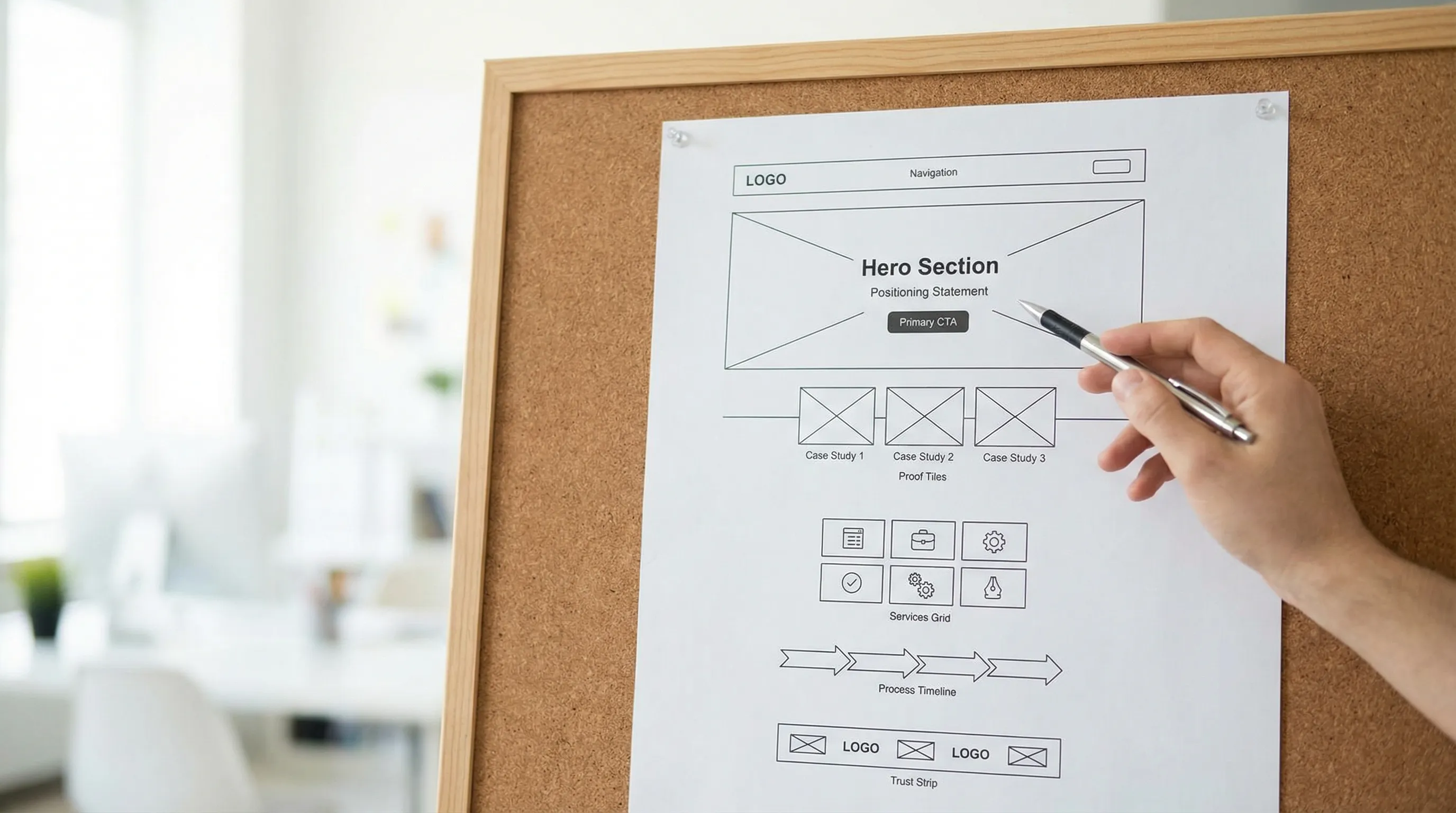
2) The “must-have” pages (and what each one must prove)
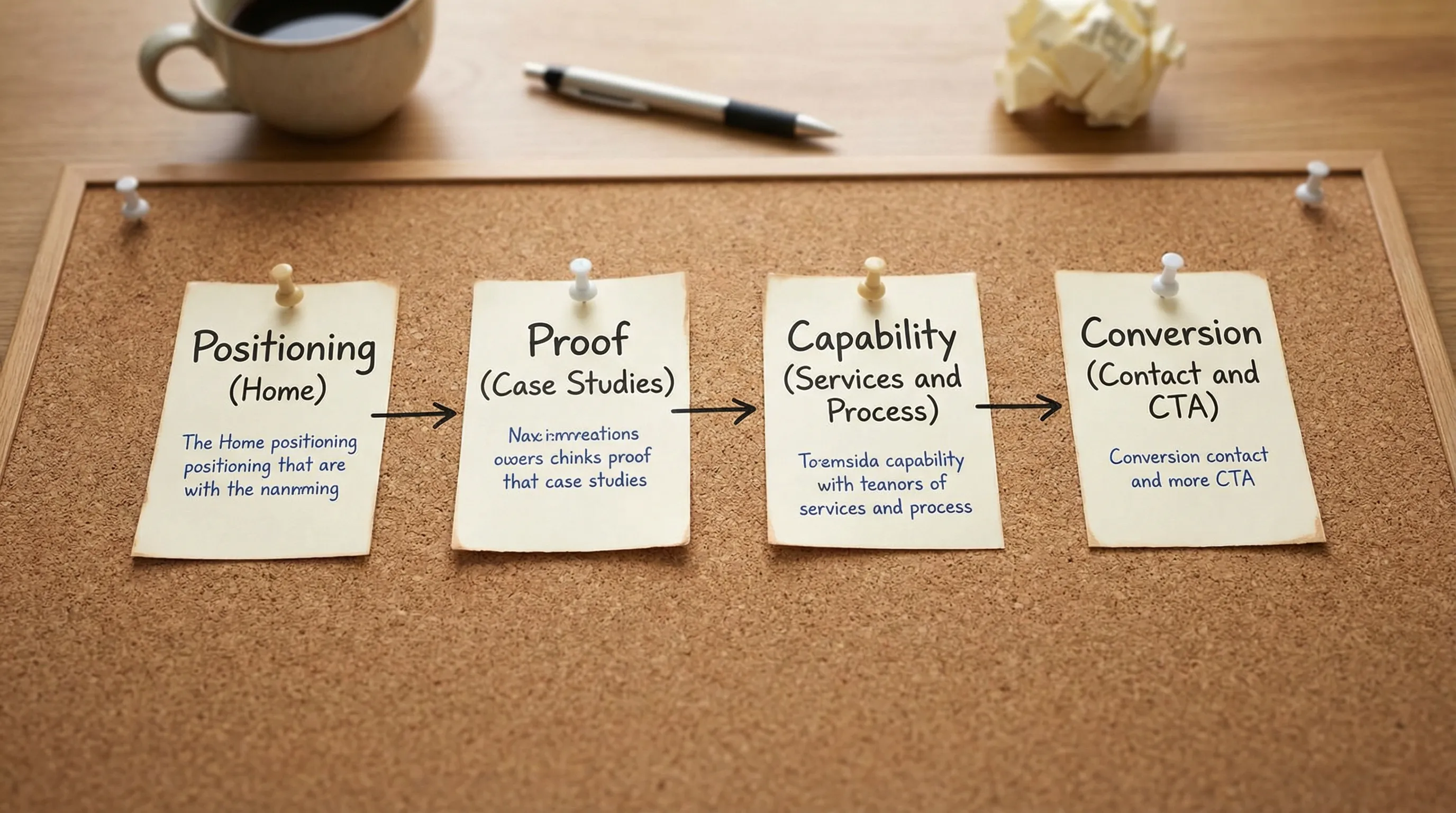
Many software firm sites have the same pages, but strong sites treat each page as a “proof container.” Each one should reduce a specific buyer fear: delivery risk, security risk, unclear scope, vendor lock-in, quality, or long-term maintainability.
| Page | Purpose | What to include to build trust | Common weak point |
|---|---|---|---|
| Home | Fast clarity and routing | Positioning, 2 to 3 concrete outcomes, top services, best proof, primary CTA | Generic buzzwords, no specifics |
| Services | Validate capability and scope | Service boundaries, deliverables, sample engagement shapes, what “done” looks like | Long lists, no deliverables |
| Case studies | Proof of execution | Context, constraints, what shipped, measurable results, risks handled, tech choices and why | “We built X” with no outcomes |
| Process / How we work | Reduce delivery anxiety | Discovery approach, thin-slice validation, quality gates, release strategy, handoff/ownership | Overly abstract process diagrams |
| About | Establish credibility | Leadership bios, experience, operating principles, how you ensure continuity | “We are passionate” filler |
| Blog / Insights | Demonstrate expertise | Practical guides, architecture trade-offs, checklists, postmortem learnings | Pure thought leadership, no practicality |
| Security & compliance | Address buyer requirements | Secure SDLC overview, dependency controls, access management, audit trail expectations, responsible AI stance | Missing entirely until procurement stage |
| Contact | Convert and qualify | Clear contact options, what happens next, form that captures context, response expectations | “Email us” with no next step |
Two Wolf-Tech posts that map well to “what should be on your services/process pages” (because they define tangible delivery expectations) are:
- Custom Software Services: What You Should Get by Default
- Software Project Kickoff: Scope, Risks, and Success Metrics
3) Case studies that include constraints and trade-offs (not just wins)
In custom software, credibility comes from how you handle constraints:
- Legacy systems and data migrations
- Tight timelines
- Regulated requirements
- Performance and reliability targets
- Multiple teams and stakeholders
High-converting case studies usually include:
- Starting state (what was broken or limiting)
- Constraints (compliance, team size, deadlines, integrations)
- Approach (discovery, architecture baseline, thin vertical slice, rollout)
- What shipped (capabilities, not just components)
- Measurable impact (time-to-ship, incident rate, conversion, cost, p95 latency)
- What you would do differently (signals maturity)
If you do not have permission to publish client names, you can still publish anonymized cases with clear constraints and results. Buyers mainly want to see your decision-making and risk controls.
4) A process page that explains “how you avoid rework”
A common buyer fear is paying twice: once to build, and again to fix avoidable issues (architecture mismatches, missing non-functional requirements, unclear acceptance criteria).
A strong process page makes your risk controls explicit, for example:
- How you turn outcomes into implementable scope
- How UX decisions get validated against architecture constraints
- How you choose a stack and prove it early
- How you ensure quality, security, and operability before launch
If you want a concrete model for communicating cross-functional alignment, Wolf-Tech’s Web Application Designing: UX to Architecture Handshake is a good reference point.
5) Proof of engineering rigor (without turning your website into docs)
Your site should signal that you are not only “builders,” but also safe operators of production systems.
What to include:
- Quality gates you consider non-negotiable (testing approach, code review standards, CI expectations)
- Security-by-design basics (threat modeling stance, dependency scanning, secrets management, least privilege)
- Operability (logging/metrics/tracing expectations, incident response readiness, release safety)
You do not need to publish every internal detail, but you should show you have a playbook.
If you reference security practices, align terminology with widely accepted sources like the OWASP Top 10 so buyers recognize your baseline.
6) Conversion elements that qualify leads (not just collect emails)
For a custom software development website, “conversion” should mean qualified conversations, not raw form fills.
Good conversion elements include:
- A primary CTA that matches buyer intent (for example, “Request a discovery call” or “Ask for an architecture review”)
- A contact form that captures context (company type, goal, timeframe, existing stack, constraints)
- A “what happens next” section (expected response time, steps, who joins the call)
- Optional secondary CTAs for earlier-stage visitors (newsletter, checklist download, assessment request)
A small but high-impact detail: add a short “fit note” near the CTA. Example: “Best fit if you need modernization, full-stack delivery, or code quality improvements.” This reduces mismatched inbound.
7) Technical SEO and performance fundamentals (because buyers judge you by them)
If you sell software competence, your site must feel competent:
- Fast pages and stable layout: Core Web Vitals matter for SEO and perceived quality. Use Google’s overview to align metrics and targets: Core Web Vitals.
- Clean information architecture: clear service clusters, internal links to supporting deep dives, minimal orphan pages.
- Schema where it helps: Organization, Service, Article, and FAQ schema can improve how you appear in search.
- No thin pages: service pages should be specific (deliverables, boundaries, proof), not 200-word placeholders.
8) Accessibility and compliance readiness
Enterprise and public-sector buyers increasingly treat accessibility as a baseline requirement. Even in commercial B2B, accessibility correlates strongly with overall engineering discipline.
At minimum:
- Build to recognized guidelines like WCAG
- Ensure forms, navigation, and core CTAs are keyboard- and screen-reader-friendly
- Avoid “design-only” cues (color as the only signal, missing focus states)
You do not need to claim certification, but you should show you take it seriously.
9) A “how we think about stacks” section (optional, high leverage)
Many buyers worry about long-term maintainability and talent availability. A short section that explains how you choose stacks, and how you preserve optionality, builds confidence.
Linking to a deeper guide is often enough. For example:
10) Common mistakes that quietly kill trust
These issues rarely show up in analytics as “the problem,” but they reduce conversion quality:
- Feature laundry lists instead of outcomes, deliverables, and proof
- No explanation of ownership (who owns the repo, cloud accounts, infra, runbooks)
- Missing security posture until late-stage procurement
- Over-claiming (naming compliance standards or clients you cannot prove)
- Vague case studies with no constraints, no metrics, no real story
A quick self-audit checklist
If you want a fast internal review, ask whether your site answers these in under 5 minutes:
- What do you build, for whom, and what outcomes do you optimize for?
- What does an engagement produce in the first 2 to 4 weeks?
- How do you prevent rework between requirements, UX, and architecture?
- What evidence shows you can ship safely (quality, security, operability)?
- Where is the proof (case studies with constraints and results)?
- What happens after someone contacts you?
Frequently Asked Questions
What is the most important page on a custom software development website? The home page is the highest leverage because it routes buyers to proof quickly, but case studies often decide whether you get shortlisted.
How many case studies do we need? Fewer, deeper is usually better. Two to five strong case studies with constraints and measurable outcomes typically outperform ten vague ones.
Should we list our tech stack on the site? Yes, if it helps buyers understand fit, but pair it with decision rationale and outcomes. A stack list without context can look like keyword stuffing.
What should a services page include for custom software development? Clear service boundaries, tangible deliverables, examples of success metrics, and how you manage risk (quality gates, security baseline, release approach).
How do we show credibility if we cannot name clients publicly? Use anonymized case studies with concrete constraints, architecture decisions, and measurable results. Buyers primarily want evidence of decision quality and delivery maturity.
Want a second opinion on your custom software development website?
If you are updating your site to attract better-fit projects, it often helps to review it the same way a technical buyer would: positioning clarity, proof strength, delivery signals, and frictionless conversion.
Wolf-Tech provides full-stack development and consulting (including code quality, legacy optimization, tech stack strategy, cloud and DevOps). If you want feedback on what your website communicates today, and what it should add to convert more qualified opportunities, start at Wolf-Tech or explore the blog for deeper implementation guidance.