
React Frontend Frameworks Compared: Next.js, Remix, Astro

Sandor Farkas
Founder & Lead Developer
Expert in software development and legacy code optimization
LinkedIn
Choosing a React frontend framework in 2026 is less about “which one is best” and more about what you need the framework to own: routing, data loading, caching, server rendering, deployment ergonomics, and long-term change safety.
Next.js, Remix, and Astro can all ship fast. When compared side by side, the difference is where they place complexity and how they help you control performance, SEO, and operational risk.
What you are actually comparing
All three sit “above React” and provide opinions about how an app becomes a production system.
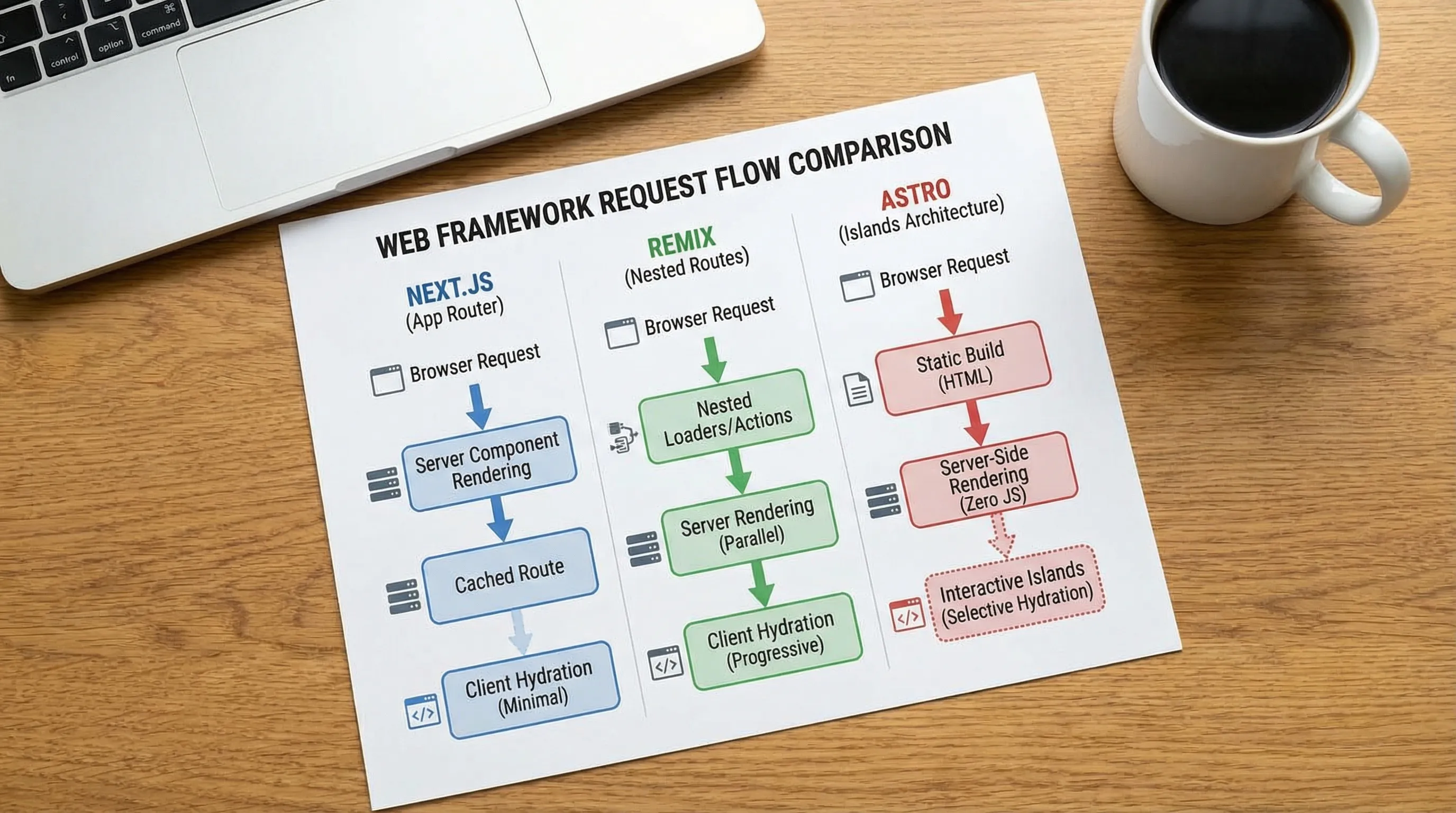
- Next.js is a React meta-framework aiming to cover the full product surface area: server rendering, caching, server-side code, and conventions.
- Remix is a web-platform-first framework: nested routing + explicit data loading/mutations, designed to make web fundamentals (forms, HTTP caching, progressive enhancement) a default.
- Astro is a content-first web framework with an “islands” model: ship minimal JavaScript by default, then hydrate only interactive components, including React components.
If you want the official positioning, see the docs for Next.js, Remix, and Astro.
Quick comparison: Next.js vs Remix vs Astro
| Dimension | Next.js | Remix | Astro |
|---|---|---|---|
| Primary fit | Full-stack web apps, content + app, SEO-critical routes | Data-driven apps with strong routing and form/mutation flows | Content sites, docs, marketing, content-heavy pages with “islands” |
| Rendering model | SSR/SSG/ISR + streaming (App Router) + React Server Components | SSR by default with nested routes, streaming supported | Static by default, SSR optional, islands/partial hydration |
| Data loading & mutations | Several options (Server Components, Route Handlers, Server Actions, client fetching) | First-class loader/action per route, HTML forms as a power feature | Content collection pipelines, fetch anywhere; app-style data flows are possible but not the focus |
| Caching ergonomics | Powerful but nuanced (per-route rendering modes, cache invalidation strategies) | Leans on HTTP semantics and explicit route loaders | Static output is the default caching strategy; SSR requires a hosting plan |
| Interactivity cost | Easy to drift into heavier client bundles if boundaries are not managed | Tends to encourage server-first and progressive enhancement | Lowest JS by default; interactive islands are opt-in |
| Best “default” for a mixed marketing + app product | Often yes | Sometimes | Often yes for marketing, less so for complex app surfaces |
Next.js: when you want an opinionated full-stack React framework
Next.js is a strong default if you want one framework to cover:
- Routing, layouts, and code splitting
- Server rendering and streaming
- Multiple deployment topologies (Node runtime, edge runtime depending on hosting)
- Server-side integration patterns (APIs, auth flows, backend-for-frontend patterns)
Where Next.js tends to win
1) Mixed workloads: marketing + product app in one codebase
Many products have both public SEO routes and authenticated “app” routes. Next.js is designed for that combination.
2) Server Components for read-heavy pages
React Server Components can reduce client JavaScript for data-heavy pages by rendering more on the server and sending a smaller payload to the browser (see the React Server Components concept in the React ecosystem and how Next.js implements it in its documentation).
3) Ecosystem and hiring market
If you optimize for talent availability and community patterns, Next.js is hard to ignore.
Where teams get surprised
Caching and invalidation become architecture, not a detail. Next.js can be extremely fast, but only if you standardize how you handle:
- Route-level rendering mode choices
- Cache keys and invalidation rules
- Personalization boundaries (especially for authenticated pages)
If you already run Next.js and want production patterns, Wolf-Tech’s internal guides may help:
Remix: when routing and data flows are your core complexity
Remix is often at its best when the hardest part of your product is data orchestration across routes and mutations that must be reliable.
Why Remix feels “clean” for many teams
1) Nested routes are not just UI, they are data boundaries
A route can declare what it needs (loader) and how it mutates (action). That structure reduces “global fetching soup” and makes it easier to reason about UI states.
2) Progressive enhancement is a real feature
HTML forms and normal navigation flows remain valid, and JavaScript enhances the experience rather than being required for correctness. This can be valuable for:
- Form-heavy apps
- Admin interfaces
- Products where reliability matters more than flashy client behavior
3) Web platform alignment
Remix leans into the Fetch API and HTTP semantics, which can make teams more disciplined about caching and headers.
Typical trade-offs
- If you want extensive built-in static site generation conventions, Remix can feel less “batteries-included” than static-first tools.
- Teams sometimes need time to internalize the nested route mental model and the loader/action lifecycle.
Astro: when performance and content delivery are the product
Astro’s default posture is simple: ship HTML first and only ship JavaScript for the parts that truly need it.
Where Astro tends to win
1) Marketing sites, documentation, blogs, content hubs
If your success metric is SEO and Core Web Vitals, Astro’s static-first and islands approach is a strong advantage.
2) “Islands” interactivity without committing everything to SPA complexity
You can use React components where interactivity exists, without turning the whole page into a React runtime exercise.
3) Framework flexibility
Astro is not “React-only.” That can be helpful in organizations with heterogeneous UI needs.
Typical trade-offs
Astro can run SSR and can build app-like experiences, but if your product is primarily an authenticated, interaction-heavy application (dashboards, complex client state, real-time collaboration), Astro is often better as:
- The marketing/content layer
- A docs layer
- A shell for a smaller interactive surface
rather than the center of your entire application architecture.
Scenario-based recommendations (pragmatic defaults)
Different teams can choose different winners with the same requirements on paper. The tie-breaker is usually the constraint you cannot compromise on.
| Scenario | Strong default | Why |
|---|---|---|
| Content-heavy public site (SEO, docs, marketing pages) | Astro | Minimal JS by default, static-first output, islands for targeted interactivity |
| Product with both marketing and authenticated app in one repo | Next.js | One framework handles both SSR content routes and app routes with shared components |
| Form-heavy, data-driven app where correctness beats “SPA cleverness” | Remix | Route-based loaders/actions + progressive enhancement makes mutations and states clearer |
| E-commerce or SEO-critical pages plus dynamic personalization | Next.js (or Remix) | Both can SSR well, but Next.js has more common patterns for hybrid rendering and caching |
| Internal dashboard (auth-first, low SEO need) | Next.js or Remix | Pick based on your preference for Next.js conventions vs Remix data flow clarity |
If you want a broader decision lens, see: React Frameworks Explained: Picking the Right Fit in 2026.
The real decision drivers (what to validate before committing)
Framework debates get unproductive when they stay abstract. The fastest way to choose is to validate a thin slice against the constraints that create cost later.
1) Rendering and caching strategy you can explain on one page
Be explicit about:
- Which routes must be SEO indexed
- Which routes must be personalized
- What your caching layers are (CDN, server, browser)
- How invalidation works after a mutation
In practice, this is where teams either love Next.js (power) or prefer Remix (explicitness) or avoid SSR complexity by using Astro (static-first).
2) Mutation complexity (the hidden tax)
If your product has many mutations (create/update flows, multi-step forms, file uploads), validate:
- Loading/error/empty states across nested UI
- Retry behavior and idempotency assumptions
- How you handle partial failure (some data saved, some not)
Remix often shines here because the mutation model is a first-class concept.
3) Client-side JavaScript budget
Regardless of framework, you should define a performance budget and verify it continuously.
A practical approach is to measure Core Web Vitals and the page’s JS payload and set budget thresholds in CI. If you need a deeper workflow, see React Website Performance: Fix LCP, CLS, and TTFB.
4) Deployment topology and operational ownership
Ask early:
- Are you standardizing on Node servers, edge runtime, or static hosting?
- Who owns observability and incident response for the frontend runtime?
- Do you need preview environments for every PR?
If your team treats “frontend” as a production system, this is a non-negotiable. (If you are building a delivery system across the org, Wolf-Tech’s capability-first selection approach may be useful: Web Application Framework Comparison: Beyond the Hype.)
A simple evaluation plan (7 days, high signal)
You do not need a month-long spike. A week is often enough if you choose the right slice.
Build the same thin vertical slice in your top 2 candidates:
- 1 public page (SEO relevant) with real content and metadata
- 1 authenticated route with role-based access behavior
- 1 list/detail flow with pagination or filtering
- 1 mutation flow (create/update) with validation and error states
- Basic observability: request logging, error reporting, and a minimal performance baseline
Then compare:
| Proof gate | What “good” looks like |
|---|---|
| Change safety | Small PRs, predictable test strategy, clear boundaries for server vs client code |
| Performance | Meets your LCP/TTFB targets for the key route types, not just Lighthouse on a blank page |
| Operability | You can explain caching and invalidation, and you can monitor errors and latency |
| Team fit | The team can maintain it without framework heroes |
Frequently Asked Questions
Is Astro a React frontend framework? Astro is a web framework that can use React for UI islands. It is not React-only, and its default model is content-first with partial hydration.
Should I always pick Next.js for React in 2026? No. Next.js is a strong default for mixed marketing + app surfaces, but Remix can be clearer for data/mutation-heavy apps, and Astro often wins for content performance.
Which is best for SEO: Next.js, Remix, or Astro? All can do SEO well when server-rendered or statically generated. Astro’s static-first approach often makes it easiest to ship excellent Core Web Vitals, while Next.js and Remix require more deliberate caching and data-loading discipline.
What is the biggest risk with Next.js? Teams often underestimate caching and rendering mode complexity. Without clear conventions and proof gates, performance and correctness can regress route by route.
What is the biggest risk with Remix? Teams sometimes expect it to behave like a conventional SPA framework. The nested routing and loader/action model is powerful, but you need to embrace it rather than working around it.
Can I use Astro for a full SaaS app? You can, especially for smaller interactive surfaces, but if the app is highly interactive and stateful across many routes, Next.js or Remix is often the more straightforward center of gravity.
Need a framework decision you can defend (and operate)?
If you are choosing between Next.js, Remix, and Astro for a real product, the safest path is to run a thin-slice evaluation with clear performance, security, and operability proof gates.
Wolf-Tech helps teams build and modernize production web applications, including tech stack strategy, full-stack implementation, and legacy optimization. If you want help designing the evaluation slice, reviewing architecture trade-offs, or implementing the chosen approach, start here: Wolf-Tech.