
Software Solutions Development: From Discovery to Launch

Sandor Farkas
Founder & Lead Developer
Expert in software development and legacy code optimization
LinkedIn
Software solutions rarely fail because a team cannot code. They fail because the solution is vague, the risks are invisible until late, and “done” means different things to product, engineering, and operations.
This guide covers software solutions development from discovery to launch with an evidence-driven approach: each phase produces artifacts that reduce uncertainty, make progress measurable, and keep the eventual launch reversible.
What “software solutions development” means (and what it should include)
A “software solution” is not just an app. It is the full system that reliably delivers an outcome: user journeys, business rules, data, integrations, security controls, delivery pipelines, and operational readiness.
In 2026, the baseline expectation is higher than “it works on staging.” Buyers and internal stakeholders usually need proof across:
- Value: Are we building the right thing for the right users?
- Feasibility: Will this work with our data, integrations, constraints, and team?
- Operability: Can we ship safely, observe behavior, and recover quickly?
- Security and compliance: Are common vulnerabilities prevented and auditable?
If any of these are deferred, the project may still “launch,” but reliability, cost, and delivery speed typically collapse right after.
Phase 1: Discovery that produces decisions (not just documents)
Discovery is successful when it turns ambiguity into clear decision inputs, not when it generates a large requirements list.
Outcomes and constraints (the non-negotiables)
Start with a short outcome brief:
- Target users and primary journeys (what users must accomplish)
- Business outcome metrics (revenue, cost reduction, cycle time, conversion)
- Constraints (deadline, regulated domain, data residency, existing platforms)
- Non-functional requirements (NFRs) with measurable targets (latency, uptime, RPO/RTO, concurrency)
If you want one metric family to anchor delivery performance, the DORA metrics are widely used for understanding deployment frequency, lead time, change failure rate, and recovery time. The latest DORA research is published by Google Cloud: DORA research.
Scope shaping: thin slices beat feature lists
Instead of prioritizing a long backlog, define a thin vertical slice that crosses the full stack end-to-end (UI, API, data, auth, logging). This slice is not an MVP, it is an early proof that the system can be built and operated.
Good slice selection rules:
- Touch at least one real integration (payments, CRM, identity, or messaging)
- Exercise real authorization and error handling
- Produce at least one meaningful business event you can measure
For deeper value validation techniques before committing to a build, Wolf-Tech also covers practical approaches here: Developing solutions: how to validate value before coding.
Phase 2: Solution blueprint (align UX, architecture, and contracts)
This phase is where most “surprise rewrites” are prevented. The goal is to define a blueprint that engineering can implement without hidden assumptions.
UX to architecture handshake
A reliable solution blueprint makes UX decisions explicit in system terms:
- Which pages or screens need fast first paint (and what “fast” means)
- What can be async (jobs, notifications, reporting)
- What must work under partial failure (offline, stale data, retry)
- What states exist (loading, empty, denied, degraded, error, queued)
Wolf-Tech’s handshake loop is described in depth here: Web application designing: UX to architecture handshake.
Contracts first (APIs, events, and data)
If your software solution integrates with other systems, define contracts early:
- API schemas and error model
- Compatibility rules (what changes are allowed without breaking clients)
- Data ownership boundaries and lifecycle
This reduces integration churn and helps parallelize work safely.
Security baseline from day one
Security should not be a launch checklist item. Establish baseline controls early and enforce them in CI.
A practical starting point for common web risk categories is the OWASP Top 10. Use it as a threat vocabulary and a checklist for prevention patterns (authz, injection, XSS, SSRF, insecure deserialization, vulnerable dependencies).
Phase 3: Build the production slice (prove you can ship and operate)
Before building “the whole product,” build a production-grade slice that proves the delivery system.
That slice should include:
- Repo structure and module boundaries that can scale
- CI pipeline with automated checks (lint, types, tests, security scans)
- Environment promotion (dev to preview to staging to prod)
- Observability basics (structured logs, metrics, tracing where needed)
- A rollback mechanism (feature flags, canary, or blue/green depending on context)
If your team is scaling and struggling with consistency, standardizing delivery and cross-cutting concerns early is often the highest leverage move. See: Software development technology: what to standardize first.
Phase 4: Hardening (reliability, performance, cost, and support model)
Hardening is where you deliberately turn a working system into a predictable one.
Reliability and failure behavior
Define SLIs/SLOs that match real user pain:
- p95 latency on key endpoints
- error rate per journey
- queue lag for background work
- availability for critical capabilities
Then add the engineering guardrails that enforce those outcomes (timeouts, retries with backoff, idempotency, circuit breakers, and sane rate limits).
If you want a concrete reliability practice checklist, Wolf-Tech covers it here: Backend development best practices for reliability.
Performance and capacity
Treat performance as a measurement workflow, not a one-time optimization sprint:
- Baseline using real user metrics where possible
- Profile bottlenecks (DB, backend, frontend)
- Make one high-leverage change
- Re-measure and add regression guardrails
A measurement-first workflow is outlined here: Performance software tuning.
Operational ownership and support readiness
Decide, before launch:
- Who is on-call (and what hours)
- Severity definitions and response targets
- Runbooks for predictable incidents (deploy rollback, DB migration failure, third-party outage)
This is also where you validate backups, restore procedures, and access controls.
Phase 5: Launch (make it reversible)
Launch should be treated as a controlled risk event. Your goal is not bravery, it is reversibility.
Practical launch mechanics that reduce blast radius:
- Feature flags to expose functionality gradually
- Canary releases (small traffic percentage first)
- Progressive enablement by tenant, region, or user cohort
- Monitoring with clear thresholds and alert routing
Also plan an “aftercare window” (often 1 to 2 weeks) where the team prioritizes production fixes, UX friction, and performance issues over new features.
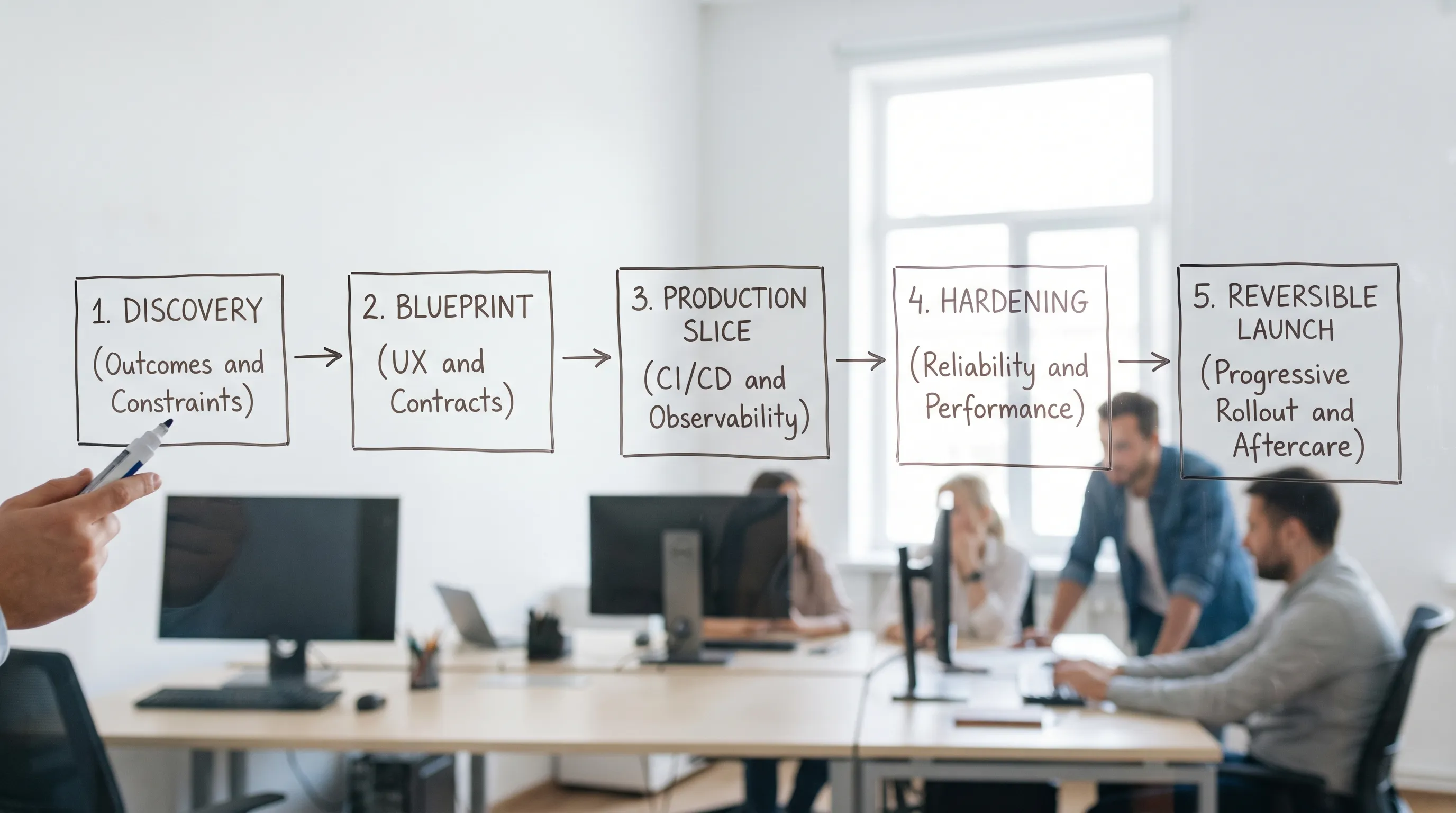
Deliverables and proof gates (a practical checklist)
The easiest way to keep stakeholders aligned is to define proof gates: observable artifacts that must exist before moving on.
| Stage | Goal | Proof artifacts (examples) | Common risk it prevents |
|---|---|---|---|
| Discovery | Decide what success means | Outcome brief, NFR targets, thin-slice definition | Building the wrong thing, vague “requirements” |
| Blueprint | Make solution implementable | Journey maps, state model, API/event sketches, data model notes | Rework from hidden assumptions |
| Production slice | Prove delivery and operability | CI pipeline, deploy to an environment, logs/metrics, rollback path | “Works locally” projects that fail in prod |
| Hardening | Make behavior predictable | SLO dashboards, load test results, incident runbooks | Outages and slow degradation post-launch |
| Launch | Reduce blast radius | Progressive rollout plan, alert thresholds, aftercare plan | Uncontrolled launch and slow recovery |
Timeline expectations (what’s realistic)
Exact timelines depend on scope, integrations, and the maturity of the existing delivery system, but the pattern below is common:
| Workstream | Typical duration range | What makes it longer |
|---|---|---|
| Decision-ready discovery | 1 to 3 weeks | Many stakeholders, unclear ownership, regulated constraints |
| Blueprint and contracts | 1 to 3 weeks | Complex workflows, multi-team dependencies, integration ambiguity |
| Production slice | 2 to 6 weeks | Weak CI/CD, unclear environments, legacy constraints |
| Hardening | 1 to 4+ weeks (often ongoing) | Reliability gaps, performance cliffs, poor observability |
| Launch and aftercare | 1 to 2+ weeks | High-risk migrations, sensitive customers, compliance reviews |
If a plan skips the production slice and goes straight from discovery to full build, budget extra time for “unknown unknowns” late in the project.
Common failure modes (and what to do instead)
“We will fix quality later”
Instead, decide which checks are gates (must pass to merge or deploy) vs which are signals (tracked, but not blocking). Enforce the gates in CI.
“We need microservices to scale”
Often you need clearer boundaries, contracts, and operability first. A modular monolith can be a safer default for early-stage solutions.
“Launch is the finish line”
Launch is when the system meets reality: real data volume, real users, real edge cases, real adversaries. Plan for iteration, monitoring, and a support model.
Frequently Asked Questions
What is the difference between a software solution and a software product? A solution is outcome-focused and includes integrations and operations (how it runs). A product is the packaged offering. Many products fail as solutions if operability and support are not designed.
How do you avoid building the wrong solution during discovery? Use measurable outcomes, explicit constraints, and a thin vertical slice definition. Validate value with interviews, prototypes, or fake-door tests before committing to a full build.
What should be in a “thin vertical slice”? One end-to-end journey that touches UI, API, data, auth, delivery, and observability. It should be deployable and measurable, not a demo.
When is it safe to launch without a full observability stack? You can start small (logs, basic metrics, error tracking), but you should still have a way to detect regressions, identify failures by journey, and roll back quickly.
How do we know we are ready for launch? If you can deploy predictably, observe key journeys, meet baseline NFR targets, and roll back safely. Launch readiness is about reversibility, not confidence.
Need an evidence-driven plan from discovery to launch?
If you are building or modernizing a software solution and want to reduce rework and launch risk, Wolf-Tech can help you shape discovery outputs, validate a thin vertical slice, and establish production-grade delivery and operability.
Explore Wolf-Tech’s approach to end-to-end delivery and quality proof, or get in touch via wolf-tech.io to discuss your project context and constraints.