
Software Development Strategy for Diverse Teams

Sandor Farkas
Founder & Lead Developer
Expert in software development and legacy code optimization
LinkedIn
Modern software delivery rarely happens inside a single, co-located team with the same background, the same seniority, and the same working hours. Today it is more common to ship products through a mix of internal squads, specialist groups (security, data, platform), contractors, and sometimes external vendors. Diversity here is a strength, but it also creates friction if you rely on an “everyone will figure it out” approach.
A strong software development strategy for diverse teams makes delivery predictable without crushing autonomy. It gives teams shared outcomes, shared quality signals, and lightweight decision rules, while still letting each group move fast inside clear boundaries.
Why diverse teams need a different strategy (not just “more process”)
When teams differ by location, culture, domain knowledge, or technical maturity, the cost of ambiguity multiplies.
Common failure modes look like this:
- Roadmaps mean different things to different groups, so delivery becomes a negotiation every sprint.
- Architectural decisions get repeated (or reversed) because there is no durable decision record.
- “Quality” becomes subjective, so incidents and rework rise and trust falls.
- Communication becomes meeting-heavy, which penalizes time zones and deep work.
A good strategy addresses these failure modes with clarity and consistency, not bureaucracy.
What “diverse teams” actually means in software delivery
Diversity is not only demographics. In delivery, it often includes multiple axes that affect coordination cost.
| Diversity dimension | What it looks like in practice | Risk if not addressed in the strategy |
|---|---|---|
| Time zones and work schedules | Distributed teams, async collaboration | Slow decisions, blocked work, meeting overload |
| Skill and seniority mix | Juniors plus staff-level engineers, specialists vs generalists | Inconsistent quality, uneven review load, fragile ownership |
| Domain context | Teams with different understanding of users, workflows, or regulations | Mis-scoped work, broken assumptions, rework |
| Tech stack variance | Multiple languages, frameworks, cloud patterns | Integration pain, duplicated tooling, rising maintenance cost |
| Organizational boundaries | Product, platform, security, data, vendors | Unclear decision rights, “handoff” delays, blame loops |
Your strategy should not try to eliminate these differences. It should create an operating system that makes them productive.
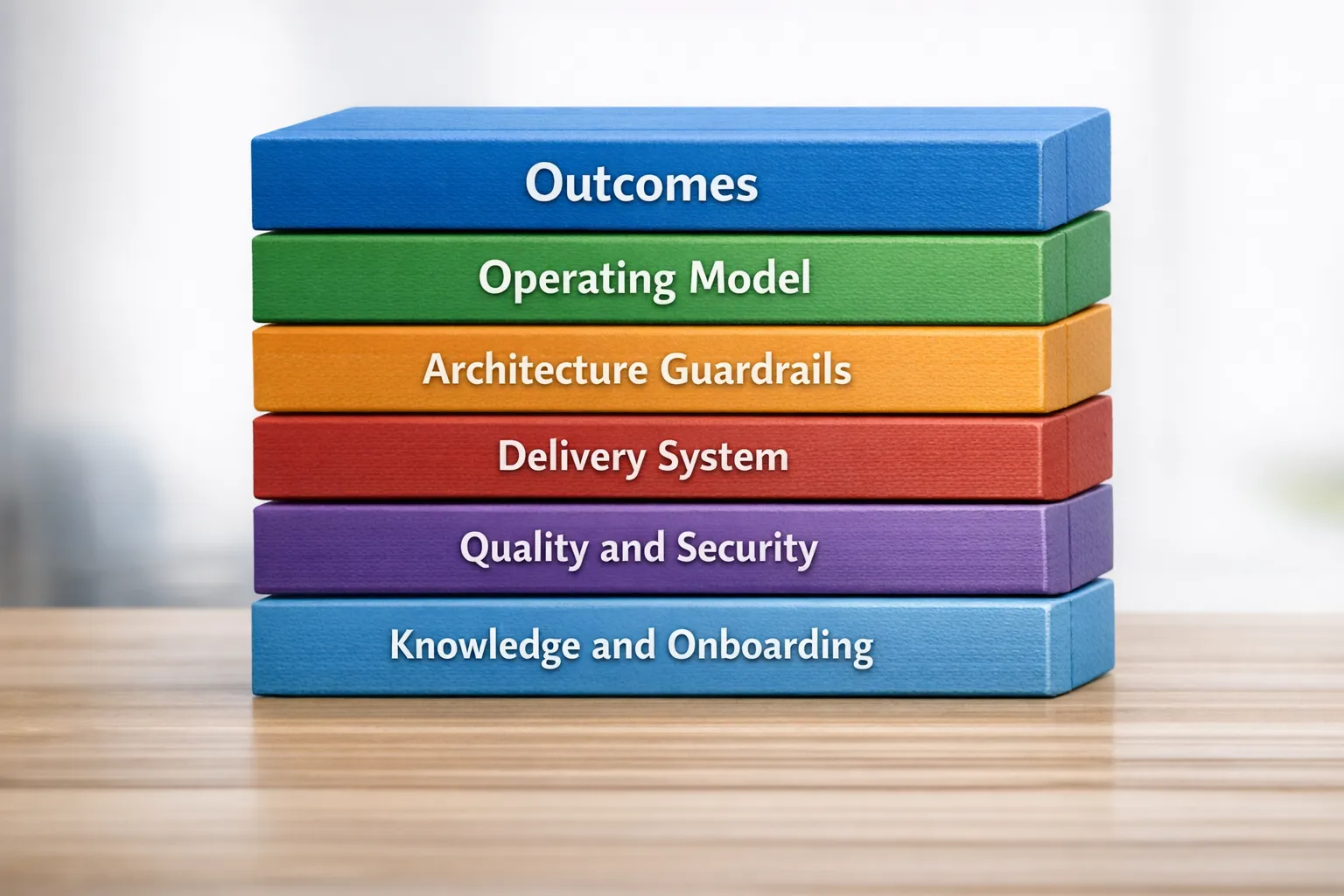
The strategy stack: 6 layers that keep diverse teams aligned
A practical software development strategy for diverse teams is easier to build if you treat it as layers. Each layer produces concrete artifacts that reduce ambiguity.
1) Outcomes and constraints (the shared “why”)
Start with a shared definition of success that is measurable. Diverse teams can execute differently, but they should aim at the same targets.
What to align on:
- Business outcomes (revenue, activation, retention, cost-to-serve)
- Non-functional requirements (availability, latency, privacy, compliance)
- Explicit trade-offs (for example, speed-to-market vs depth of automation)
High-leverage artifacts:
- A one-page product brief per initiative (problem, users, success metrics, constraints)
- A “definition of done for outcomes” that includes operational readiness, not just feature completion
If you want a deeper outcome-first approach, Wolf-Tech’s guide on moving from requirements to measurable value is a useful companion: Business Software Development: From Requirements to Value.
2) Operating model and decision rights (the shared “how we work”)
Diverse teams fail faster from unclear ownership than from imperfect code.
Define:
- Team boundaries (what a team owns end to end)
- Decision rights (who decides, who advises, who must be consulted)
- Escalation paths (how to unblock without politics)
A lightweight way to do this is a decision table that teams can reference during delivery.
| Decision area | Recommended owner | How decisions are recorded |
|---|---|---|
| Product scope and sequencing | Product lead (with engineering input) | Roadmap and sprint goals, written acceptance criteria |
| Architecture direction and boundaries | Tech lead or architecture group (small) | ADRs (Architecture Decision Records) |
| API contracts and data models | Owning team (with consumers consulted) | Versioned schemas, OpenAPI/GraphQL schema, change logs |
| Security and compliance controls | Security partner (with team ownership) | Threat model notes, control checklist, evidence in repo |
| Release readiness | Owning team | Release checklist, runbooks, rollback plan |
If you are scaling from a small group to multiple squads, align this layer with your growth plan so it does not collapse under load. See: Application Development Roadmap for Growing Teams.
3) Architecture guardrails (autonomy with boundaries)
Architecture is where diverse teams either gain autonomy or create coupling.
A strategy that works well across team maturity levels is:
- Prefer a modular monolith as a default starting point, then split when you can prove it is needed
- Define bounded contexts (or at least clear module ownership) that map to team ownership
- Use explicit contracts at boundaries (APIs, events, schemas)
Key artifacts:
- A system map that shows major domains, data stores, and integration points
- ADRs for decisions with long-term impact (service boundaries, eventing approach, tenancy model)
- A “golden path” reference implementation for common patterns (auth, logging, deployment)
For a pragmatic view on architecture and stack trade-offs, reference: How to Choose the Right Tech Stack in 2025.
4) Delivery system (a shared cadence that survives time zones)
Diverse teams need delivery mechanics that minimize coordination overhead. That usually means:
- Trunk-based development (or short-lived branches) with tight CI feedback loops
- CI/CD that supports frequent, low-risk releases
- Preview environments so reviewers can validate without synchronous handoffs
- Feature flags to decouple deploy from release
What changes in distributed environments is not the tools, it is the working agreements.
A practical cross-team “delivery contract” should include:
- Expected PR size and review turnaround targets
- When to require synchronous review (for example, security-sensitive changes)
- A shared incident and on-call handoff approach, especially across time zones
If you want a reliability-focused delivery baseline, this guide pairs well with the strategy layer above: Backend Development Best Practices for Reliability.
5) Quality, security, and reliability (a shared language for “good”)
In diverse teams, quality must be observable. If you cannot measure it, every disagreement becomes personal.
Use a small set of metrics that connect engineering activity to outcomes. The DORA metrics are widely used because they correlate with delivery performance and stability.
A practical scorecard for diverse teams:
| Category | Metric | Why it works across diverse teams |
|---|---|---|
| Delivery | Lead time for changes | Reveals friction in handoffs, reviews, and CI |
| Delivery | Deployment frequency | Encourages smaller, safer batches |
| Stability | Change failure rate | Shows whether speed is creating incidents |
| Recovery | MTTR (mean time to restore) | Highlights operational readiness and observability |
| Maintainability | Hotspots, complexity, duplication | Predicts long-term delivery drag |
| Security | Vulnerability age (time to remediate) | Forces prioritization, not just detection |
For a deeper, engineering-led approach to quality metrics and how to avoid vanity tracking, see: Code Quality Metrics That Matter.
Also, make “done” include operability:
- Monitoring and alerting expectations
- SLOs for critical user journeys
- Runbooks and rollback procedures
- Basic threat modeling and dependency hygiene
6) Knowledge and onboarding (how diverse teams become one team)
Diverse teams win when knowledge moves faster than people.
Most organizations underinvest here, then pay for it forever in:
- Repeated questions in chat
- Risky changes due to missing context
- Slow onboarding and uneven performance
High-leverage artifacts:
- An engineering handbook (ways of working, coding standards, release process)
- “First day” and “first week” onboarding paths per role
- System documentation that is task-oriented (how to deploy, how to test, how to debug)
- A lightweight internal RFC process for changes that affect multiple teams
This layer is also where you can explicitly support inclusion and psychological safety. Google’s research popularized psychological safety as a key team effectiveness factor, and their practical guidance is accessible via re:Work.
A practical 30-60-90 day rollout plan
If your current delivery is inconsistent across teams, do not attempt a big-bang transformation. Roll out the strategy in small increments, with feedback.
| Timeframe | What you implement | What you should be able to show |
|---|---|---|
| Days 0 to 30 | Shared outcomes, basic decision rights, a minimal “definition of done” | One-page briefs for top initiatives, a clear owner for each system area, fewer blocked handoffs |
| Days 31 to 60 | Delivery contract, CI baseline, preview environments (where applicable), ADR habit | Shorter PR cycles, fewer “surprise” architecture changes, faster review turnaround |
| Days 61 to 90 | Initial golden path, team scorecard, SLOs for key journeys, onboarding handbook | More frequent releases with stable incident rate, clearer ownership, faster onboarding |
If legacy constraints are part of why teams diverge in quality and speed, consider aligning this rollout with a “no disruption” modernization approach. Wolf-Tech covers this well here: Modernizing Legacy Systems Without Disrupting Business.
Common pitfalls when building a software development strategy for diverse teams
These are the mistakes that most often break strategy adoption:
- Over-standardizing early, teams comply on paper but bypass in practice
- Under-standardizing, every team reinvents workflows and quality gates
- Measuring activity instead of outcomes (for example, story points instead of lead time and change failure rate)
- Architecture decided centrally without feedback loops from delivery teams
- Async theater (lots of docs, no decisions, no ownership)
The goal is not more documentation. The goal is fewer unknowns during execution.
Frequently Asked Questions
What is the difference between a software development strategy and a delivery process? A strategy defines outcomes, boundaries, and decision rules that stay stable across projects. A delivery process is the day-to-day workflow (planning, coding, reviewing, releasing) that can evolve as tools and teams change.
How do you keep standards consistent without slowing teams down? Use “guardrails, not gates.” Standardize what creates leverage across teams (CI baseline, observability, security controls, API contracts), but let teams choose local implementation details inside those boundaries.
What metrics work best across teams with different tech stacks? Prefer stack-agnostic metrics such as lead time, deployment frequency, change failure rate, MTTR, and a small set of maintainability and security signals. Avoid metrics that reward volume over value.
How should distributed teams handle architecture decisions? Make decisions in writing (ADRs or lightweight RFCs), timebox feedback, and define who decides. Pair that with a reference implementation (golden path) so teams can copy proven patterns instead of debating them repeatedly.
When should you bring in external help? If teams are stuck in recurring rework, incidents, or delivery delays, an external assessment can quickly identify the highest-leverage changes across architecture, delivery system, and operating model, then help implement them without a long pause in feature delivery.
Build a strategy that scales across people, not just code
If you are leading a product organization with multiple teams, time zones, or mixed seniority, the biggest risk is not that any single team writes bad code. It is that the system of delivery becomes inconsistent and unpredictable.
Wolf-Tech helps organizations design and execute practical software development strategy across diverse teams, from operating model and tech stack guidance to delivery systems, code quality consulting, modernization, and full-stack implementation.
If you want a clear baseline for alignment, quality, and delivery (without heavy process), explore Wolf-Tech at wolf-tech.io and reach out to discuss a strategy and execution plan tailored to your teams.