
Digital Transformation in Software Development: Guide

Sandor Farkas
Founder & Lead Developer
Expert in software development and legacy code optimization
LinkedIn
Digital transformation can sound like a grand, one-time initiative. In software development, it is usually the opposite: a sequence of measurable changes to how you build, ship, and operate software so the business can move faster with less risk.
If you are leading engineering, product, or IT in 2026, the stakes are clear. Customers expect continuous improvement, security expectations keep rising, and legacy systems are now competing with AI-ready, cloud-native platforms. The teams that win are not the ones with the newest framework, they are the ones with the best delivery system and the discipline to modernize incrementally.
What “digital transformation” means in software development
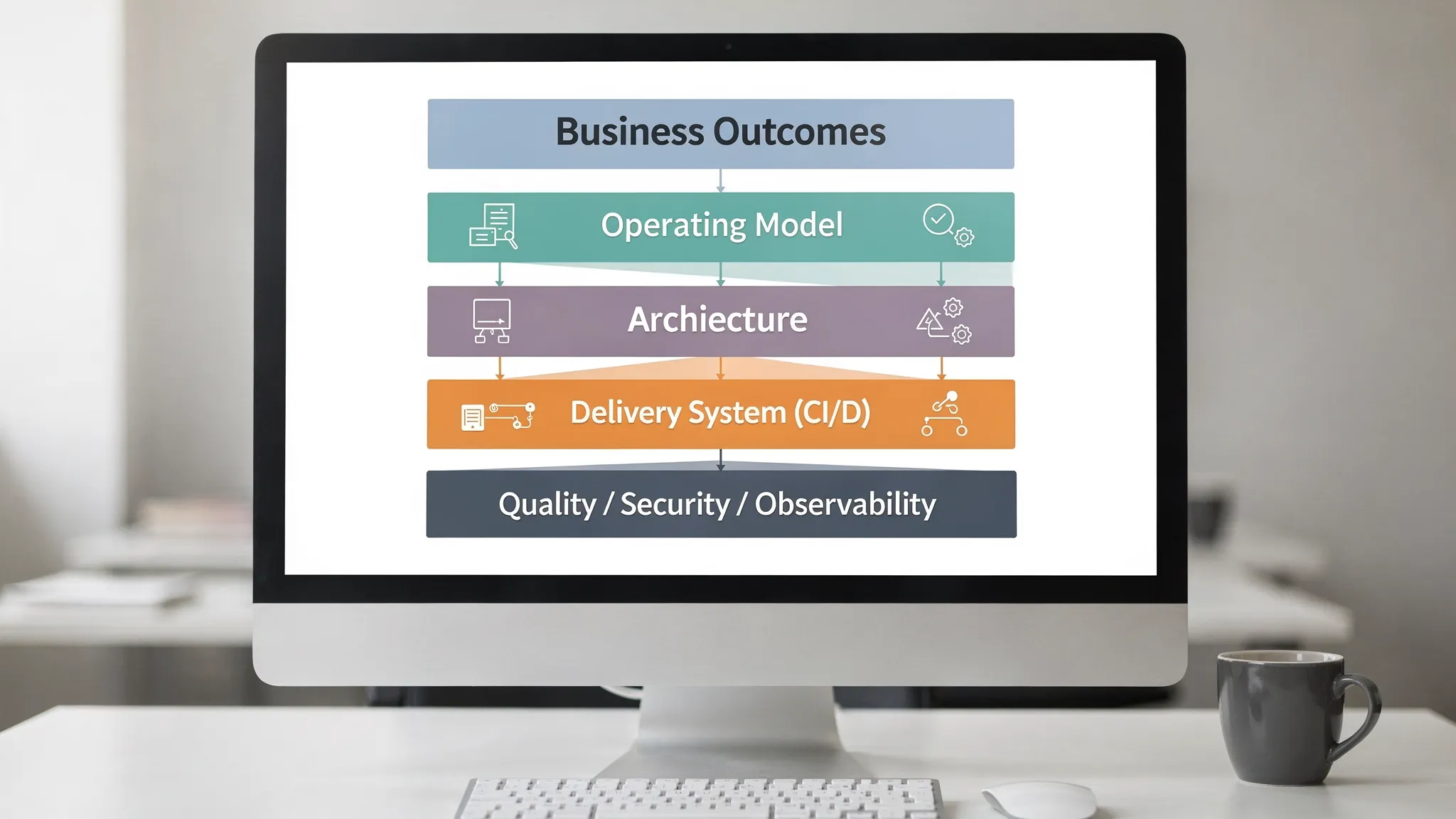
In a software context, digital transformation is not “moving to the cloud” or “rewriting the monolith.” It is a coordinated upgrade across:
- Business outcomes (what you are optimizing for)
- Product and engineering operating model (how decisions get made and work flows)
- Architecture and platform (how software is structured and deployed)
- Quality, security, and reliability (how risk is controlled)
- Data and integration (how information moves safely and usefully)
A useful definition for leadership teams is:
Digital transformation in software development is the intentional redesign of your delivery capabilities so you can deliver business changes faster, safer, and at lower total cost of ownership.
That definition matters because it keeps the focus on capability building, not cosmetics.
The most common transformation traps (and how to avoid them)
Many transformation programs fail for predictable reasons. Here are the ones we see most often.
Trap 1: Treating transformation as a tooling project
New CI tooling, a new cloud provider, or a new framework can help, but tools do not fix:
- unclear ownership
- long feedback loops
- fragile releases
- missing tests
- inconsistent security controls
If your lead time is slow because work bounces between teams, a new tool will not fix it.
Trap 2: Big-bang rewrites
Big rewrites concentrate risk, delay value, and often collapse under changing requirements. In most organizations, transformation works best as incremental modernization with explicit safety mechanisms (feature flags, canary releases, contract tests, observability).
If legacy modernization is a big part of your situation, you will likely benefit from an incremental approach like the one outlined in Wolf-Tech’s guide on modernizing legacy systems without disrupting business.
Trap 3: Optimizing for output, not outcomes
Shipping more “features” does not matter if conversion, retention, cycle time, or operational cost do not improve. Transformation should be judged on measurable business and engineering outcomes.
The six pillars of digital transformation in software development
A practical transformation program can be organized into six pillars. The goal is not perfection in each, but steady improvement with clear priorities.
| Pillar | What good looks like | Typical first deliverable |
|---|---|---|
| Outcomes and value | Teams align on a small set of measurable outcomes | Outcome tree and baseline metrics |
| Operating model | Clear ownership, lightweight governance, fast decisions | Team boundaries, decision rules, RACI trimmed to essentials |
| Architecture | Evolvable structure, intentional tradeoffs, controlled coupling | Architecture baseline and migration plan |
| Delivery system | Reliable CI/CD, fast feedback, repeatable environments | A working pipeline for one service/app |
| Quality, security, reliability | Risk reduced by design and automation | Definition of Done + quality gates |
| Data and integration | Governed APIs, safe data flows, auditability where needed | API standards + integration map |
These pillars map to what modern engineering research has shown for years: high-performing organizations invest in delivery capabilities, automation, and fast feedback loops. DORA’s widely used metrics are a practical way to measure progress (see Google’s DORA research overview).
A transformation roadmap that works in the real world
Most organizations need a roadmap that respects three constraints:
- the business must keep running
- the team cannot stop shipping for months
- risk and compliance requirements are non-negotiable
The roadmap below is designed for incremental adoption.
Phase 1: Align on outcomes and baseline reality
Before touching architecture, align leadership on what “better” means. Good outcomes are measurable and tied to the business.
Examples:
- Reduce onboarding time from 14 days to 2 days.
- Increase weekly release frequency from monthly to weekly.
- Reduce incident MTTR from hours to minutes.
- Cut cloud cost per transaction by 20 percent.
Then baseline your current state:
- delivery metrics (lead time, deploy frequency, change failure rate)
- reliability (availability, latency, error rates, paging volume)
- quality (defect escape rate, flaky tests, high-risk hotspots)
- security posture (patch latency, vulnerability age, audit findings)
If you want a practical metric set that does not devolve into vanity dashboards, Wolf-Tech’s post on code quality metrics that matter pairs well with DORA-style delivery metrics.
Phase 2: Pick an operating model you can sustain
Digital transformation is constrained more by decision-making than by technology.
Key design choices:
Define ownership boundaries
Teams ship faster when they own an outcome end-to-end. Even if you use platform teams or shared services, product teams need a clear path to production.
Set lightweight decision rules
Avoid governance that requires committees for every change. Use:
- architecture decision records (ADRs)
- a small set of non-negotiable guardrails (security, privacy, reliability)
- a “thin slice” validation rule for big changes
For distributed organizations, this becomes critical. Wolf-Tech’s software development strategy for diverse teams is a strong companion if your teams are multi-site or cross-time-zone.
Phase 3: Build a modern delivery system (CI/CD plus operability)
If you want transformation speed, invest early in the delivery system. This is where many teams see the fastest compounding returns.
What to implement first
A minimal, high-leverage delivery system includes:
- version control discipline (trunk-based or a constrained branching strategy)
- automated tests that run in CI
- repeatable builds and artifact management
- automated deployments to at least one environment
- observable deployments (logs, metrics, traces tied to releases)
If you need a deep, practical breakdown, Wolf-Tech’s guide on CI/CD technology covers the stack, bottlenecks, and a pragmatic adoption plan.
Add safety mechanisms before you “go faster”
Speed without safety is just faster outages. The most common safety mechanisms that unlock confident change are:
- feature flags
- canary or blue/green releases
- automated rollback paths
- contract testing for APIs
- SLOs and error budgets
Phase 4: Modernize architecture incrementally (do not chase trends)
Once you can ship reliably, you can modernize architecture with less risk.
Start with architecture as a business decision
Architecture should match business risk and change patterns. Your default might be:
- a modular monolith for many internal products
- a small number of services around clear domains
- event-driven components where async workflows are essential
The right answer depends on scale, team topology, compliance, and latency requirements. For a structured way to decide, see Wolf-Tech’s how to choose the right tech stack in 2025 (the principles still hold in 2026).
Modernize legacy with “safe seams”
If you have a legacy system, focus on creating seams that allow parallel change:
- anti-corruption layers
- strangler pattern routes
- shadow traffic to test new paths
- incremental database migration strategies
Wolf-Tech’s taming legacy code and refactoring legacy applications both emphasize incremental techniques that reduce disruption.
Phase 5: Embed security and compliance into the workflow
In 2026, security cannot be a late-stage checklist. The most effective transformations treat security as part of the delivery system.
Practical steps that tend to work across industries:
- threat modeling for meaningful changes
- SAST and dependency scanning in CI
- secrets management (do not store secrets in repos)
- least-privilege access and audit logging
- clear ownership for vulnerability remediation
For security-by-design guidance, the NIST Secure Software Development Framework (SSDF) is a widely referenced baseline.
Phase 6: Make data and integration “product-grade”
Transformation stalls when teams cannot trust data or when integrations are brittle.
A strong target state includes:
- clear API standards (versioning, error conventions, auth)
- an integration map tied to domain ownership
- data contracts for critical pipelines
- governance that enables teams, rather than blocking them
If GraphQL is part of your modernization plans, Wolf-Tech’s GraphQL APIs guide is helpful for deciding where it fits and how to avoid common failure modes.
How to measure transformation progress (without fooling yourself)
Measurement is how you protect transformation from politics and optimism bias. Use a small set of metrics that connect engineering performance to business outcomes.
| Category | Metric | Why it matters |
|---|---|---|
| Delivery (DORA) | Lead time for changes | Measures how quickly ideas reach users |
| Delivery (DORA) | Deploy frequency | Indicates batch size and release health |
| Delivery (DORA) | Change failure rate | Shows whether speed is creating incidents |
| Delivery (DORA) | MTTR | Measures recovery capability |
| Reliability | SLO attainment (availability/latency/errors) | Keeps customer impact visible |
| Quality | Defect escape rate | Quantifies quality “leaks” to production |
| Security | Vulnerability age / patch latency | Tracks security responsiveness |
| Cost | Cost per transaction or per active user | Connects FinOps to product decisions |
A simple rule: if a metric does not drive an action, it is not a good transformation metric.
A practical “first 30 days” plan
If you need momentum without boiling the ocean, the first month can be about clarity and one demonstrable improvement.
Week 1: Baseline and map constraints
Document:
- current release process and bottlenecks
- top operational risks
- top 5 systems/integrations by business criticality
Week 2: Define outcomes and pick one pilot scope
Choose one product or one service path where you can prove improvement quickly (for example, one customer workflow).
Week 3: Implement one delivery improvement end-to-end
Examples:
- add a CI pipeline with reliable tests
- add a safe deployment strategy (canary) for one service
- add observability basics (service dashboards and alerting tied to SLOs)
Week 4: Review, standardize, and expand
Capture learnings, document lightweight standards, and decide what to roll out next.
If your organization benefits from more structure, Wolf-Tech’s application development strategy playbook provides a well-scoped strategy flow and a 90-day plan.
When to bring in outside expertise
Transformation is not only about knowledge, it is about execution speed and risk control. External help is most valuable when:
- you need a fast, objective architecture and delivery assessment
- legacy risk is high and downtime is unacceptable
- you are modernizing under compliance pressure
- you need to upskill teams while still shipping
A good partner should be able to show how they will measure progress and transfer capability, not just deliver code.
Frequently Asked Questions
What is digital transformation in software development? Digital transformation in software development is the process of improving how a company designs, builds, deploys, and operates software so it can deliver business value faster and more safely. It usually includes changes to operating model, architecture, CI/CD, security, and data practices.
Is moving to the cloud the same as digital transformation? No. Cloud migration can be part of transformation, but transformation is broader. Without improvements to delivery workflows, ownership, security, and operability, moving infrastructure alone rarely improves speed or reliability.
How do we modernize legacy systems without disrupting the business? Use incremental modernization patterns like the strangler pattern, feature flags, canary releases, contract tests, and strong observability. This allows new and old components to run in parallel while you reduce risk step by step.
How long does digital transformation take? Meaningful progress can be visible in 4 to 12 weeks if you pick a pilot scope and improve the delivery system first. Full transformation for complex organizations typically takes multiple quarters because it involves operating model changes, modernization, and capability building.
What metrics should we track during transformation? Start with DORA metrics (lead time, deploy frequency, change failure rate, MTTR) and add a small set of reliability, quality, security, and cost metrics tied to your business outcomes.
Make your transformation measurable and low-risk
If you are planning a digital transformation and want it to translate into faster delivery, safer releases, and lower long-term maintenance costs, Wolf-Tech can help with full-stack development, legacy code optimization, code quality consulting, and tech stack strategy.
Explore Wolf-Tech’s approach at Wolf-Tech or start by benchmarking your current delivery and architecture using the guides above (CI/CD, modernization, tech stack selection).