
Next JS Frameworks: How to Choose the Right One in 2026


Picking “a Next.js framework” in 2026 is rarely about choosing Next.js itself. For most teams, the real decision is which opinionated layer you put on top of Next.js: your data access approach, auth model, content strategy, deployment target, and the defaults that shape how safely you can ship.
Choose well and you get predictable performance, clear security boundaries, and a maintainable codebase. Choose poorly and you inherit hidden coupling (to a BaaS, a CMS, a hosting platform, or a boilerplate) that shows up later as cost, outages, or stalled velocity.
This guide gives you a practical way to evaluate Next JS frameworks in 2026, plus a short, evidence-based plan to pick one without months of debate.
What “Next JS frameworks” means in 2026
In 2026, “Next JS frameworks” typically refers to pre-integrated frameworks or stacks built around Next.js that make major architectural choices for you.
Most of these fall into one of five shapes:
- Next.js as the full-stack runtime: App Router, React Server Components (RSC), Server Actions, Route Handlers, plus your own DB and services.
- Typed full-stack frameworks on top of Next.js: you get end-to-end types, a default ORM, and conventions for API boundaries.
- Next.js as a frontend plus a separate backend: Next.js handles UI and BFF needs, while an API service owns business logic.
- Next.js + headless CMS: content and editorial workflows are first-class, with Next.js as the presentation layer.
- Next.js + BaaS: auth, database, storage, and realtime are largely outsourced.
If you want a strong baseline for production-grade Next.js regardless of which direction you choose, Wolf-Tech’s companion guide is a good prerequisite: Next.js best practices for scalable apps.
The 7 decision questions that pick the right framework (without hype)
Before comparing options, write down your answers to these. They will eliminate most choices quickly.
1) What is your “page mix” (and what must be fast)?
Different Next.js stacks optimize different things:
- Marketing, docs, SEO pages: fast first render, stable caching, low JS.
- SaaS app surfaces: auth-first, interactive UI, predictable mutations.
- Mixed products: both (and this often argues for clear route-level boundaries).
If your product success depends on Core Web Vitals and predictable caching semantics, validate your caching strategy early. Next.js is powerful here, but only if you’re deliberate about it. The official Next.js documentation is the best source of truth for rendering and caching behavior.
2) Where does your core business logic live?
Be explicit:
- If Next.js owns business logic, you must treat it like a backend (secrets management, background work patterns, idempotency, observability).
- If a separate backend owns business logic, Next.js can be simpler and safer (UI + BFF orchestration), especially in regulated or integration-heavy environments.
A useful mental model is to define boundaries and contracts first, then pick tooling. If you want a pragmatic boundary checklist, see Software systems 101: boundaries, contracts, and ownership.
3) How complex is auth and authorization?
Auth is where many “framework” decisions become expensive:
- Single-tenant SaaS with simple roles is one thing.
- Multi-tenant SaaS (tenant isolation, tenant-aware caching, RBAC/ABAC, audit logs) is another.
If you are multi-tenant, you should assume you need strong tenant-aware caching rules and strict separation of server-only secrets from client code.
4) What is your data access shape?
Ask:
- Do you need a relational model (Postgres), complex queries, and migrations you control?
- Do you need realtime?
- Do you need strict contract governance (OpenAPI/GraphQL) because multiple clients or teams depend on it?
Your data shape is a bigger driver than “framework popularity.”
5) How will you deploy and operate it?
Your operational model is part of the framework choice:
- Are you fine with a platform-managed deployment model, or do you need self-hosting?
- Do you need edge execution, or is a Node runtime sufficient?
- What are your SLOs, on-call expectations, and incident processes?
If you want a broader capability-first evaluation approach (not only Next.js), Wolf-Tech’s web development technologies: what matters in 2026 gives a good checklist.
6) How important is optionality (avoiding lock-in)?
Lock-in is not inherently bad, but you should choose it consciously.
Typical lock-in sources in Next.js ecosystems:
- A BaaS that owns auth + DB + storage.
- A CMS with a deep coupling to content schemas and editorial workflows.
- A framework that hides boundaries (everything is “just a function call”).
Optionality usually means choosing explicit contracts and portable data.
7) What is your team’s real skill profile for the next 12 to 24 months?
A framework can reduce cognitive load, or it can become a dependency maze.
- If your team is strong in backend engineering and operations, a separate API service can be a win.
- If your team is small and full-stack, a tighter Next.js-centric approach can reduce coordination costs.
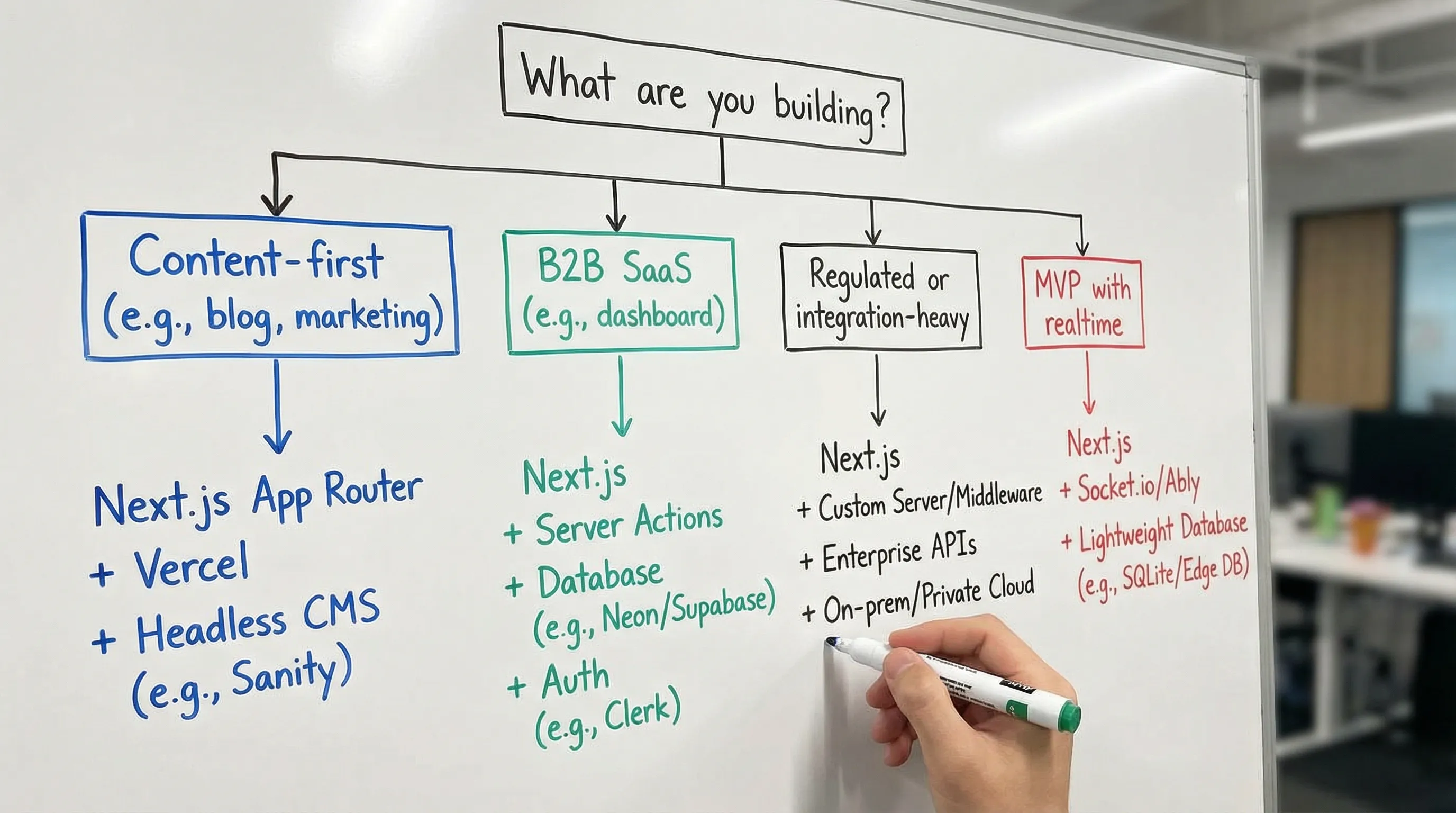
Common Next JS framework options in 2026 (and when they fit)
The goal is not to pick “the best” option, but the best fit for your constraints.
| Next.js framework option (in practice) | Best for | What you get | Watch-outs to validate early |
|---|---|---|---|
| Next.js (App Router) as your full-stack | Products that benefit from server rendering, fast iteration, and a unified repo | One framework for UI + server endpoints + mutations, strong performance primitives | Background jobs, long-running work, and integration-heavy logic can get messy if you do not enforce boundaries |
| Typed full-stack stack on top of Next.js (for example tRPC + Prisma) | Small to mid teams building CRUD-heavy SaaS fast | End-to-end typing, fast dev loops, consistent patterns | Contract governance across teams, coupling between client and server, migration path if you later need public APIs (tRPC, Prisma) |
| Next.js + separate backend (NestJS, Spring, .NET, etc.) | Regulated apps, complex domains, heavy integrations, multi-team orgs | Clear boundaries, independent scaling and deployment, mature backend governance | More moving parts (CI/CD, local dev, versioned contracts), you must design the integration boundary intentionally |
| Next.js + headless CMS | Content-first sites, marketing + product hybrids, editorial workflows | Editors can ship content safely, you keep UI performance and SEO | Preview flows, cache invalidation, content model governance, and permissions in the CMS (Payload, Sanity, Strapi) |
| Next.js + BaaS (Supabase/Firebase style) | Fast MVPs, prototypes, small teams, realtime needs | Auth, DB, storage, rules, and tooling out of the box | Data portability, complex authorization, and operational visibility as you scale (Supabase, Firebase) |
| Next.js commerce starter (headless commerce) | E-commerce frontends where the backend is a commerce platform | Strong UX, performance control, flexible composition | SEO + caching with personalized content, checkout constraints, and integration complexity (platform-specific) |
The “right” answer is often hybrid. For example:
- Use Next.js routes for marketing and docs, and a separate backend for sensitive operations.
- Use a CMS for content pages, but keep product data in your own database.
If you need a realistic view of App Router patterns, caching, and mutation choices, see Next JS React: App Router patterns for real products.
A practical scorecard to choose your Next.js framework
Instead of debating opinions, score 2 to 4 candidate options against the same criteria. Keep the scoring lightweight, but require evidence.
| Criterion | What “good” looks like | Evidence to request in a 10-day evaluation |
|---|---|---|
| Performance and caching clarity | You can explain what is cached, where, and how it is invalidated | Route-level rendering modes, cache rules, and a measurement baseline |
| Security boundaries | Secrets are server-only, authZ is consistent, least-privilege is feasible | Threat model notes, auth flow sketch, and boundary tests |
| Data fit | Your common queries and mutations are straightforward and safe | A thin slice that implements one real query + one real mutation |
| Operability | You can debug production, roll back safely, and measure user impact | Logs/metrics/traces wired, error handling, and a rollback plan |
| Change safety | The framework supports testing and safe refactors | CI checks, one E2E test, linting, typed contracts |
| Optionality | You can change key providers later without a rewrite | Clear contracts, data export path, and minimal framework magic |
| Team fit | The team can build and operate it reliably | Time-to-first-change, onboarding notes, and dev experience friction log |
You can reuse the same scoring approach across technologies. Wolf-Tech provides a deeper template in Software technology stack: a practical selection scorecard.
The 10-day evaluation plan (thin slice, real signals)
If you only do one thing, do this. A short evaluation beats months of architecture debates.
Day 1: Write a one-page context pack
Include:
- Your top 3 outcomes (business and user).
- Non-functional requirements (speed, reliability, compliance).
- Core integrations (payment, CRM, identity, data sources).
- Team reality (skills, capacity, timeline).
Days 2 to 6: Build one thin vertical slice
Pick one user journey that forces real decisions, for example:
- Sign in
- View a real data-backed page
- Perform one mutation (create/update)
- See the result reflected correctly
Make it production-shaped:
- Add error boundaries and observable logs.
- Add one E2E test.
- Add caching rules you can explain.
Avoid scaffolding “hello world” routes that never touch real data. Thin slice means “small but real.”
Days 7 to 8: Prove operability
A Next.js framework choice is as much about operations as code.
Validate:
- How you deploy.
- How you roll back.
- How you observe failures (and who gets paged).
- How you protect secrets and handle auth.
If you want an operations baseline for web apps, this pairs well with CI/CD technology: build, test, deploy faster.
Days 9 to 10: Decide and write an ADR
Make the decision explicit:
- Chosen option and why.
- Rejected options and why.
- Known risks and the first mitigation actions.
- What would cause you to revisit the decision.
This is how you keep optionality without staying indecisive.
Common failure modes when choosing Next.js frameworks (and how to avoid them)
Confusing “fewer services” with “less complexity”
Putting everything into Next.js can reduce coordination, but it can also hide complexity inside one repo.
Prevention: define boundaries early. Even in a monorepo, treat domain logic and integrations as explicit modules with clear contracts.
Over-optimizing for developer experience and ignoring production reality
Fast local dev does not guarantee predictable caching, secure auth, or reliable releases.
Prevention: require operational proof in the thin slice (logging, rollback, failure behavior).
Locking into a provider without a data exit path
BaaS and CMS tools are great accelerators, until you need a migration.
Prevention: validate export, backup/restore, and schema governance before you scale usage.
Picking a stack that fights your architecture constraints
If your domain needs strict policy enforcement, audit logs, and strong separation of concerns, a “magic” full-stack layer can work against you.
Prevention: choose explicit boundaries and contract governance. If GraphQL is part of your plan, see GraphQL APIs: benefits, pitfalls, and use cases.
Frequently Asked Questions
Are there multiple “Next.js frameworks,” or is Next.js the framework? Next.js is the framework, but in practice teams choose an opinionated layer on top of it (data, auth, CMS, BaaS, conventions). That combined choice is what people mean by “Next JS frameworks.”
Is Next.js enough for a large SaaS in 2026? Yes, if you treat it as a real full-stack system: clear server/client boundaries, explicit caching, strong authZ, CI/CD quality gates, and production observability. Many teams still choose a separate backend for domain complexity or governance.
When should you avoid a BaaS with Next.js? Avoid it when you need complex authorization, strict auditability, custom data residency requirements, or you expect heavy integration and domain logic that will outgrow provider-specific rules.
Is tRPC a good default with Next.js? It can be great for speed and end-to-end typing in single-product teams. Validate early how you will handle contract governance, API versioning, and integrations if you later need public APIs or multiple clients.
How do I choose between Next.js + CMS and MDX in the repo? Use MDX when content volume is low and engineering owns the workflow. Use a CMS when editorial teams need publishing workflows, permissions, previews, and content governance.
Want a defensible Next.js framework decision (with proof, not opinions)?
If you are choosing between Next JS frameworks for a new build or a migration, Wolf-Tech can help you run a timeboxed evaluation that produces real artifacts: a thin vertical slice, measurable performance and operability baselines, and a written decision record your team can stand behind.
Learn more about Wolf-Tech’s approach at wolf-tech.io or explore our production patterns in Next.js best practices for scalable apps.