
Symfony Software: When It’s the Best Choice for Teams

Sandor Farkas
Founder & Lead Developer
Expert in software development and legacy code optimization
LinkedIn
Choosing a web framework is rarely about syntax or developer hype. For teams, it is about change safety, operability, and whether the codebase will still be easy to evolve after dozens of releases, multiple engineers joining and leaving, and a backlog that keeps moving.
That is where Symfony software often becomes the best choice. Symfony tends to reward teams that care about architecture, long-term maintainability, and production rigor, especially when the product is expected to live for years and the organization is scaling.
What “best choice for teams” actually means
Framework discussions get stuck on speed of initial delivery. Teams in real organizations usually have a different definition of “best”:
- Predictable delivery: you can ship weekly (or daily) without fragile releases.
- Change safety: refactors and new features do not create surprise regressions.
- Operational fit: the app is observable, debuggable, and resilient in production.
- Security posture: authentication, authorization, and dependency hygiene are first-class.
- Longevity: upgrades and staffing remain feasible over a 3 to 7 year horizon.
Symfony is not the only way to get there, but it is one of the most consistent ecosystems in PHP for building these capabilities without reinventing everything.
High-signal scenarios where Symfony software shines
Symfony is at its best when your constraints look more like “platform engineering” than “website development.” The following scenarios are strong indicators.
You have a complex domain, not just CRUD
When your business rules get dense (pricing rules, entitlements, fulfillment workflows, permissions, audit trails), Symfony’s structure nudges teams toward clearer boundaries and testable design.
Patterns that become easier to sustain in Symfony include:
- Explicit services with dependency injection
- Clear layering (controllers thin, domain and application services richer)
- Validation and serialization that can be made consistent across the codebase
This matters because complex domains rarely fail due to a missing feature, they fail because changes become too risky.
You expect the system to live for years, with regular upgrades
Long-lived products need a framework with a mature release process, a strong commitment to backward compatibility, and a large community. Symfony maintains a published release and support policy (including LTS releases) and a broad set of reusable components. The official reference is Symfony’s release documentation on symfony.com.
If you already know your roadmap includes multi-year development, the upgrade story is not a “later problem.” It is a core selection criterion.
Multiple teams (or a growing team) will touch the same backend
Many frameworks feel great with a small, aligned team. Friction shows up later when you need:
- Shared conventions that reduce review overhead
- Composability and modularity
- Guardrails that make it hard to create “action at a distance” bugs
Symfony’s ecosystem and architecture (components, dependency injection container, event dispatcher, Messenger, Validator, Security) support a more governed style of development. Not rigid by default, but easier to standardize.
You are building integration-heavy B2B software
B2B platforms frequently live and die by integrations: ERPs, CRMs, payment providers, identity providers, data pipelines, partner APIs.
Symfony is a strong fit when you need:
- Stable HTTP APIs (REST or GraphQL)
- Background processing for sync jobs and imports
- Retryable workflows and idempotency patterns
Symfony Messenger is commonly used to move work off the request path and implement asynchronous processing patterns. Symfony’s docs provide an entry point to the component here: Symfony Messenger.
Security and compliance requirements are non-negotiable
If you operate in regulated environments (finance, healthcare, education, enterprise SaaS with strict customer security reviews), you will spend time on:
- Authentication and authorization boundaries
- Secure defaults
- Audit trails and traceability
- Dependency and supply-chain hygiene
Symfony’s Security component is a strong foundation for authentication and authorization primitives, including modern auth flows. The canonical starting point is Symfony Security.
It is still your job to implement a full security program (threat modeling, secure SDLC, OWASP practices), but starting from a mature security-oriented framework helps.
You are modernizing a legacy PHP system
A very common “team” scenario is not greenfield, it is modernization. Symfony is often chosen as a target architecture because it supports incremental migration well:
- You can introduce Symfony components into existing PHP code.
- You can build new modules in Symfony while strangling legacy entry points.
- You can enforce new quality gates on new code without blocking the entire legacy codebase.
If you are in this situation, pair the framework choice with a modernization strategy (incremental seams, tests, observability). Wolf-Tech’s approach to modernization is covered in Modernizing Legacy Systems Without Disrupting Business.
What Symfony gives teams “by design”
Symfony is best understood as a set of production-minded building blocks, not just a monolithic framework. Teams benefit from:
Component-driven architecture
Symfony’s component ecosystem encourages reuse and consistency across projects. Even if you do not adopt the full framework, teams can standardize on components (HTTP Foundation, Console, Validator, Serializer).
That component approach reduces risk when you scale teams because it reduces “one-off” internal libraries.
Dependency injection as a default
Symfony’s DI container encourages explicit wiring and makes dependencies visible. This is a practical team benefit:
- Code is easier to test.
- Dependencies are less likely to become hidden globals.
- Architecture discussions become more concrete (what depends on what).
Clear conventions around configuration and environments
Teams operating multiple environments (dev, staging, prod) need predictable configuration management. Symfony’s conventions (env vars, config files per environment, sensible defaults) make it easier to avoid “works on staging” surprises.
A path to async and decoupling without microservices
Teams frequently jump to microservices to “handle complexity,” then discover the operational cost. Symfony gives you credible in-process modularity plus messaging patterns that can delay or avoid premature service splits.
If your organization is debating monolith vs microservices, Wolf-Tech’s pragmatic baseline is often a modular monolith first. See Software Applications: When to Go Modular Monolith First.
A practical decision matrix for teams
Symfony is rarely a binary choice of “good” or “bad.” It is a fit question. Use this as a fast signal check.
| Team and product reality | Symfony software is usually a strong fit | Symfony may be overkill |
|---|---|---|
| Time horizon | Multi-year roadmap, planned upgrades | Short-lived project or one-off marketing build |
| Domain complexity | Significant business rules, workflows, permissions | Mostly simple CRUD with minimal rules |
| Team topology | Multiple engineers and teams, onboarding matters | One small team, tight alignment, low turnover |
| Integrations | Many external systems, imports, sync jobs | Few integrations, minimal background work |
| Risk tolerance | Regulated environment, customer security reviews | Low-risk internal tool with minimal data sensitivity |
| Delivery maturity | You want CI gates, strong testing, safe refactors | You optimize purely for speed to first release |
If you are choosing Symfony mainly because it is “enterprise,” pause and validate what enterprise means in your context (auditability, uptime, change safety, compliance, total cost of ownership).
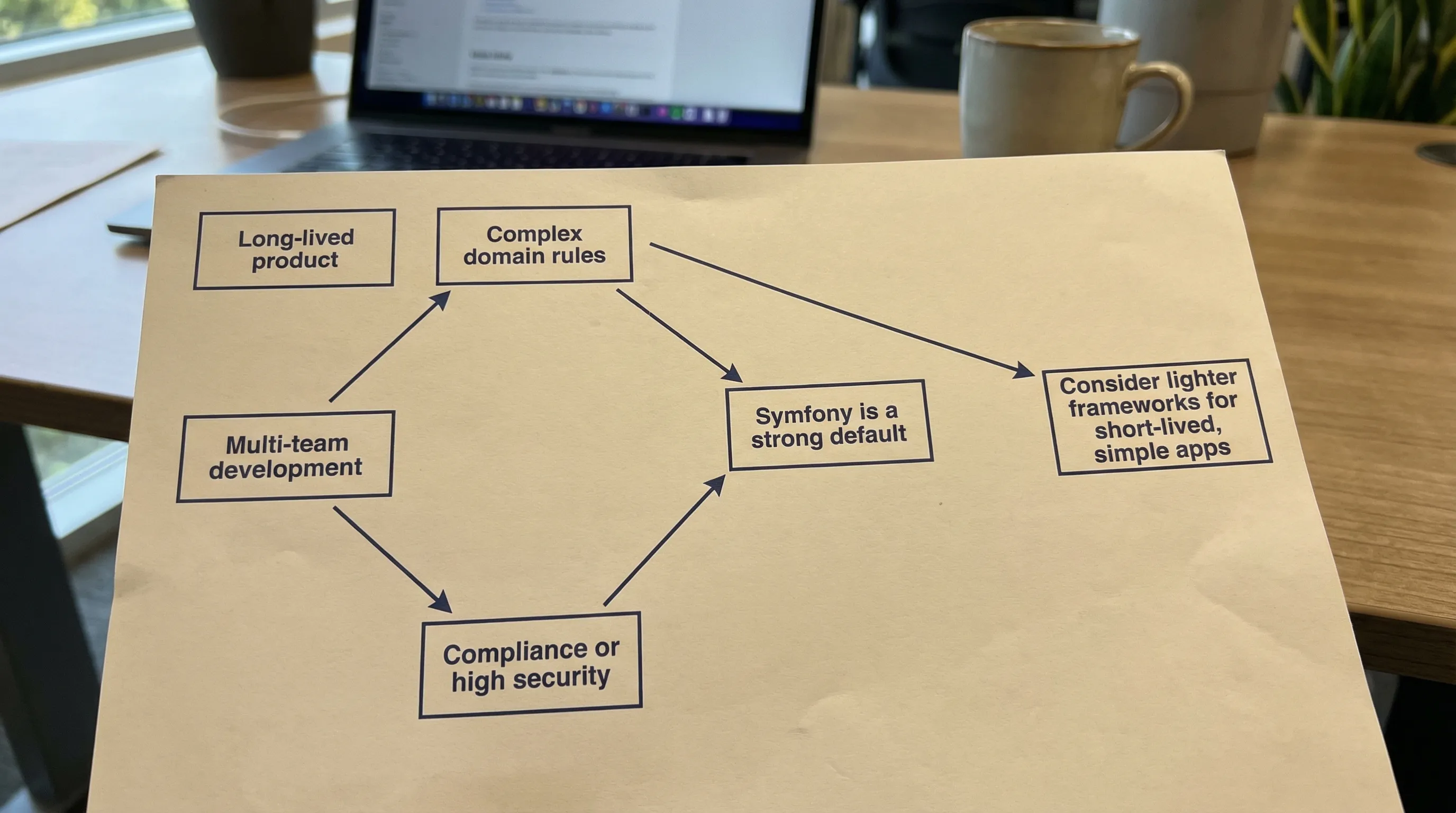
How Symfony helps teams scale engineering standards
Framework fit is tightly connected to your delivery system. Symfony aligns well with teams that enforce quality and operational habits.
Code quality and safer releases
Symfony projects pair naturally with modern PHP quality tooling: static analysis, consistent formatting, automated testing, dependency scanning.
If you want a concrete baseline for quality gates in PHP projects (Symfony included), use Wolf-Tech’s checklist: PHP Code Quality Checklist for Safer Releases.
Performance and maintainability as first-class concerns
Symfony can perform extremely well, but only if teams measure and tune intentionally (caching strategy, Doctrine query patterns, async offloading, runtime config).
For a practical playbook, see PHP Symfony: Performance and Maintainability Best Practices.
Standardization without killing team autonomy
As organizations grow, they need shared defaults (CI/CD, security baseline, observability, API contracts) without blocking product teams.
Symfony’s conventions, plus a thin set of internal standards, supports this balance. If you are building a broader standardization plan, Wolf-Tech’s sequencing guidance is in Software Development Technology: What to Standardize First.
Common ways teams misuse Symfony (and how to avoid it)
Symfony itself is not the risk. The risk is using it in ways that increase coordination cost.
Treating bundles and abstractions as “architecture”
Teams sometimes over-invest in custom abstractions early (frameworks on top of frameworks). A better default is:
- Start with a thin vertical slice that proves the delivery system and operational readiness.
- Keep boundaries simple and enforced (modules by business capability).
Wolf-Tech’s broader guidance on proving scalability early is in Developing Software Solutions That Actually Scale.
Letting Doctrine defaults define your data model
Doctrine is powerful, but default ORM usage can lead to hidden performance issues (N+1 queries, overly chatty graphs) and leaky domain boundaries. Teams should treat data access as a designed contract, not an accident.
Ignoring asynchronous workflows until you “need them”
Integration-heavy apps often add background processing late, then struggle with reliability (retries, idempotency, partial failures). If you already see imports, webhooks, or batch jobs on the roadmap, design for async early (even minimally).
Symfony vs Laravel (briefly, for teams who are deciding)
Many teams consider Symfony and Laravel together. The short version is:
- Symfony is often better when architecture, longevity, multi-team governance, and complex domains matter.
- Laravel often wins when you prioritize speed of initial delivery and prefer more opinionated “batteries included” conventions.
For a deeper comparison (including real scenarios and decision criteria), see Wolf-Tech’s dedicated guide: Symfony PHP: When It Beats Laravel.
A low-risk adoption path teams can actually execute
If Symfony looks like the right choice, the next risk is implementation approach. The safest path is typically iterative.
| Phase | What you prove | Evidence you should have |
|---|---|---|
| Thin vertical slice | End-to-end delivery, deployability, basic operability | CI pipeline, one production-like environment, logs/metrics, a reversible deploy |
| Architecture baseline | Module boundaries and core patterns | ADRs, folder/module rules, dependency direction, initial coding standards |
| MVP expansion | Delivery speed without quality collapse | Test strategy, code quality gates, predictable release cadence |
| Scale readiness | Multi-team change safety and operations | Ownership model, SLOs, on-call/runbooks, incident response habits |
If you want a broader stack selection workflow that fits this style (scorecards, thin-slice validation), Wolf-Tech’s guide is Apps Technologies: Choosing the Right Stack for Your Use Case.
When you should not pick Symfony software
Symfony is a great default for many serious PHP products, but teams should avoid it when the constraints do not justify it.
Symfony is often not the best choice when:
- The project is a short-lived campaign site or simple content experience.
- You need a prototype in days, and the backend is disposable.
- Your team strongly prefers a different ecosystem and you cannot staff Symfony comfortably.
- You cannot invest in basic delivery hygiene (CI, tests, observability), which Symfony will not magically provide.
A framework that your team cannot operate confidently is not a good framework, even if it is “technically superior.”
If you want a defensible Symfony decision (not a guess)
A strong framework decision is backed by evidence: a thin vertical slice, measurable non-functional requirements, and an operating model that fits your team.
If you are evaluating Symfony for a new build, a rewrite, or a legacy modernization effort, Wolf-Tech can help with:
- Tech stack strategy and fit assessment
- Full-stack Symfony development
- Code quality consulting and safer release pipelines
- Legacy code optimization and incremental modernization
You can explore Wolf-Tech’s approach at wolf-tech.io or start with the stack evaluation mindset in Software Technology Stack: A Practical Selection Scorecard.