
Custom Software Companies: What to Look for in a Partner

Sandor Farkas
Founder & Lead Developer
Expert in software development and legacy code optimization
LinkedIn
Choosing among custom software companies is not just a procurement exercise. You are selecting a delivery system that will shape your product speed, reliability, security posture, and even team morale for months or years.
The hard part is that many vendors can demo nice UIs and show a tech stack you recognize. The real differences show up later, when requirements shift, production incidents happen, stakeholders disagree, or a legacy integration starts fighting back.
This guide is an evaluation framework for picking a true partner, not just a builder. It focuses on what to verify, what evidence to ask for, and what patterns predict a stable, long-term engagement.
Start by defining what “partner” means for your situation
Before comparing custom software companies, get clarity on your side. Otherwise you end up evaluating vendors on vibes, or on a feature checklist that has nothing to do with success.
A good starting definition of “partner” is: a team that can co-own outcomes, surface risks early, and help you make trade-offs across product, engineering, security, and operations.
Clarify these items internally first:
- Business outcome: What will be measurably better in 90 days and in 12 months (revenue, cycle time, cost-to-serve, error rate, churn)?
- Scope shape: New product, rebuild, modernization, or ongoing platform evolution?
- Constraints: Compliance, data residency, performance targets, SSO/identity, integrations, release windows.
- Operating model: Do you want a project team, team augmentation, or a hybrid? (If you are unsure, Wolf-Tech’s guide on custom software outsourcing risks and best practices is a useful primer.)
- Decision rights: Who owns product decisions, architecture decisions, and security sign-off?
- Success metrics: At minimum, define delivery and reliability metrics you will track (many teams use the DORA metrics popularized by the research program now hosted by Google Cloud: DORA).
If a prospective partner does not ask you about these fundamentals, that is already a signal.
The 9 things to look for in custom software companies (and how to verify each)
Below are the criteria that most reliably separate “can build” from “can partner”. For each one, focus on proof, not promises.
1) Outcome-driven discovery, not “requirements intake”
Strong partners do not start with a backlog and a price. They start by reducing uncertainty: clarifying user journeys, mapping constraints, and validating a thin slice.
What to look for:
- Ability to translate fuzzy goals into testable outcomes and acceptance criteria.
- Clear discovery artifacts (problem framing, scope boundaries, risks, assumptions).
- Comfort saying “we don’t know yet, let’s test it in a small way”.
Evidence to request:
- A sample discovery plan and deliverables.
- Example of a thin vertical slice they shipped early (what they validated, what changed).
- How they handle requirement changes without chaos.
If you want a reference point for what good end-to-end design artifacts look like, Wolf-Tech’s software designing guide outlines pragmatic deliverables that reduce rework.
2) Engineering quality you can measure
Custom software is an asset that you will operate, extend, and secure. Code quality determines your long-term cost and speed.
What to look for:
- Consistent engineering standards (review discipline, testing strategy, maintainable architecture).
- A “production mindset” early (instrumentation, safe deploys, rollback paths).
- Willingness to show how they keep complexity under control.
Evidence to request:
- A walkthrough of a real codebase (even if sanitized) and how they structure modules.
- Examples of automated tests and what their “definition of done” includes.
- The code quality metrics they track, and how those metrics drive action.
For teams that want a practical baseline, Wolf-Tech’s code quality metrics guide can help you define what “good” means beyond “it works on my machine”.
3) Security built into the delivery system
In 2026, security cannot be a separate phase at the end. You want a partner that treats secure-by-design as part of normal delivery, not as an upsell.
A credible reference here is the U.S. National Institute of Standards and Technology’s Secure Software Development Framework, NIST SP 800-218.
What to look for:
- Threat modeling and security requirements integrated into planning.
- Dependency and supply-chain hygiene (patching cadence, artifact provenance).
- Clear approach to secrets management, least privilege, and logging.
Evidence to request:
- Their secure SDLC checklist mapped to recognized standards (NIST SSDF is a solid option).
- Example of a vulnerability remediation workflow (triage, SLAs, verification).
- If relevant, how they handle OWASP-style risks and API authorization.
4) Operability: they ship what they can run
Many teams can deliver features. Fewer teams deliver systems that behave well in production.
Operability includes observability, incident response, runbooks, SLOs, and safe deployment practices. If you are modernizing or scaling, this is often the difference between “growth” and “constant fire drills”.
What to look for:
- Monitoring and alerting tied to user-impacting signals.
- Clear on-call and incident processes (even if lightweight).
- Reliability engineering practices in the build phase, not after launch.
Evidence to request:
- Sample dashboards, alert definitions, and an incident postmortem template.
- How they define SLOs and error budgets in a project like yours.
For a concrete reliability lens, see Wolf-Tech’s backend development best practices for reliability.
5) Delivery model and governance that reduces ambiguity
When engagements fail, it is often not because of a single “bad developer”. It is because delivery and decision-making were undefined.
What to look for:
- A clear cadence: planning, demos, risk reviews, stakeholder touchpoints.
- Transparent progress reporting tied to outcomes (not just story points).
- Explicit escalation paths and decision logs.
Evidence to request:
- A sample weekly status report that includes risks and decisions.
- How they handle cross-team dependencies and approvals.
- How they prevent slow feedback loops.
If you are scaling teams, you may also benefit from Wolf-Tech’s application development roadmap for growing teams, which outlines phase-specific delivery and operational exit criteria.
6) Team composition, continuity, and senior ownership
A “partner” is not interchangeable staffing. Continuity matters, especially for architecture, data modeling, and integration-heavy systems.
What to look for:
- Senior technical ownership (someone accountable for quality and architecture).
- Low turnover expectations and a real onboarding process.
- A team shape that matches your scope (for example, product + engineering + DevOps coverage).
Evidence to request:
- Named roles and responsibilities (who is the tech lead, who owns security, who owns delivery).
- What happens if key people leave.
- How they document decisions and keep knowledge accessible.
7) Pragmatic architecture, not ideology
Custom software companies often oversell microservices, event sourcing, or “AI-first rewrites”. A partner starts with constraints, then chooses the simplest architecture that can meet them.
What to look for:
- Preference for incremental, reversible decisions.
- Comfort with modular monoliths and thin slices when appropriate.
- A clear strategy for data and integrations.
Evidence to request:
- Architecture decision records (ADRs) or similar decision logs.
- A migration strategy if legacy systems are involved.
If legacy modernization is part of your scope, Wolf-Tech’s guide to modernizing legacy systems without disrupting business captures the low-risk patterns you should expect a partner to know.
8) Commercial terms that match reality
Many “bad” software projects are actually mis-sold commercial models.
What to look for:
- Pricing model aligned to uncertainty (fixed price only works when scope is truly stable).
- Clear assumptions, change control, and acceptance criteria.
- IP ownership, licensing clarity, and exit terms that do not trap you.
Evidence to request:
- A sample statement of work showing how change is handled.
- Their definition of “done” in contractual terms.
- How they estimate and what they do when estimates are wrong.
If you want a budgeting lens, Wolf-Tech’s custom software development cost, timeline, and ROI breaks down typical cost drivers and how to avoid hidden costs.
9) Credible proof: references, demos, and a pilot
Case studies are helpful, but the best proof is how a team works with you in a constrained timebox.
What to look for:
- References you can talk to (ideally similar scope and constraints).
- The ability to explain trade-offs, not just show outcomes.
- Comfort proposing a paid pilot or assessment.
Evidence to request:
- Reference calls that include “what went wrong and how did they respond?”
- A pilot plan with explicit acceptance criteria.
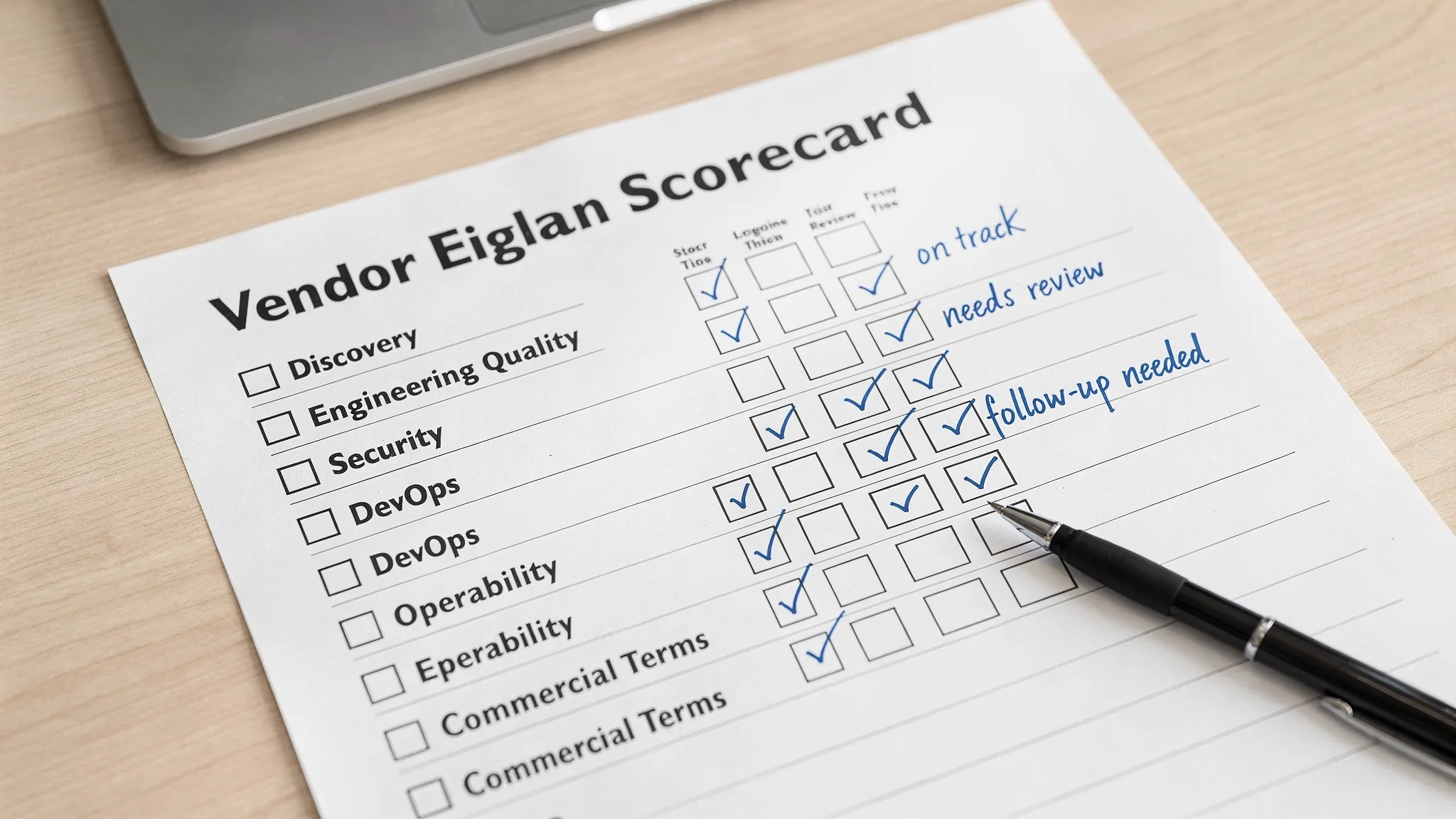
A practical scorecard to compare custom software companies
Use this table to keep evaluations grounded. Adjust weights based on your context (for example, regulated industries should weight security and evidence higher).
| Dimension | What “good” looks like | Proof to request | Common red flag |
|---|---|---|---|
| Discovery | Outcome-first, thin-slice validation | Discovery deliverables, example roadmap | Jumps straight to build and deadlines |
| Engineering quality | Maintainable architecture, tests, CI discipline | Repo walkthrough, test strategy, code review norms | “Testing later” or heavy manual QA reliance |
| Security | Secure SDLC aligned to standards | NIST SSDF mapping, vuln workflow | Security treated as a separate phase |
| Operability | SLOs, observability, safe releases | Dashboards, runbooks, rollback approach | No monitoring plan until after launch |
| Delivery & governance | Clear cadence, risk transparency | Sample status reports, decision logs | Vague reporting, no escalation path |
| Team & continuity | Named owners, stable core team | Role clarity, turnover plan | Bait-and-switch staffing |
| Architecture | Pragmatic and incremental | ADR examples, migration approach | Ideology-led design choices |
| Commercials | Clear assumptions and exit terms | Sample SOW, change control | Lock-in clauses or unclear IP |
| Proof | References and a pilot | Reference calls, pilot acceptance criteria | Refuses a pilot or avoids specifics |
How to run a short pilot that reveals the truth
A pilot is not a mini-project. It is a test designed to answer: “Should we trust this team with the real thing?”
A strong 2 to 4 week pilot usually includes:
- A thin vertical slice that touches UI, backend, data, and one real integration.
- Quality gates (CI pipeline, minimal test coverage for critical paths, code review discipline).
- Production readiness basics (logging, metrics, error handling, a rollback plan).
- A decision log capturing trade-offs made and why.
Good pilot outputs are often more about clarity than quantity: you want to see how the team communicates risk, how they handle ambiguity, and whether they can ship something real without cutting corners.
If you want a reference for what “thin slice to production” should include, Wolf-Tech’s build a web application checklist is a practical baseline.

Red flags that usually predict a painful engagement
Some issues are fixable. These usually are not.
- You cannot meet the actual team before signing, or senior people are only involved in sales.
- They avoid talking about production (monitoring, incidents, rollback, on-call), especially for customer-facing systems.
- Estimates are overly confident without a discovery phase, risk list, or assumptions.
- Security is hand-wavy, or treated as “a tool we can add later”.
- No documentation norms, no decision logs, no clear ownership.
- They optimize for output (features shipped) rather than outcomes (impact and reliability).
Frequently Asked Questions
What’s the difference between a custom software company and a development agency? A custom software company should operate like an engineering partner: outcome-driven discovery, strong engineering discipline, and production responsibility. Many agencies focus primarily on delivery throughput and visuals. Some do both, but you should verify with evidence (tests, CI/CD, operability, security process).
Should I choose fixed price or time and materials? Fixed price can work when scope is stable and acceptance criteria are unambiguous. For most product and modernization work, uncertainty is real, so time and materials with clear governance, milestones, and outcome checkpoints often reduces risk.
How do I know if a vendor can handle legacy systems? Ask for an incremental modernization plan (for example, Strangler-style approaches), how they reduce risk with observability and reversible releases, and what they do to lock behavior with tests before changing code.
What should I ask for to validate code quality quickly? Request a walkthrough of a real repo (sanitized if needed), their definition of done, CI pipeline overview, test strategy, and how they track actionable metrics like complexity hotspots and defect escape rates.
How long should vendor evaluation take? For most teams, a structured shortlist plus a paid pilot can be completed in 3 to 6 weeks. Rushing tends to create months of rework later.
Work with Wolf-Tech as your custom software partner
If you are evaluating custom software companies and want a partner that can build, modernize, and scale with you, Wolf-Tech provides full-stack development and consulting across code quality, legacy optimization, tech stack strategy, cloud and DevOps, and database/API solutions.
If you want to pressure-test a vendor, de-risk a modernization initiative, or ship a thin slice that proves the approach, explore Wolf-Tech at Wolf-Tech and read next: