
How to Choose Companies for Web Development in 2026

Sandor Farkas
Founder & Lead Developer
Expert in software development and legacy code optimization
LinkedIn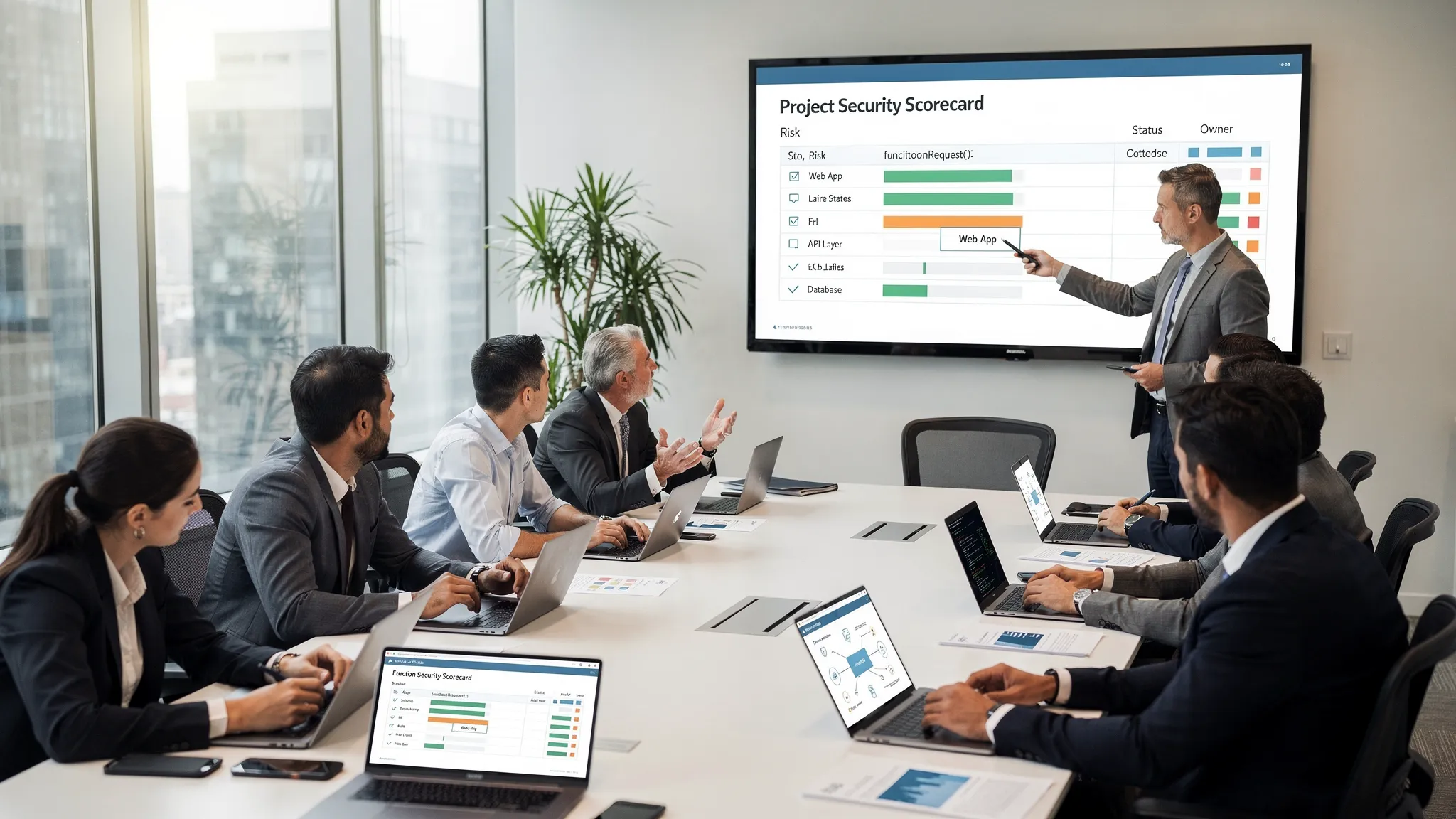
Choosing a web development partner in 2026 is less about finding “a team that can build pages” and more about selecting an organization you can safely trust with delivery, security, and long-term maintainability.
The stakes are higher than they were even two years ago: AI-augmented coding has increased delivery speed (and risk), supply-chain and dependency vulnerabilities keep making headlines, performance expectations are stricter, and many businesses are modernizing or integrating with legacy systems at the same time they ship new features.
This guide gives you a practical, evidence-based way to choose companies for web development in 2026, without drowning in buzzwords or generic vendor checklists.
Step 1: Clarify what you are actually buying (and why)
A surprising number of failed web projects start with a mismatch between what the buyer needs and what the vendor is optimizing for.
Before you compare vendors, align internally on:
- Outcome: What changes when the project succeeds (revenue, conversion rate, cycle time, operational cost, compliance posture)?
- Users and workflows: Who uses it, how often, and what must never break?
- Constraints: Timeline, budget range, regulatory requirements, data residency, identity provider, existing systems.
- Non-functional requirements (NFRs): Performance, availability, privacy/security, accessibility, auditability, maintainability.
If your scope is more than marketing pages (portals, dashboards, e-commerce logic, internal tooling), treat it as a web application problem, not “a website build.” If you need a crisp baseline, see Wolf-Tech’s plain-language explainer on what a web application is and the delivery-oriented build a web application checklist.
A useful output: a one-page “vendor brief”
Aim for a single page you can share with candidate companies. Include:
- Problem statement and primary users
- Success metrics and key constraints
- Integrations (payments, CRM, ERP, data warehouse, SSO)
- NFR targets (even rough targets are better than none)
- Your preferred engagement model (project, team augmentation, hybrid)
This document is what makes vendor proposals comparable.
Step 2: Choose the right type of web development company for your situation
In 2026, the “best” company is usually the one whose operating model matches your risk profile and internal capability.
| Company type | Best for | Common pitfalls | What to verify early |
|---|---|---|---|
| Boutique product studio | MVPs, UX-heavy products, fast validation | Can underinvest in operability and governance | How they handle CI/CD, monitoring, security, handover |
| Full-stack engineering consultancy | Complex builds, modernization, scale-up to production | Can be overengineered if outcomes are unclear | Their discovery process, delivery metrics, architecture approach |
| Enterprise SI | Large transformation programs, vendor management layers | Slow feedback loops, heavy process, expensive change requests | How they ship increments, who does hands-on engineering |
| Staff augmentation provider | You can lead technically, need extra capacity | You own architecture and quality, results vary by individual | Screening bar, replacement policy, integration with your team |
| Specialist agency (e-commerce/CMS) | Content-led sites, known platforms (Shopify, WordPress, Webflow) | Platform lock-in, custom code debt, weak app security | Security posture, upgrade path, performance budgets |
If you are unsure whether you need custom software or an off-the-shelf platform, Wolf-Tech’s decision framework on custom vs off-the-shelf is a strong pre-filter.
Step 3: Build a shortlist that is feasible, not aspirational
Shortlists fail when they are built on brand impressions instead of fit.
In 2026, practical shortlisting filters that save time:
Fit filters (fast “yes/no” checks)
- Relevant delivery examples: Similar complexity and constraints (integrations, auth, multi-tenant, regulated data), not just the same industry.
- Your stack reality: Can they work with what you have, or do they push a rewrite by default?
- Timezone and collaboration: Overlap hours, incident response expectations, meeting cadence.
- Security and compliance maturity: Even if you are not regulated, you still need sane defaults.
- Ownership and maintainability: Your ability to run the product after launch.
Ask for proof, not promises
Instead of “We do best practices,” request artifacts:
- A sanitized architecture diagram from a real project
- Example PRs (redacted), coding standards, or review checklist
- A sample runbook or on-call notes (even for a small system)
- A CI pipeline overview and how releases are promoted
If you want a deeper technical trait list, Wolf-Tech already published a thorough reference on top traits of web application development companies. Use that as a second-pass filter after you establish fit.
Step 4: Evaluate vendors using a 2026-ready scorecard (with evidence)
Most evaluation processes overweight demos and underweight delivery behavior.
A good 2026 evaluation scorecard focuses on risk removal. Here are the dimensions that most strongly predict whether you will ship safely and keep shipping.
1) Delivery system and predictability
Ask how they reduce lead time from idea to production, and how they prevent late-project surprises.
Evidence to request:
- A typical delivery cadence (weekly? biweekly?) and how they slice work
- How they track throughput and stability (many teams use the DORA metrics as a baseline)
- Their approach to CI/CD and release safety
If you want to calibrate “what good looks like” for delivery performance, the ongoing DORA research is a credible reference.
2) Security-by-default (including supply-chain security)
In 2026, security is not “a pen test at the end.” It includes your dependency graph, build pipeline, secrets handling, and access model.
Ask directly:
- Do you follow a secure development framework (for example NIST SSDF)?
- What is your policy for dependency scanning and vulnerability remediation?
- Can you provide an SBOM if required?
- How do you handle secrets and environment access?
A useful verification standard is OWASP ASVS, because it turns “secure” into testable requirements.
3) AI-augmented development governance
AI assistance is now normal, but governance varies widely. The risk is not “AI is bad,” it is untracked code generation, unclear IP boundaries, and accidental leakage of sensitive context.
What to verify:
- Policy on using AI tools with client code and data
- How they ensure generated code still meets your quality and security bar
- How they document decisions and changes when speed increases
If a vendor cannot explain this clearly, you are betting your product on unexamined behavior.
4) Performance and user experience quality
“Fast enough” depends on your users, but you still need explicit targets and measurement.
Evidence to request:
- Performance budgets and how they prevent regressions
- Their Core Web Vitals approach (measurement first, then changes)
- Accessibility standards and testing
References worth aligning on:
- Google’s Core Web Vitals overview
- The W3C WCAG 2.2 guidelines
If you build with Next.js or similar stacks, it is also fair to ask for a concrete tuning approach rather than vague promises. Wolf-Tech’s Next.js performance tuning guide shows what a measurement-driven approach looks like.
5) Architecture and maintainability under change
Your system will change. Your vendor should optimize for change without drama.
Look for:
- How they keep boundaries clear (modules, APIs, data ownership)
- Their approach to testing strategy, not just test volume
- How they handle migrations and legacy integration
If modernization is part of your initiative, pay attention to whether they default to big-bang rewrites. Incremental strategies are often safer. (Wolf-Tech’s guide on modernizing legacy systems without disrupting business is a good baseline for questions to ask.)
A simple weighted scorecard you can actually use
Adjust weights based on your context, but keep the structure. Score each category 1 to 5, and require written evidence notes.
| Category | Weight | What “5” looks like (short version) |
|---|---|---|
| Outcomes and product thinking | 15% | Can restate goals, proposes measurable scope cuts, validates assumptions |
| Delivery predictability | 20% | Working CI/CD, small batches, clear release process, transparent metrics |
| Security and compliance | 20% | SSDLC posture, dependency discipline, access controls, audit-friendly artifacts |
| Architecture and maintainability | 15% | Clear boundaries, practical patterns, testing strategy tied to risk |
| Performance and accessibility | 10% | Measured budgets, CWV plan, WCAG-aware design and QA |
| Collaboration and governance | 10% | Crisp roles, escalation path, decision logs, good communication hygiene |
| Commercials and ownership | 10% | Clear IP terms, clean handover, realistic assumptions, transparent pricing |
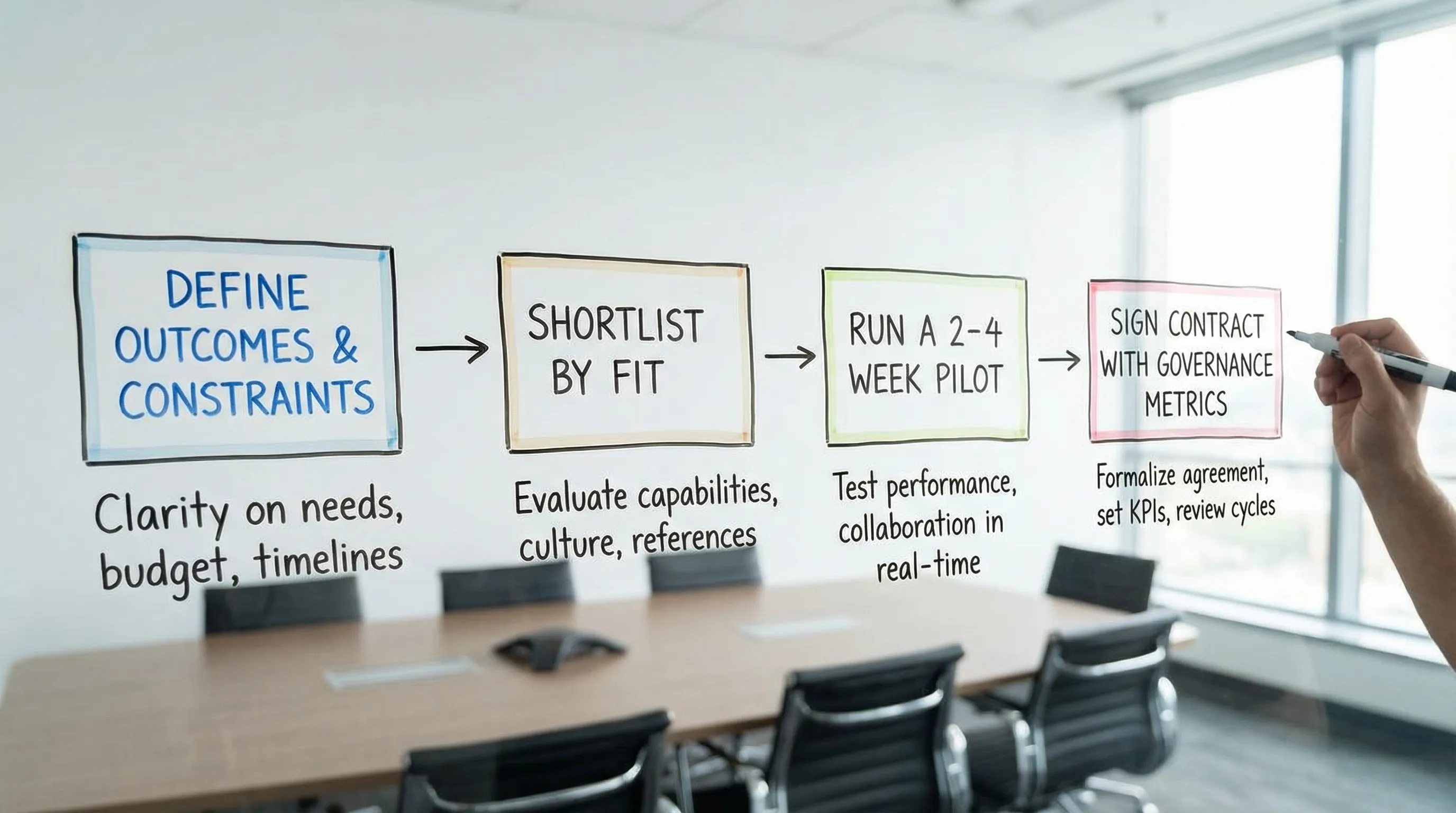
Step 5: Run a paid pilot that forces reality to show up
For anything beyond a simple CMS implementation, a pilot is often the highest ROI step in vendor selection.
A good pilot in 2026 is not a “design sprint” only, and not a months-long mini-project. Aim for 2 to 4 weeks.
Pilot goal: prove that the vendor can deliver a thin, production-shaped slice with your constraints.
What to include in a strong pilot definition
- One thin vertical slice (UI, API, data, auth) that matches real complexity
- A deployment path (even if to a staging environment) that reflects how you will ship
- Non-functional acceptance checks (basic security, basic performance instrumentation)
- A handover artifact (runbook draft, README, architecture notes)
Wolf-Tech’s CI/CD primer can help you turn “we have pipelines” into concrete evaluation questions: CI/CD technology: build, test, deploy faster.
Step 6: Get the contract right for how web development works in 2026
Contracts often fail by treating software like a one-time delivery. In reality, most value comes from iteration, and most risk comes from ambiguity.
Key items to address explicitly:
IP, AI, and confidentiality
- IP ownership and licensing, including dependencies and reusable components
- Policy on AI tool usage, code provenance, and data handling
- Confidentiality and access controls (who can access repos, environments, data)
Security and supply-chain expectations
- Vulnerability response expectations (triage and fix timelines)
- Dependency management responsibilities
- Build pipeline integrity expectations (many teams align with SLSA concepts)
Acceptance criteria that match outcomes
Instead of “pages completed,” define acceptance in terms of:
- Working user journeys
- Observable behavior (logs/metrics/traces available)
- Performance budgets for critical paths
- Accessibility checks appropriate to your audience
Commercial model fit
Fixed-price is not always wrong, but it must be paired with tight scope control and explicit change management.
If you need help forecasting budget and timeline tradeoffs, Wolf-Tech’s guide on custom software development cost, timeline, ROI provides a grounded way to think about cost drivers.
Step 7: After selection, manage the engagement like a delivery system
Even the best company will struggle if you run the engagement as “send requirements, wait, approve.” High-performing teams build feedback loops.
Set a lightweight operating cadence:
- Weekly demo with acceptance notes (what shipped, what did not, what is next)
- A single prioritized backlog with clear owners
- A decision log (architecture decisions, scope tradeoffs, risk calls)
- A small set of metrics that reflect outcomes and stability
If you are leading a distributed or multi-team effort, Wolf-Tech’s article on software development strategy for diverse teams provides practical governance artifacts that reduce misalignment.

A quick “red flag” pass (use sparingly, but do use it)
Red flags are not about style preferences, they are signals of unmanaged risk.
Common red flags when choosing companies for web development:
- They cannot show real artifacts (only marketing slides)
- They avoid a pilot and push for a large upfront commitment
- Security is framed as a final-phase activity only
- They promise timelines without clarifying constraints and tradeoffs
- They cannot explain how they prevent regressions (performance, reliability, security)
- They insist on a rewrite as the default solution, without evidence
Where Wolf-Tech fits (and how to engage safely)
Wolf-Tech focuses on full-stack development and modernization, including code quality consulting, legacy code optimization, tech stack strategy, and cloud and DevOps support. If you are evaluating partners and want an evidence-driven comparison, you can use the scorecard approach above and then ask Wolf-Tech to benchmark your current situation or run a short pilot.
If you want a more formal vetting flow (including RFI/RFP guidance and a deeper scoring framework), Wolf-Tech’s CTO published a detailed guide on how to vet custom software development companies.
To discuss your project context and constraints, start at Wolf-Tech.