
PHP Full Stack: When PHP Still Wins in 2026

Sandor Farkas
Founder & Lead Developer
Expert in software development and legacy code optimization
LinkedIn
PHP has been “declared dead” for almost two decades, and yet it keeps showing up in places where teams care about shipping, stability, and predictable operating costs. In 2026, the question is not whether PHP is fashionable. The question is whether a PHP full stack is the fastest, safest path to a product you can run for the next 3 to 5 years.
This guide is written for CTOs, tech leads, and product teams evaluating stacks for new builds, rebuilds, or pragmatic modernization.
What “PHP full stack” means in 2026
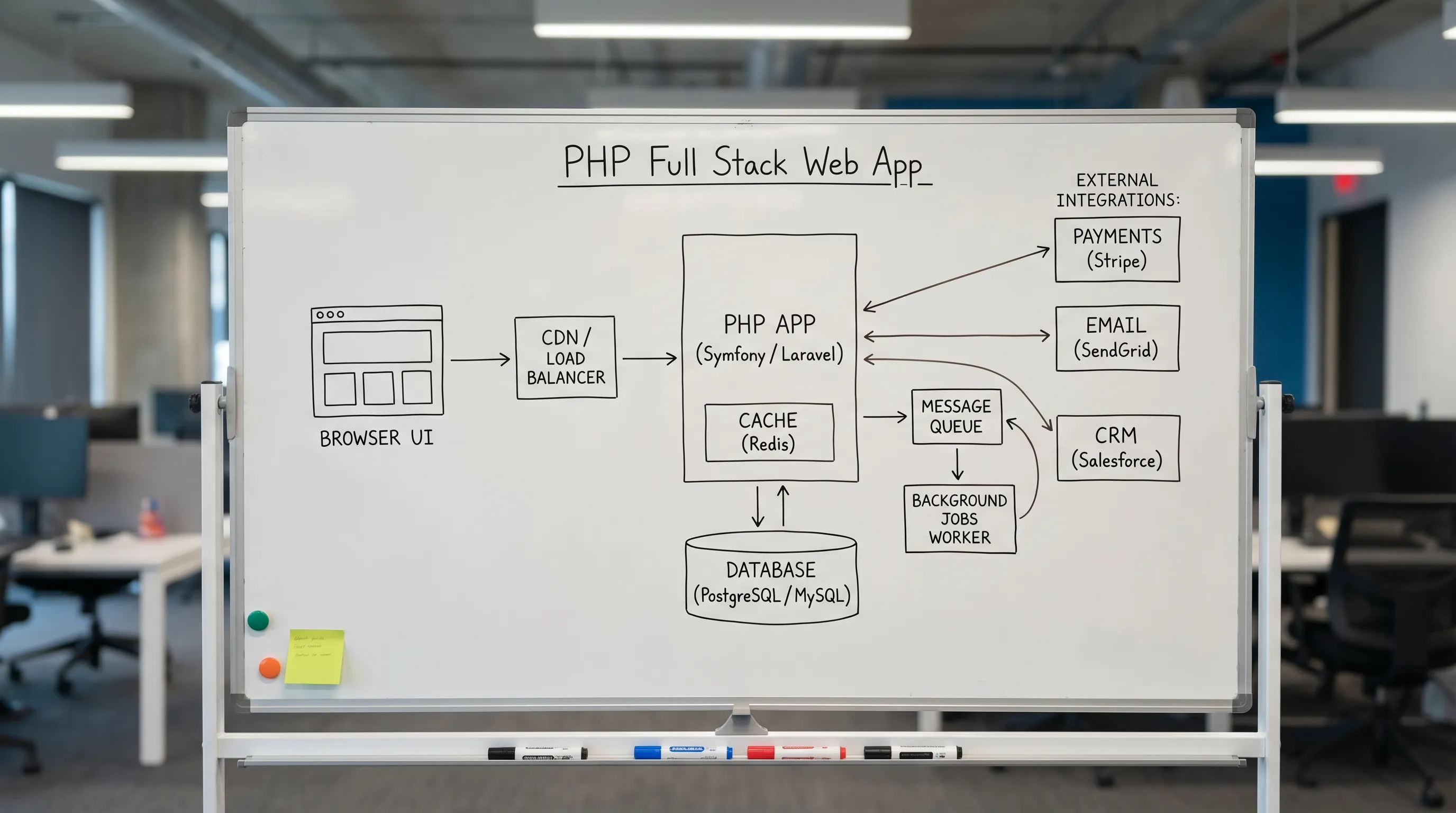
A PHP full stack in 2026 is rarely “just PHP + jQuery.” It is typically:
- A modern PHP runtime (generally PHP 8.x) with a framework like Symfony or Laravel
- A clear architecture baseline (often a modular monolith first)
- A production delivery system (CI/CD, automated quality gates, rollback-friendly releases)
- A data layer (PostgreSQL/MySQL, Redis), plus queues and async processing when needed
- A frontend that matches your product needs: server-rendered templates, a lightweight interactivity layer, or a separate SPA
In other words, “full stack” is about end-to-end ownership: from UI flows and API contracts to database migrations, production observability, and incident readiness.
If you want the organizational view of full-stack ownership (beyond tools), see Wolf-Tech’s guide on full stack development for CTOs.
Why PHP still wins (specifically) in 2026
PHP wins when your success depends on speed-to-value without turning your system into a science project.
1) The “boring” advantage: low coordination cost
For many B2B and internal products, most work is business logic, permissions, workflows, forms, and integrations. A PHP stack can keep this work close together, reduce boundary churn, and support a modular monolith that is easy to operate.
This matters because coordination cost, not raw runtime speed, is what slows teams down at scale.
2) Ecosystem maturity where most business apps live
PHP’s ecosystem is extremely mature for:
- Auth and role-based access control
- Background jobs and queues
- CRUD-heavy workflows
- Payments and invoicing integrations
- Content and admin experiences
- Common compliance-adjacent requirements (audit trails, export logs, retention)
It is not that other stacks cannot do these things. It is that in PHP you can often do them with fewer custom abstractions.
3) Performance is usually “good enough”, and often better than teams expect
Modern PHP with OPcache, sensible caching, and predictable data access patterns can perform well for a large class of web workloads. In practice, many “PHP performance problems” are actually:
- N+1 queries
- missing indexes
- synchronous work that belongs in a queue
- lack of caching strategy
- oversized payloads
Those issues exist in every language. The fix is engineering discipline and measurement, not a rewrite.
If you are already on Symfony, Wolf-Tech’s Symfony performance and maintainability best practices is a practical starting point.
4) Hiring and maintainability are still pragmatic strengths
PHP is widely known, and Symfony and Laravel remain common in long-lived products. For many organizations, that means:
- faster onboarding
- easier replacement hiring
- a deeper pool of “been there” operational experience
A stack that is slightly less trendy but easier to staff can be a competitive advantage.
5) It is still everywhere on the web
If you want a reality check on adoption, sources like W3Techs track web technology usage and consistently show PHP remains a major part of the web’s server-side footprint.
When a PHP full stack is the right default
If you are deciding under uncertainty, these scenarios tend to be high-signal fits.
You are building a workflow-centric product
Think B2B SaaS, internal tools, portals, back offices, multi-step onboarding, approvals, and “lots of states” systems. PHP frameworks shine when your domain is mostly:
- forms + validation
- permissions
- business rules
- reporting
- integrations
You need a safe modernization path (not a heroic rewrite)
A lot of real companies are sitting on legacy PHP (or legacy anything) that still runs revenue. PHP can be an excellent modernization “landing zone” because you can incrementally improve architecture, delivery, and operability without forcing a full platform rewrite.
For a proven incremental migration approach, see Wolf-Tech’s article on the Strangler Fig pattern.
You want modular monolith economics first
Many teams do not need microservices to win. They need:
- clear boundaries
- predictable deployments
- fast tests
- operability
- a path to extract later if it becomes necessary
PHP full stack works very well with a modular monolith baseline. If you are debating architecture, Wolf-Tech’s guide on when to go modular monolith first pairs naturally with PHP.
Your differentiation is product execution, not platform R&D
If your business advantage is shipping workflows, integrations, and UX improvements faster than competitors, PHP can be a strong choice because it reduces reinvention.
When PHP does not win (and you should be honest about it)
PHP is not the best answer for every problem. In 2026, PHP is usually not the default when:
You are building real-time, high-concurrency systems as the core product
If your primary value is real-time collaboration at scale, low-latency streaming, or heavy pub/sub workloads, you may prefer ecosystems that are more “real-time native” operationally. PHP can still participate (for example, as a backend for admin and workflows), but it might not be the center.
You are doing CPU-bound or ML-heavy backend workloads
For compute-heavy services, languages and runtimes optimized for CPU throughput and concurrency patterns may be a better center of gravity.
Your organization is already standardized around another backend platform
If you have strong paved paths, shared libraries, security baselines, and platform support in another ecosystem, the switching cost can outweigh PHP’s benefits.
This is why Wolf-Tech tends to recommend choosing based on capabilities and proof, not trends. A related read is web development technologies: what matters in 2026.
A decision table: where PHP full stack tends to score well
Use this as a fast lens for decision conversations. It is not a universal truth, it is a practical pattern.
| Decision factor | If this is true in your context | PHP full stack tends to be a good fit because | Watch out for |
|---|---|---|---|
| Product shape | Workflow-heavy B2B, portals, dashboards, admin | Mature frameworks and conventions reduce custom glue code | Over-customizing early without boundaries |
| Team skills | You can staff Symfony/Laravel seniors | Hiring and onboarding are typically straightforward | “PHP generalists” without production habits |
| Time horizon | You need a 3 to 5 year maintainable platform | PHP frameworks have stable upgrade paths when you plan them | Upgrade debt if you skip maintenance releases |
| Operability | You want simple deployments and predictable runtime behavior | Conventional app + queue + DB architectures are well understood | Under-investing in observability and incident readiness |
| Integrations | Payment, CRM, ERP, identity, email, files, third-party APIs | Libraries and patterns are abundant | Integration sprawl without contracts and ownership |
| Budget model | You want high ROI engineering, not platform experimentation | Good “boring tech” economics | False savings if quality gates are missing |
The 2026 PHP full-stack blueprint (pragmatic, production-first)
A good PHP full stack is not defined by a framework choice. It is defined by whether you can ship and operate safely.
1) Start with a thin vertical slice
Before committing to the stack, build a thin slice that proves:
- One real user journey end-to-end
- One or two integrations (if relevant)
- Real auth and authorization
- Production-like CI/CD
- Minimum observability (structured logs, basic metrics, error reporting)
Wolf-Tech’s stack selection approach consistently recommends thin-slice validation because it surfaces hidden complexity early. See apps technologies: choosing the right stack for your use case and the reusable technology stack selection scorecard.
2) Choose Symfony vs Laravel based on change cost, not taste
Both are viable. The best choice depends on how you expect your product and team to evolve.
- If you need stricter structure, long-term governance, and enterprise-grade modularity, Symfony often fits better.
- If you prioritize rapid MVP delivery with a smaller team, Laravel can be a strong path.
If you want the detailed decision lens, Wolf-Tech has a dedicated guide: Symfony vs Laravel: when Symfony beats Laravel.
3) Treat frontend as a product decision, not a default
In 2026, “PHP full stack” does not mean you must render everything server-side. Common, valid patterns include:
- Server-rendered pages for marketing, docs, and SEO-sensitive routes
- A PHP backend with a separate React/Vue frontend for complex in-app UI
- A hybrid approach with clear boundaries (for example, server-rendered shells plus interactive islands)
What matters is aligning UX expectations with architecture constraints. A useful mental model is Wolf-Tech’s UX to architecture handshake.
4) Build quality gates into the delivery system (this is where stacks succeed or fail)
If you do one thing “enterprise-grade” in a PHP project, do this: automate quality and security checks.
A minimal baseline usually includes formatting, static analysis, tests, dependency auditing, and safe migration practices. Wolf-Tech’s PHP code quality checklist for safer releases is a practical template you can adapt.
For security posture, avoid inventing your own rules. Use established guidance such as the OWASP Top 10, then enforce what you can in CI.
5) Make performance and cost measurable early
Performance debates are often speculative until you instrument the system. Define a small set of measurable targets (for example, p95 latency for key endpoints, error rate, queue lag, and DB query counts on the critical journey), then tune based on evidence.
If your team needs a measurement-first workflow, Wolf-Tech’s performance tuning playbook generalizes well to PHP.
A fast “yes/no” filter you can use in stakeholder discussions
If most answers are “yes,” PHP full stack is often a strong bet:
- Do we primarily ship workflows, business rules, integrations, and admin experiences?
- Do we need predictable operations more than cutting-edge runtime novelty?
- Can we commit to basic quality gates (static analysis, tests, CI) from day one?
- Do we want a modular monolith first, with an extraction path later?
- Do we want to de-risk with a thin vertical slice in 1 to 3 weeks?
If most answers are “no,” you probably have constraints that justify a different center stack, or a split architecture where PHP is not the core.
Frequently Asked Questions
Is PHP full stack a good choice for a new product in 2026? Yes, when your product is workflow and integration heavy, and you want a maintainable, production-friendly platform fast. Validate with a thin vertical slice and measurable NFRs.
Does PHP still scale? PHP can scale for many real-world workloads when you design for predictable data access, caching, and async processing. Most scaling failures come from architecture and operational gaps, not the language.
Symfony or Laravel for a full-stack PHP app? Pick based on change cost. Symfony tends to win for long-lived, multi-team governance and strict modularity. Laravel often wins for fast MVPs and small teams. Validate against your delivery and operability constraints.
Can a PHP backend work with a modern React frontend? Yes. Many teams run a PHP API (or BFF) with a React UI. The key is contract discipline, auth boundaries, and operability (logging, tracing, error handling) across the seam.
What are the biggest risks with PHP projects today? The biggest risks are not PHP itself. They are missing quality gates, unclear boundaries, integration sprawl, upgrade neglect, and lack of observability, all of which are fixable with disciplined delivery practices.
Want a quick, defensible stack decision (and a plan you can execute)?
Wolf-Tech helps teams build, modernize, and scale production web applications with full-stack development, code quality consulting, legacy code optimization, and tech stack strategy.
If you are considering PHP full stack for a new build or a modernization effort, Wolf-Tech can help you:
- run a short thin-slice validation to prove the choice
- assess an existing PHP codebase for performance, maintainability, and risk
- set up CI-backed quality gates and a production-ready delivery baseline
Reach out at Wolf-Tech to discuss your context and constraints.